
Key Insights:
- Stablecoin regulation is gaining momentum and lawmakers are in consensus over a yield ban compromise which will reduce uncertainty in the digital asset markets.
- The framework strikes a balance between banking interests and crypto innovation with activity-based allowances in the form of reward allowances.
- The market confidence improves with a probability of 70% of approval of CLARITY Act in 2026.
The regulation of stablecoins in the United States has entered a decisive stage due to months of tense negotiations. With this major compromise now finalized, a grey area on one of the most controversial aspects of the sector has been cleared.
The agreement concerns yield-generating incentives, which have long pitted banks and participants in the crypto industry. The move is an indicator of growing momentum of the broader CLARITY Act as the policymakers continue to push towards completion.
The move shows a compromise between the issue of financial stability and further innovation in digital assets markets. It also minimizes the possibility of a long delays which in the past stalled legislative processes in the Congress.
Final deal locks yield rules framework.
The agreement was confirmed by Tillis and Alsobrooks, senators, that the agreement will not be revised again. In their combined announcement, it was pointed out that a period of negotiation has led to a practical and balanced regulatory framework.
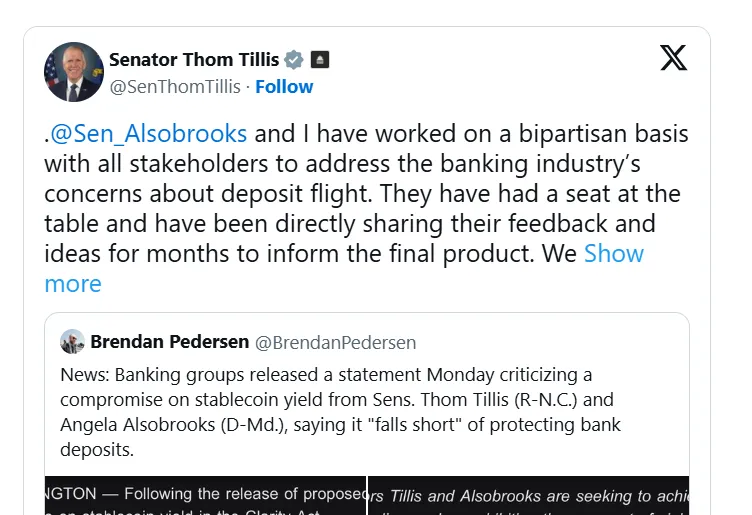
The resulting language is directly constraining of rewards that are similar to traditional bank deposit interest structures. This limitation is designed to ensure that the products offered by stablecoins do not directly compete with traditional savings accounts.
Nevertheless, the framework does not exclude other types of incentives that depend on the user activity and on platform activity. These can be trading volume-based rewards, staking participation or any other quantifiable interaction within the ecosystem.
Stablecoin yield bans focuses on deposit flight risk
The main issue that underlines the yield limit is the possible flight of money out of the banks.
The regulators have cautioned that high yields may transfer deposits to digital assets which will interfere with the lending capacity. Lawmakers framed the compromise as a preemptive action against what they termed a “deposit flight risk.”
Banking groups claimed that under some conditions any incentive, even an indirect incentive, could reproduce deposit-like returns. They cautioned that even those rewards that were bearable on balances or length of holding could still be an enticement to idle capital.
Studies mentioned by such groups indicated that there could be a reduction of at least 20% in the sectoral loans. Meanwhile, economists at the White House gave a more moderate view on the potential impact.
In their analysis, they estimated that a ban on yield would lead to higher bank lending by about $2.1 billion. This amount is a mere 0.02% of total lending implying that there was no significant disruption of the system.
Banks push back in spite of political advancements.
Major financial institutions such as the American Bankers association, continued to show discontent with the compromise. They admitted the intentions of lawmakers but claimed that the framework failed to address significant regulatory gaps.
Their main worry is that there is a threat of loss of deposit-based funding particularly to smaller institutions. The community banks were found to be exceptionally vulnerable since they lacked the flexibility of handling balance sheet pressures.
Banking groups even reported that they were preparing to make more recommendations to enhance the current provisions. With this backlash, politicians indicated that no further reforms would be brought on board at this point.
The congressional support has continued to grow with leading players pointing out that a committee markup is being made. The vote in the Senate is now anticipated to be between June and July provided that the proceedings continue without any hitches.
Market response gathers momentum with regulatory transparency.
The crypto sector has been positive about the completed compromise amid a previous doubt that slowed down the pace. The leaders of big companies, such as Coinbase, have supported the existing version of the bill.
This change comes after previous opposition which had led to stalling of the further advancement of the broader bill. Currently, prediction markets are giving a 70% likelihood that the CLARITY Act would pass in the year 2026.
This increase in confidence is a sign of greater convergence between political stakeholders and industry players. Market sentiment has also increased because there are fewer rules that have created uncertainty in regard to digital asset operations.
The completed framework presents disclosure criteria and outlines reasonable reward models of platforms. These steps will enhance more transparency but still be flexible to innovation within the ecosystem.
Conclusion
The regulation of stablecoins is slowly becoming a reality as government officials finalize a yield compromise that has been discussed for a long time. The compromise strikes a balance between the issues of financial stability and the necessity to contribute to the further evolution of technologies.
Despite the reserved attitude of banking groups, the political processes indicate that the bill will not be delayed any longer. Should it be enacted, the CLARITY Act may turn into a landmark within the regulation of digital assets in the United States.
FAQs
1. What is the CLARITY Act?
The CLARITY Act is a proposed U.S. legislative bill to regulate digital assets and stablecoins.
2. What was controversial about stablecoin yield?
Yield bonuses created an issue of moving deposits out of the traditional banks to the crypto platforms.
3. What is the new rule that is prohibited?
The rule prohibits rewards that serve as interest on bank deposit accounts of the traditional type.
4. Do you still have any rewards?
Yes, platforms can provide incentives based on trading, staking, or user activity instead.
5. What might be the time when the bill would be made a law?
Assuming that the current progress runs smoothly, the lawmakers hope that a vote in the Senate will take place in mid-2026.