
- Prediction market regulation gains focus as Coinbase submits a formal letter to the CFTC.
- Coinbase is calling on regulators to give a clear picture of how they plan to implement the law.
- States are challenging platforms, and CFTC is claiming control over event contracts in ongoing legal battles.
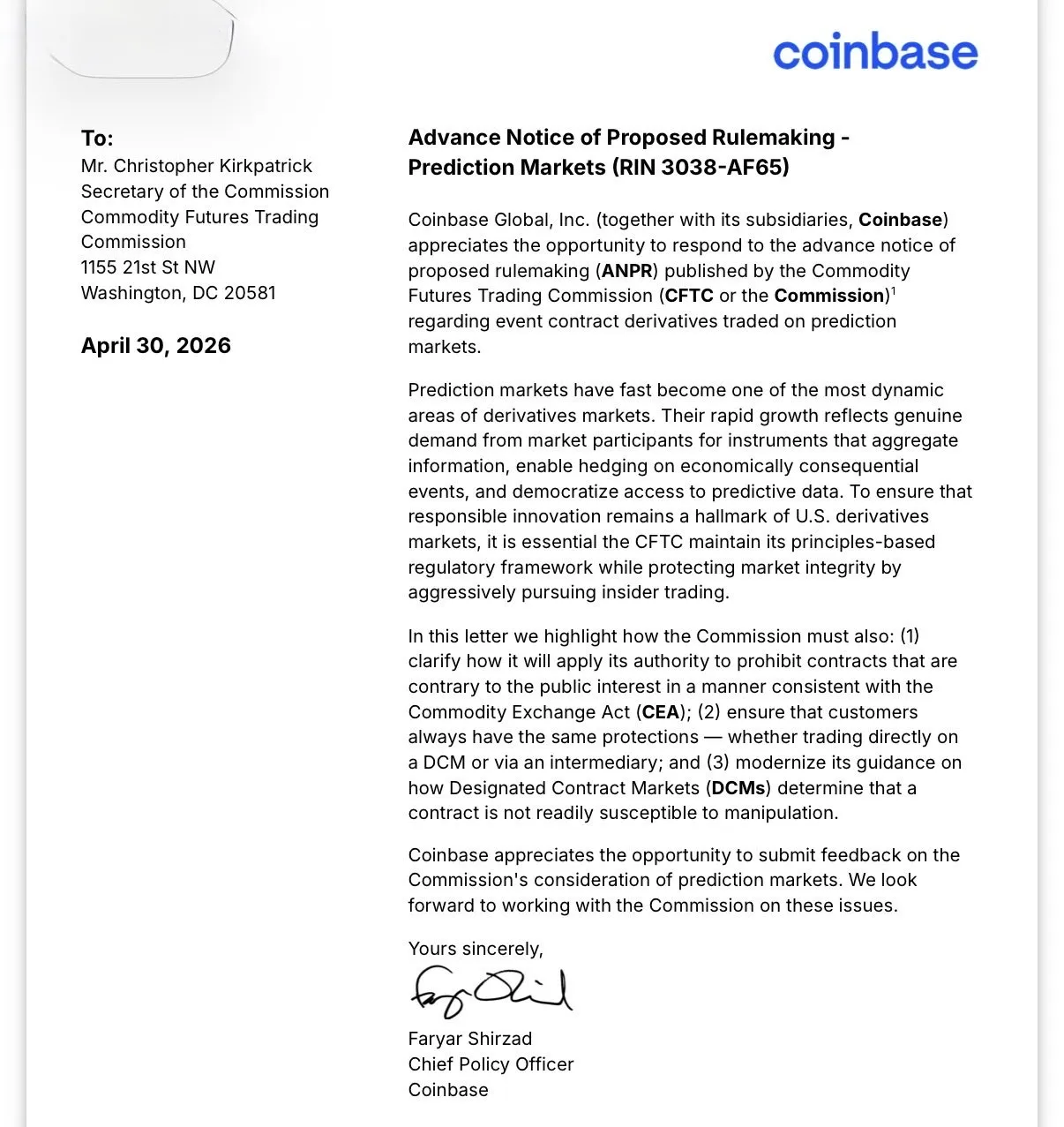
Prediction markets regulation has become a central topic in U.S. derivatives policy after Coinbase submitted a formal comment letter to the Commodity Futures Trading Commission (CFTC). The filing, dated April 30 and addressed to Christopher Kirkpatrick, responds to the regulator’s Advance Notice of Proposed Rulemaking (ANPR) on event-based contracts.
In the letter, Coinbase stated that prediction markets are among the fastest-growing segments within derivatives trading.
Source: Chief Policy Officer Faryar Shirzad
The company noted that these markets already fall within the CFTC’s existing statutory authority and do not require new regulatory mandates. Instead, the exchange called for clarity in how current rules are applied and enforced.
What Coinbase Asked Regulators for
Coinbase encouraged the CFTC to explain how it intends to exercise its right to regulate contracts of public policy interest. The firm noted that such an option is already available to the regulator according to current regulations.
Source: Chief Policy Officer Faryar Shirzad
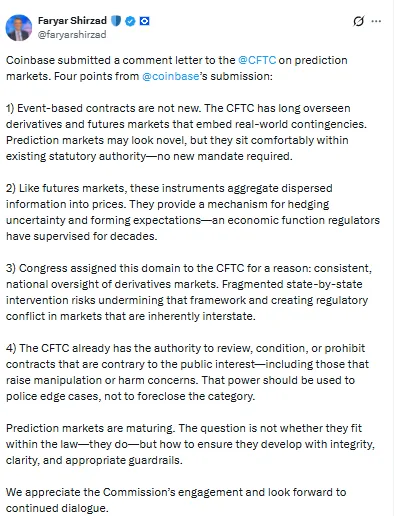
Moreover, the filing highlighted the importance of uniformity in the level of protection to be extended to users. Coinbase argued that users who trade directly and those who participate in prediction markets via intermediaries should receive equal protection.
Further, the company pointed out that the use of event-related contracts is not a novel concept. The company compared prediction markets and traditional futures markets on the basis that both involve aggregating information into prices.
Regulation of Prediction Markets Related to Legal Conflicts
The issue of regulating prediction markets arises on the heels of growing legal conflicts among federal agencies and the states of the United States. Some states have already brought actions against Coinbase, Kalshi, Robinhood, Polymarket, and Crypto.com.
Meanwhile, the CFTC itself has sued both Wisconsin and New York. In Wisconsin, there is even a charge of felony associated with violation of the state gambling law. Nonetheless, the trading platforms in question fall under federal regulations governing derivatives; as a result, jurisdictional overlap arises between state and federal governments.
Coinbase raised this point by saying that the CFTC already has the authority to regulate and prohibit certain contracts that go against public interests. The company’s position indicates that existing federal oversight mechanisms should be applied to resolve these disputes.
Industry Responses to CFTC Rule Proposal
The CFTC’s ANPR has generated significant industry participation, with more than 1,500 responses submitted during the public comment period.
Some participants supported the current regulatory framework, while others called for stricter rules governing event-based contracts. The consultation follows a proposed rule introduced in March that would allow the CFTC to amend existing regulations or issue new ones related to prediction markets.
Among the responses, Kalshi’s co-founder and chief operating officer, Luana Lopes Lara, supported the regulator’s existing approach.
The letter described current regulations as effective and called for additional guidance to ensure that event contracts can continue to be listed, traded, and overseen under the Commission’s authority.
Why This Case Matters for Prediction Markets Regulation
The ongoing regulatory process reflects a broader effort by the CFTC to define its authority over prediction markets. The proposed regulation is intended to provide more clarity on the criteria used to classify event contracts and supervise them.
Concurrently, legal actions filed by various states reflect ongoing controversies over whether the relevant contracts should be regulated as derivatives or as gambling. This intersection has heightened concerns about platforms offering prediction markets.
The Coinbase filing adds weight to the argument that current regulations are sufficient, provided enforcement strategies are clearly laid out. The company’s focus on a principles-based framework aligns with calls from other industry participants for regulatory consistency.
Conclusion
The current situation concerning the regulation of prediction markets shows that attempts to establish clear regulation continue in the U.S. derivatives market. In its application letter to the CFTC, Coinbase stresses the importance of regulatory authority and further guidelines.
FAQ
What did Coinbase request from the CFTC?
Coinbase asked the CFTC to clarify how it will apply existing authority to oversee and restrict certain prediction market contracts.
How many responses did the CFTC receive on its proposal?
The regulator received more than 1,500 responses from industry participants and advocacy groups.
Why are states taking action against prediction platforms?
Some states claim that some contracts based on events are similar to unregulated gambling in their jurisdictions.