

Key Points:
- The momentum of CLARITY Act gains momentum as politicians and businesses come nearer to stablecoin conflicts.
- The collaboration between SEC and CFTC on regulation is an indication that the shift towards more specific crypto classification schemes has been made.
- The greater the political and institutional backing, the higher the chances of a next-genmeal legislative breakthrough.
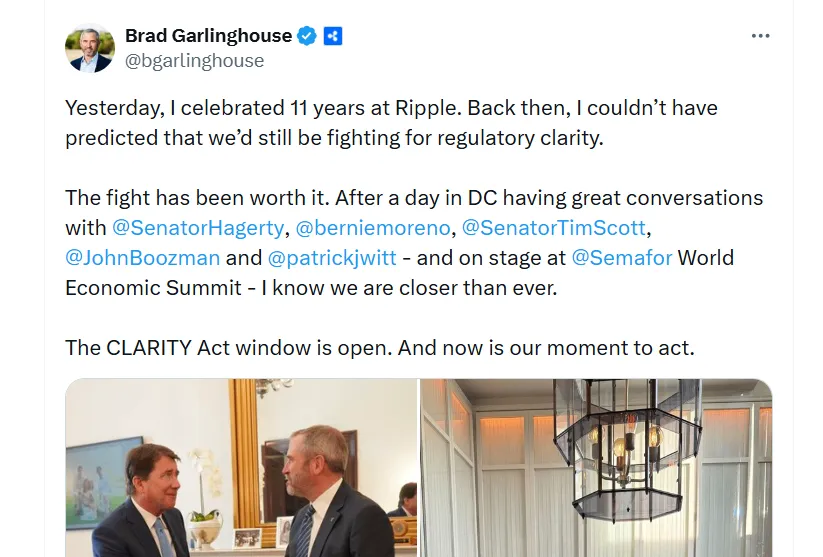
The talks on Clarity Act have reached a decisive stage with legislators and industry stakeholders clamoring towards clarity. The recent Washington meetings indicate that digital asset regulation is nearing consensus, Brad Garlinghouse said. He also held conferences with such officials as Bill Hagerty and Patrick McHenry to talk about progress. He cited that years of uncertainty over regulation can soon be replaced with an organized system of oversight.
He elaborated that the long-running drive towards a definite crypto regulation is finally bearing some quantifiable gains. The Clarity Act is designed to create a system that has a comprehensive framework on the way in which digital goods should be classified. Garlinghouse cautioned that the existing legislative opportunity might not be permanent unless action is taken. He encouraged stakeholders to take action early when there is momentum in both political and industry circles.
Policy-makers develop roadmap to regulate digital assets
The Clarity Act is commonly considered to be the initial serious efforts to establish single federal crypto regulations. The policymakers are trying to establish the relationship between assets and the various regulatory authorities. Such an endeavor would redefine oversight roles in various agencies that deal with digital finance. It also indicates a larger shift to coordinated regulatory practices in the United States.
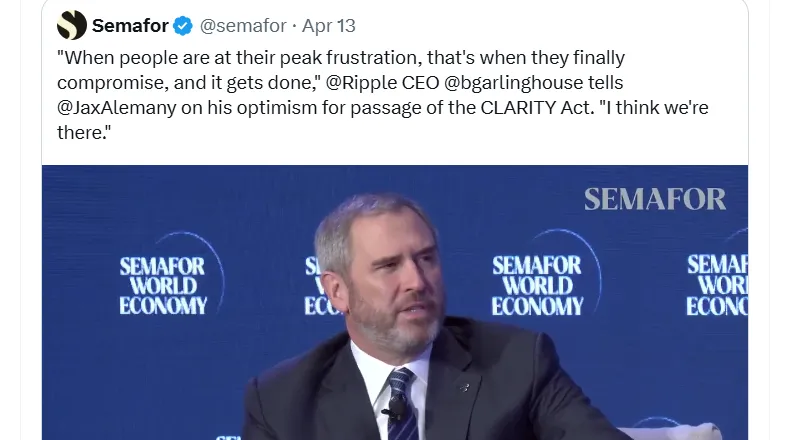
In comments at the Semafor World Economy Summit, Garlinghouse noted improvement among regulators. The U.S. Securities and Exchange Commission and the Commodity Futures Trading Commission published unanimous guidance with a new system of classifying digital assets. This framework found XRP as a digital commodity which was a significant policy change. He observed that this kind of coordination could diminish regulatory conflicts that had brought about uncertainty in the past.
Stablecoin Yield Controversy Prolongs Legislation
Nevertheless, disputes on the provision of stablecoins have postponed the Clarity Act. Garlinghouse previously predicted an 80% likelihood of passing by April of this year. Nonetheless, unsubdued policy differences compelled legislators to delay major legislative processes. Such delays have decelerated the rate of development even as political attention is up.
Cryptocurrency companies such as Coinbase have fought against limitations that could prevent them from providing yield to stablecoin users. They state that such actions are mainly favorable to conventional financial institutions but not to digital asset firms. The Senate Banking Committee postponed its markup, originally planned in January. It is now being reported that a new timeline would have the markup towards the end of this month.
Political support spreads among the leaders of the crypto industry
The Clarity Act has gained momentum because of the negotiations that are nearly nearer to an agreement. Garlinghouse now anticipates progressing by the end of May, with delays but in other ways building consensus. The legislation is gaining momentum being supported by industry leaders and policymakers. This increased support may be critical in speeding up the legislative process.
Brian Armstrong has just signed the bill, having decided to disagree with some aspects of the proposal. Secretary of the treasury, Scott Bessent, also supported, indicating more institutional congruence. All these are signs that the resistance is slowly waning among major stakeholders. According to analysts, these changes usually become the precursors of significant legislative breakthroughs.
Institutional adoption may be unlocked by regulatory clarity
The CLARITY Act continues to play the key role in the creation of long-term stability in the U.S. crypto market. Garlinghouse made it clear that coordination of regulations even in the absence of legislation is still fragile and prone to changes. He cautioned that changes in leadership would turn back the gains made without a legal guarantee. This issue still creates a feeling of urgency in the passage of the bill.
Revised proposals that will deal with the issue of stablecoin yield are likely to be introduced by lawmakers, such as Thom Tillis. With both parties accepting the compromise, Senate Banking Committee may be ready to vote a markup in the near future. Observers think increasing frustrations among players could eventually lead to consensus. An effective result may open up increased institutional adoption in digital asset markets.