

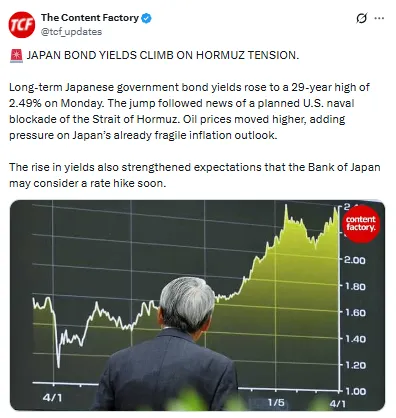
- The yield on Japanese bonds has soared to 2.49% amid expectations of tighter global policy and higher inflation.
- Bitcoin fell to near $70,000 amid increased selling and negative interest rates.
- Japan now considers cryptocurrency a financial instrument, and the regulatory framework will focus on market rules.
Interest rates on Japanese bonds have risen to among the highest seen in decades, while the yield on the 10-year government bond now stands at 2.49%, last seen in 1997. This marks a major shift in expectations for investors who had enjoyed loose monetary policies for several years.
According to the Bank of Japan, the rise in bond yields corresponds with a decline in bond prices, indicating that investors are demanding higher returns. Moreover, the Japanese yen has weakened to about 160 yen per US dollar, thereby adding to inflationary pressures from higher import costs. These developments have combined to alter expectations around the Bank of Japan’s policy path.
Japan Bond Yields Signal Changing Monetary Outlook
Market data indicate that traders are assigning a 54% probability to a Bank of Japan rate increase by April. Furthermore, the market has already fully anticipated a 25-basis-point rise by July. Some market positions also reflect expectations that policy rates could approach 1% over time.
Japan has historically maintained low rates, enabling it to serve as a source of low-cost capital. The investors have been using yen financing to invest in higher interest-earning assets, including cryptocurrencies.
The rise in Japanese bond rates will affect the structure discussed above. High rates will disincentivize yen borrowing, which could lead to an inflow of funds. As liquidity from external sources dries up, the process takes place amid broader macroeconomic pressure.
Crypto Markets Respond to Liquidity Drought
The impact of tightening liquidity is now being seen in the crypto markets. The price of Bitcoin has fallen by about 3% over the last 24 hours, approaching $70,000. The price fluctuation was matched by an increase in selling volume, as Binance derivatives saw nearly $1 billion in sell volume in an hour.
Source: tcf updates
Meanwhile, the funding rates turned negative to approximately -0.0065%. This is below the 0.01% threshold normally applied on Binance, indicating that short positions are controlling current market activity. The shift in the rate of change in funding is an indicator of higher short-term bearishness.
These changes are consistent with the overall effect of the increase in Japanese bond yields on global liquidity. Markets that have thrived under loose monetary policies are likely to see monetary policies tighten. There have also been geopolitical developments that have led to the current environment. On the weekend, talks between Iran and the United States broke down over nuclear issues.
Japan, a major importer of energy from the Middle East, is directly affected by changes in oil prices. With ongoing inflationary pressures, expectations of monetary changes keep shifting.
Cryptocurrency Classification: Changing the Face of Regulatory Changes.
Apart from monetary changes, Japan has also introduced regulatory changes that help determine the classification of cryptocurrencies. With the amendment of the Financial Instruments and Exchange Act introduced last Friday, cryptocurrencies have been categorized as financial instruments.
In the past, Japan’s regulatory framework was based on the Payment Services Act, which treated crypto assets largely as a payment system. The new categorization reflects the change in how digital assets are positioned in the financial world.
By categorizing crypto assets under the Financial Instruments and Exchange Act, Japan will be putting the assets on the same level as other financial tools such as shares and bonds. In doing so, Japan will create a regulatory framework for digital assets based on its overall financial regulatory system.