

Key Insights:
- Ripple CTO Emeritus David Schwartz identifies trade-offs of DeFi security as hazardous with growth and protection being in conflict.
- The cross-chain bridging setups are risky as pointed out by the KelpDAO exploit of $290 million.
- Security features are optional and can be a vulnerability when not fully applied.
A reported exploit of KelpDAO ecosystem worth $290 million has shaken the markets of DeFi. The hack has heightened the inquiry regarding security choices in swiftly growing cross-chain systems.
In spite of the fact that the protocols are expected to provide advanced security, their application in practice is apt to illustrate trade-offs with the convenience and scalability in mind.
Ripple CTO Emeritus David Schwartz also commented on the incident, highlighting the importance of careful adoption of security structures.His observations are in line with the increasing concerns that optional safeguards are usually ignored within fast-paced settings.
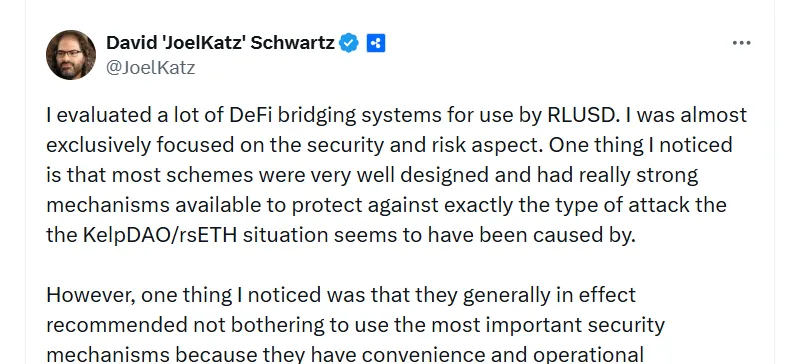
The use of KelpDAO incidents raises concerns about the implementation decisions.
The KelpDAO exploit has also impacted funds as well as brought more questions related to system design decisions.A number of specialists assume that the problem can be connected with the configuration of bridging mechanisms and does not concern its flaws.
These protocols, like LayerZero, offer several verification layers capable of enhancing transaction integrity to a great extent. Nevertheless, these protections usually have extra setup, monitoring and technical overhead in deployment phases.
This complexity may demoralize teams to go through with advanced safeguarding, more so when there is a rush to grow.
DeFi bridging systems put comfort before security.
Bridging frameworks within DeFi ecosystems are often sold as safe and scalable.However, the simplicity of integration can be frequently based on the minimization of the dependence on the most powerful possible protections.
Such features as multi-oracle verification, rate limiting, and circuit breakers can considerably decrease the risks of exploits.Although effective, these mechanisms add latency and complexity to operations to development teams.
Consequently, not all protocols enforce full security settings, with some using simplified settings that favor speed over a thorough security enforcement.
Research indicates systemic DeFi infrastructure risks.
The KelpDAO exploit highlights a more systemic vulnerability to the DeFi infrastructure in various chains. Modern protocols seldom lack security, but rather include optional layers that must be activated.
This design poses a risky distance separating theoretical security and practical execution of the design on production sites.
Ripple CTO Emeritus David Schwartz has already written that systems that seem to be secure by design end up failing to work.His view is a common industry trend in which operational compromises create unwanted weaknesses.
It is not uncommon to reward teams to grow fast, to raise liquidity, and to make simultaneous mergers with several networks.Under these circumstances, hard security measures can seem oppressive, hindering the implementation, and restricting accessibility to the user.
This trade-off is especially noticeable in liquid restaking systems such as KelpDAO, where the capital efficiency is paramount.Moreover, the supposition of the possibility to enable advanced features later poses a great risk of delay.
These windows are usually used by attackers and attack systems with incomplete security platforms are targeted.The outcome is not so much a breakdown in technology, but rather in the discipline of the operation and prioritization of risks.
In most instances protocols are based on assumptions of trust instead of imposing stringent validation of chains.Such dependence may undermine the overall robustness of the ecosystem, particularly when there are large traffic volumes.
The KelpDAO case might thus be considered as the expected result of a security failure and not a single instance.
Impact Is More Than Short-term Financial Losses.
The $290 million adventure has caused greater anxieties regarding trust and sustainability in DeFi markets.Investors will also start doubting the fact that protocols are focusing on growth measures rather than long-term security integrity.
This perceptional change may have a decelerating impact on adoption, especially by institutional players joining the space.Also, developers might be under pressure to ensure they are transparent with their security settings.
Audits will not be sufficient any more, as stakeholders require information on what kinds of safeguards are being actively implemented.
Conclusion
The KelpDAO exploit acts as an important lesson that protection is not provided as far as available security measures are involved.Projects in DeFi need to go past hypothetical protections and concentrate on disciplined practices of implementation.
Striking the balance between scalability and strong risk controls will be critical as cross-chain ecosystems keep on changing at a swift pace.The lack of this balance may lead to the appearance of similar incidents and loss of trust in the otherwise promising technologies.
FAQs
Why was the KelpDAO exploit?
It was probably caused by the loopholes in bridge security settings.
What makes DeFi bridges risky?
They add complexity, and create larger attack surfaces.
Are security features disregarded by the protocols?
In some instances, because of speed and operational simplicity considerations.
What can be done to avert such exploits?
By fully enabling security features and maintaining strict monitoring.
Will this affect DeFi adoption?
It may slow confidence short term but improve standards long term.









This really answered my problem, thank you!
Whats up very cool website!! Man .. Excellent .. Wonderful .. I will bookmark your web site and take the feeds additionally…I’m glad to find so many helpful info here in the post, we want develop extra strategies in this regard, thanks for sharing.
fantastic post, very informative. I wonder why the other specialists of this sector don’t notice this. You should continue your writing. I’m sure, you have a huge readers’ base already!
Hello I am so excited I found your weblog, I really found you by error, while I was searching on Aol for something else, Regardless I am here now and would just like to say thanks a lot for a fantastic post and a all round entertaining blog (I also love the theme/design), I don’t have time to read through it all at the minute but I have saved it and also added your RSS feeds, so when I have time I will be back to read more, Please do keep up the superb work.
Some genuinely nice and useful info on this internet site, too I conceive the layout has got wonderful features.
thanks
I have recently started a blog, the info you provide on this site has helped me tremendously. Thank you for all of your time & work.
Valuable information. Lucky me I found your website by accident, and I’m shocked why this accident did not happened earlier! I bookmarked it.
Yay google is my king assisted me to find this outstanding website ! .
whoah this blog is wonderful i love reading your articles. Keep up the good work! You know, lots of people are searching around for this info, you could aid them greatly.
I just could not depart your website prior to suggesting that I actually enjoyed the standard info a person provide for your visitors? Is going to be back often in order to check up on new posts
Woh I enjoy your content, saved to fav! .
I in addition to my friends were found to be studying the best tactics located on your site and then all of a sudden got a terrible feeling I never thanked you for those secrets. Most of the young men happened to be absolutely warmed to read through them and now have in fact been using those things. Thank you for genuinely really considerate and then for considering this kind of magnificent resources millions of individuals are really needing to be aware of. My very own sincere apologies for not expressing appreciation to you earlier.
I have recently started a web site, the info you offer on this web site has helped me tremendously. Thanks for all of your time & work.
What’s Going down i’m new to this, I stumbled upon this I have found It positively useful and it has helped me out loads. I am hoping to give a contribution & help other users like its helped me. Great job.
There are some fascinating closing dates in this article however I don’t know if I see all of them middle to heart. There may be some validity however I will take maintain opinion till I look into it further. Good article , thanks and we wish extra! Added to FeedBurner as effectively
I have not checked in here for a while because I thought it was getting boring, but the last several posts are great quality so I guess I will add you back to my daily bloglist. You deserve it my friend 🙂
I envy your piece of work, appreciate it for all the good articles.
Hi! I could have sworn I’ve been to this blog before but after reading through some of the post I realized it’s new to me. Anyways, I’m definitely glad I found it and I’ll be bookmarking and checking back frequently!
Enjoyed reading this, very good stuff, thankyou. “I will do my best. That is all I can do. I ask for your help-and God’s.” by Lyndon B. Johnson.
Normally I do not read post on blogs, but I would like to say that this write-up very forced me to check out and do it! Your writing style has been surprised me. Thank you, very great article.
You actually make it appear so easy along with your presentation however I in finding this topic to be actually something that I believe I’d never understand. It kind of feels too complicated and extremely vast for me. I’m taking a look ahead to your subsequent post, I’ll attempt to get the hang of it!
What i do not realize is in truth how you’re no longer actually a lot more smartly-favored than you might be now. You’re so intelligent. You recognize therefore considerably in the case of this matter, made me personally consider it from a lot of numerous angles. Its like women and men aren’t involved except it is one thing to do with Girl gaga! Your individual stuffs excellent. All the time take care of it up!
Whenever corporate executives receive highly personalized spear-phishing emails referencing recent industry conferences, they must always verify the sender’s identity through a secondary communication channel, because attackers meticulously research public profiles to craft convincing lures that bypass traditional email spam filters.