Key Insights
- Critical Resistance Rejection: Ethereum rejected at $2,400 is an affirmation of high overhead supply and reluctance in buyers.
- Macro Influence Rising: The tensions between the US and Iran are contributing to risk-off sentiment, which is directly affecting the price action of cryptocurrencies.
- Support Decision Keys: The zone of $2,150-$2,200 is essential- a decline below this would hasten a decline to below $2,000.
Ethereum is feeling the squeeze again- its inability to break above $2,400, coupled with the escalating US-Iran tension have brought about renewed concerns of falling below the $2,000 mark.
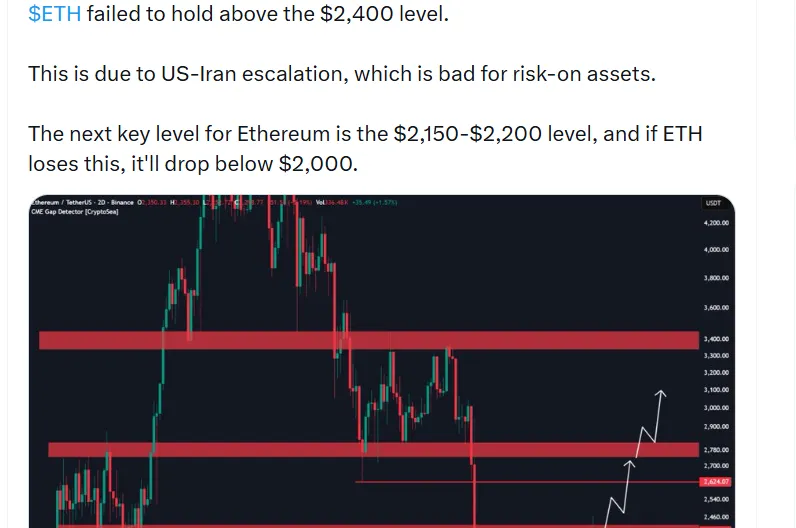
Ether is experiencing a new negative pressure following its inability to break above the major resistance level of $2,400 because the US-Iran tensions are increasing, and the global markets are moving towards a more significant risk-off. This rejection has returned ETH to a precarious area, and traders are keeping a close eye on the support zone of $2,150–$2,200. Failure in this regard may expedite the selling force and push Ethereum under the important threshold of $2,000.
Ethereum price analysis
The daily timeframe is seeing Ethereum recover slowly with a drastic correction in the initial part of the year. The price action recovered the $1,800–$1,900 area and has been creating a higher lows series since, which means that buyers are gradually winning the battle. ETH is presently trading on the order of the $2,300 mark and trying to stabilize just below a major resistance area between $2,350-$2,400, which was a supply area in the past.
The shape indicates an uptrend that is yet to gain momentum, but it is not explosive. The 9-day moving average is moving upwards and price is clad around it and indicates a short-term bullish continuation provided that this dynamic support is not broken. In the meantime, the RSI is floating in the mid-to-upper area, which signifies the increasing strength without being overbought yet there is still the possibility of further upside in case of the heightened buying pressure.
Nonetheless, Ethereum continues to test a critical level at the $2,400 resistance. An established breakout at this point would lead to the possibility of reaching $2,600 and even beyond. The negative side of it is that below the level of holding of above $2,200, the existing structure would be weakened and it may be retested once again at the level of $2,000, which is the psychological level. In general, ETH is carefully optimistic but requires further momentum to ensure a further breakout.
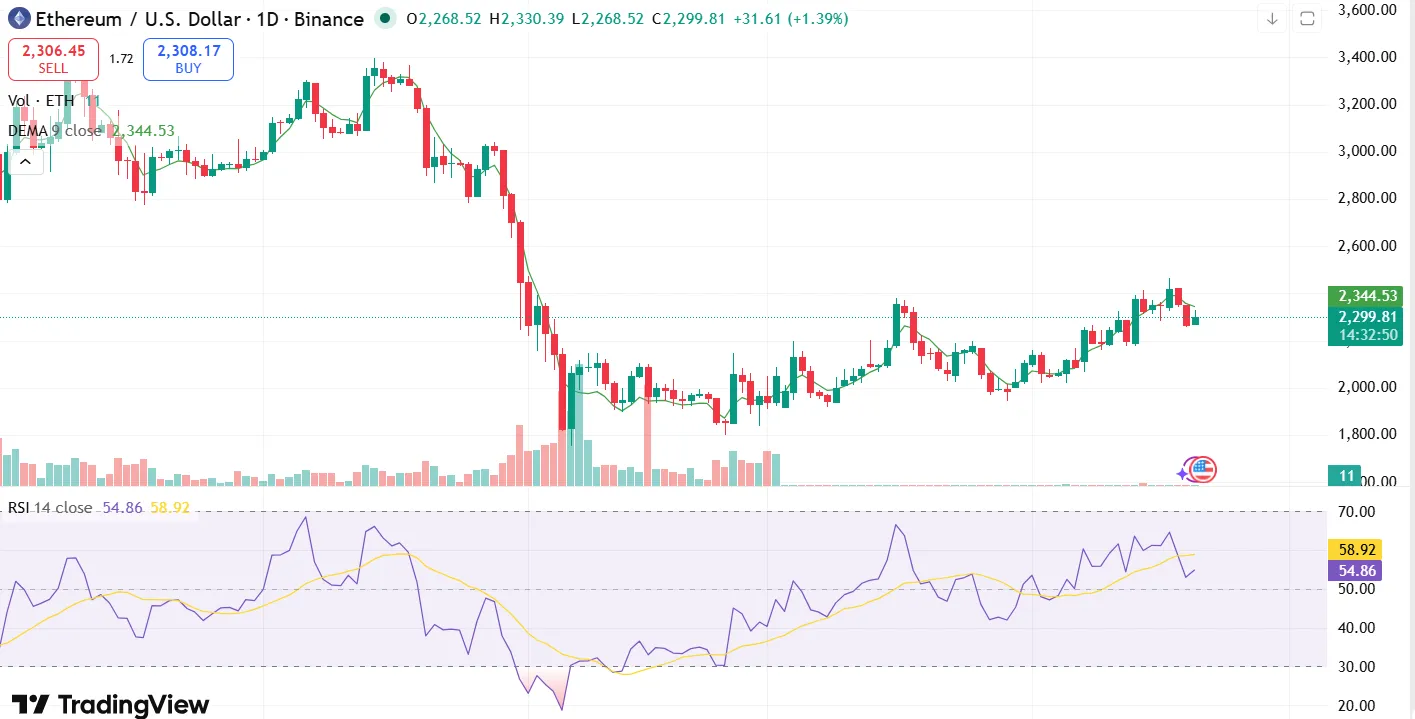
Ethereum is affected by US-Iran tensions as the risk-off sentiment intensifies.
The rejection of Ethereum at the $2,400 price point highlights the fact that the increasing tensions between the United States and Iran are having a direct effect on crypto markets. With increased geopolitical risks, investors are moving out of risk-on assets such as cryptocurrencies to safer instruments, and it is causing sell pressure across digital assets. Surging oil prices and inflation fears related to possible supply shocks in the Middle East are enhancing this risk-off rotation that, historically, suppresses liquidity and interest in speculative markets.
As long as the conflict remains a factor to create uncertainty, the Ethereum as a currency will be weaker and weaker as it nears the $2,150-$2,200 support level. A fall below this would indicate a sustained outflow of capital and may hasten closer to below $2,000 levels, which would prove a more profound correction period. But the crypto markets are very sensitive to geopolitical news, and a de-escalation will soon help to restore confidence and stabilize prices. In the meantime, ETH is closely correlated to macro processes, and the U.S. and Iran scenario is a major determinant of short-term price trends.
Conclusion
Ethereum is at the junction of technical structure and macro forces colliding. Although the emergence of higher lows is an indication of gradual recovery, the fact that the target of the bullish has been rejected severally at $2,400 indicates that it is not a very strong force. Meanwhile, the increasing US-Iran tensions are strengthening a risk-off environment, capping the upside and amplifying volatility.
The support zone of between $2,150-$2,200 has become the focal point- sustaining it might save the present structure, and the failure might result in more correction at a lower level of below $2,000. Until there is some light shed on the macro conditions and market momentum, Ethereum will be confined to a range with a careful bearish bias.
FAQs
Why is Ethereum not able to smash above 2400?
Selling pressure was caused by strong resistance at that level coupled with macro uncertainty particularly, geopolitical tensions.
What is the highest level of support needed at the moment?
The most important level that will be observed by the traders is the range of 2,150-2,200.
Is Ethereum yet to go bullish?
Yes, but it requires a verified break above 2400 and good volume in order to start the bullish movement.
What impact does US–Iran tensions have on crypto?
They drive investors to the safety of assets and decrease the demand on risk-on assets such as cryptocurrencies.
What will occur when ETH falls below 2,000?
It would probably validate a more profound correction and might result in further underperformance in the short-term.