Key Insights
- Binance will work with BlockShoals under the SEC’s regulatory sandbox, and will be welcoming users in the Philippines.
- BlockShoals must complete local VASP integration before customer onboarding begins.
- The BSP confirmed the sandbox approval does not replace a required VASP license.
Binance has taken a major step toward re-entering the Philippine market after local partner BlockShoals Technologies Inc. secured final approval to begin testing under the Philippine Securities and Exchange Commission’s Strategic Regulatory Sandbox. The move will further reinforce the exchange’s regulation efforts in the Southeast Asian region and ensure that in the first phase of the rollout, operations will be directly supervised.
Approval will enable BlockShoals to test a number of financial products and services under the crypto-asset intermediary model. However, the authorization does not grant a virtual asset service provider license, leaving additional regulatory requirements before full commercial operations can begin.
Regulatory approval marks the next phase
The latest development followed an announcement by Binance co-founder and Chief Customer Service Officer Yi He, who stated on X that the exchange had officially entered the Philippine market. The statement accompanied an SEC document confirming that BlockShoals had received final approval to launch testing under the Commission’s Strategic Regulatory Sandbox framework.
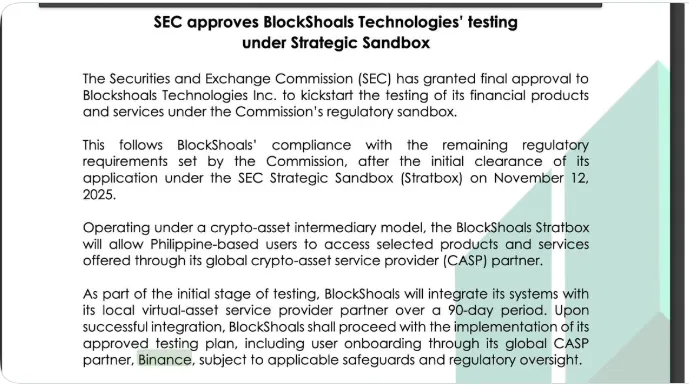
Under the approved structure, BlockShoals will provide access to selected crypto services through its global Crypto Asset Service Provider partner, Binance. The SEC requires the company to complete system integration with a licensed domestic virtual asset service provider during an initial 90-day period.
Only after that integration is complete can the testing program proceed to user registration and onboarding. The process will operate under regulatory safeguards while authorities continue monitoring compliance throughout the sandbox period.
This approval follows the SEC’s approval of BlockShoals’ Stratbox application in November 2025, with the company fulfilling the remaining regulatory requirements.
Licensing questions linger despite market progress
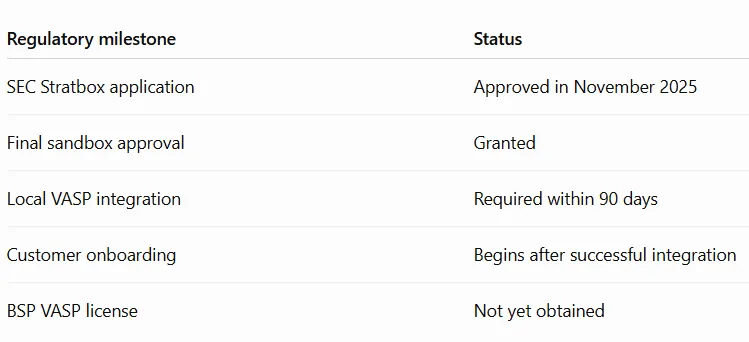
The SEC approval is a step forward for the project but regulatory hurdles remain. The Bangko Sentral ng Pilipinas recently clarified that neither Binance nor BlockShoals currently holds the Virtual Asset Service Provider license needed for certain payment and transaction activities.
The central bank explained that participation in the SEC’s sandbox framework does not replace separate licensing requirements because both regulators supervise different parts of the country’s financial sector.
The BSP also said that the launch of the BlockShoals on Binance’s infrastructure would only start after it integrates with a licensed domestic VASP. Therefore, the new approval allows for controlled testing, rather than commercial rollouts.
This is still relevant, as Yi He’s announcement called the project the exchange’s formal market entry. In the meantime, the SEC papers explicitly permit BlockShoals to test in the ‘sandbox’ and name Binance as its CASP ‘partner’ around the world. Approval does not mean that the exchange has been licensed as a Philippine VASP.
Broadened regulatory approach begins to take form
The move to the Philippines is part of Binance’s global initiative to increase compliance in key markets. Over the years the company has gradually shifted away from the unchecked partnerships and local licensing practices, toward regulated partnerships.
The move could attract more investment trust in the regulated services for cryptocurrencies in Southeast Asia, especially among institutional investors and retail traders. It may also encourage other global exchanges to adopt similar market entry strategies through regulatory sandboxes rather than direct launches.
The development arrives shortly after the exchange updated European Union users on service changes linked to the Markets in Crypto-Assets regulation. The company confirmed that withdrawals and other account functions would remain available while it continues seeking authorization under the EU’s new regulatory framework.
As regulatory relationships tighten among regions, key crypto exchanges seem to be increasingly seeing compliance as a competitive edge. If testing is successful, the Philippine sandbox may prove to be a blueprint for market expansion going forward.
Industry implications
- The practical application of regulatory sandboxes remains as a tool for global crypto businesses to enter.
- The Philippine authorities maintain separation of the SEC and BSP.
- If the testing is successful, it will impact the digital asset regulation in the Southeast Asia region in the future.
The BlockShoals partnership is an important start for Binance, however, there are several regulatory hurdles to cross before it can become operational. The next 90 days will be crucial as some of the necessary integration and compliance is to be implemented. A success of the testing could create a regulated pathway for the wider adoption of crypto and help to solidify the country’s place in the region’s developing digital asset market.
Conclusion
The SEC approval gives BlockShoals a clear path to begin regulated testing with Binance as its global crypto-asset service provider partner. However, the partnership must still complete local VASP integration and satisfy additional regulatory requirements before broader customer onboarding can begin.
The advancement represents another instance of Binance’s efforts to expand into regulated markets, instead of direct launches. The result of the Philippine sandbox program will also affect future regulatory policies and impact on how other crypto exchanges around the globe enter the markets of the Southeast Asia region.