

- Arbitrum halted 30766 ETH associated with the exploit and made sure the network continued to run smoothly.
- Kelp DAO liquidation exhausted $292M and caused bad debt in DeFi lending platforms.
- As cross-chain asset tracking is carried out, governance will determine when funds are released.
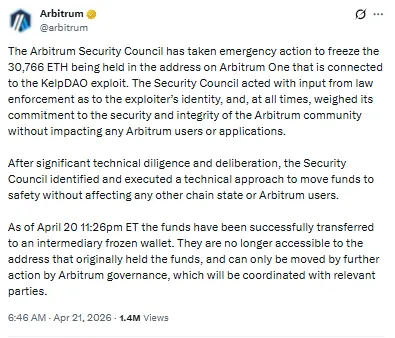
The Arbitrum Security Council’s freeze led to the recovery of 30,766 ETH, valued at around $71.1 million, following a major hack targeting Kelp DAO’s cross-chain bridge. The funds were identified at an address on Arbitrum One associated with the attacker and transferred to an intermediary wallet designed to restrict access.
According to a statement released Tuesday, the action did not affect other chain states or disrupt user activity across the network. The council added that the assets will remain frozen unless a governance decision approves further movement.
Source: Arbitrum
The intervention follows a Saturday exploit that resulted in the loss of 116,500 rsETH tokens, valued at around $292 million at the time. The Arbitrum Security Council freeze was carried out after internal discussions and coordination with law enforcement authorities regarding the identity linked to the exploit.
What Led to the Arbitrum Security Council Freeze?
The Arbitrum Security Council’s freeze was enacted following a vote among council members, with 9 of 12 voting in favor.
Council member Griff Green stated that the decision followed extended deliberations involving technical, operational, and governance considerations. The council reported that law enforcement input was considered before the freeze was implemented. Following this process, the identified ETH was moved into a restricted intermediary wallet.
Moreover, the council explained that the measure ensured that there would be no further transfers of the money and that the platform would continue to function. The move affected only the affected address and did not affect other users or dApps.
Kelp DAO Exploit and Market Impact
Arbitrum Security Council had frozen its network following a critical exploit at Kelp DAO, a cross-chain bridge operating on the LayerZero blockchain. This exploit enabled an individual to steal 116,500 rsETH tokens.
After stealing these tokens, the hacker moved some of them into the DeFi system, using them as collateral to obtain more cryptocurrencies. It was observed that some tokens were moved to the Aave platform.
Additionally, this led to bad debts in the loan ecosystem because the loans were not secured by adequate collateral. The networked nature of DeFi systems ensured that the impact of this attack was felt across several platforms.
The ETH frozen by the Arbitrum Security Council is part of the collateral backing these activities in Arbitrum One. The retrieval of other funds will depend on whether they were moved to other ecosystems before consolidation.
LayerZero Discovery and LayerZero settings.
Based on preliminary analysis by LayerZero, the attack was due to the design of the decentralized verification network employed by Kelp DAO. According to LayerZero, the network used a 1-of-1 decentralized verification architecture.
LayerZero also noted that diversification of verification nodes had been recommended before the incident. In response, Kelp DAO stated that the 1-of-1 configuration was the default setting in LayerZero’s framework.
LayerZero has not publicly commented on the Arbitrum Security Council freeze itself.
Governance and Next Steps
The Arbitrum Security Council freeze places the controlled ETH under the network’s governance framework. According to the council, any move to release or redistribute the money must be sanctioned through the proper governance channels.
Kelp DAO stated that it is working with its ecosystem partners to deal with the impact of the hack. The firm is considering options such as creating a recovery fund, sharing losses, and communicating with legal counsel.
Response and Monitoring
The freezing of tokens by the Arbitrum Security Council became a popular narrative on X, as users analyzed the possible consequences of such measures, which depend on the governance of blockchain networks. According to the council, this decision had a limited impact to not affect users and applications.
ETH is kept frozen inside the intermediary wallet during further negotiations concerning governance. The outcome will be determined by the Arbitrum governance system and by monitoring other related funds that have been exploited.
Conclusion
The $71 million in ETH frozen by the Arbitrum Security Council due to the Kelp DAO hack has been placed under governance control.
FAQ
What is the Arbitrum Security Council freeze?
It is an action that restricted access to 30,766 ETH linked to the Kelp DAO exploit.
Were users affected by the freeze?
No reported effects on other users or applications.
Are the frozen funds to be released?
Only under an approved governance decision.
What caused the Kelp DAO exploit?
Early results suggest an error in the verification setup for the bridge.