
- Coinbase Exchange resumed trading after AWS problems led to the suspension of trading on the markets.
- Coinbase reported lower earnings due to lower trading revenue and decreased trading activity.
- Coinbase’s stock price dropped due to lower-than-expected revenue for the quarter.
Coinbase Exchange resumed normal trading operations after a service disruption linked to an Amazon Web Services (AWS) outage forced the platform to suspend order matching and temporarily limit trading activity. The incident moved markets into “Cancel Only” and later auction modes as Coinbase worked through recovery procedures before fully reopening trading across the exchange.
The disruption started on May 7 after Coinbase Support announced on X that customers “may be experiencing degraded performance” tied to an AWS outage. In a later update, the company confirmed the issue was related to a “broader AWS outage” and said internal teams were working to restore full functionality.
Source: Coinbase Support
According to Coinbase’s live status page, the incident first affected ALEO and Solana network transactions. Users experienced delayed sends and receives beginning at 21:00 ET on May 7. Coinbase stated that buys, sells, and fiat deposits and withdrawals for both networks continued operating during the disruption.
Coinbase Exchange Introduces Cancel Only Mode
As the outage expanded, Coinbase Exchange shifted several trading services into degraded performance mode. The company stated that some users could temporarily become unable to transact through web and mobile applications.
Coinbase later connected the issue to “increased temperatures” affecting AWS Availability Zone use1-az4 within the US-EAST-1 region. Following that development, the exchange introduced phased recovery measures to stabilize trading systems before fully reopening markets.
During the first stage of recovery, Coinbase Exchange moved all markets into “Cancel Only” mode. Under those conditions, customers could cancel existing orders, but the platform stopped accepting new market and limit orders.
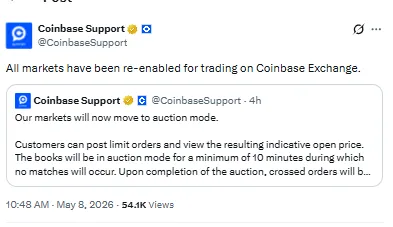
The exchange later transitioned markets into auction mode. Coinbase stated that users could place limit orders and monitor indicative opening prices while order matching remained paused for at least 10 minutes.
Once the auction process concluded, crossed orders were matched at the determined opening price. Coinbase later confirmed through its support account that all markets had been re-enabled for trading across Coinbase Exchange.
Coinbase Workforce Reduction and Earnings Pressure
The AWS-related disruption came days after Coinbase disclosed a 14% workforce reduction tied to operational restructuring efforts focused on AI-driven systems and cost controls.
The company announced the changes during a period of weaker market conditions across the digital asset sector. Coinbase said lower digital asset prices and reduced market activity affected several parts of its business during the first quarter.
Coinbase also reported quarterly earnings that fell below analyst expectations. According to the company’s financial results for the quarter ending March 31, it posted a loss of $1.49 per share. Estimates compiled by LSEG had projected a profit of 27 cents per share for the same period. Coinbase reported quarterly revenue of $1.41 billion, below analyst expectations of approximately $1.52 billion.
Coinbase Revenue Falls Below Analyst Expectations
Transaction-related revenue remained one of the weaker-performing segments during the quarter. Coinbase reported transaction revenue of $755.8 million, below analysts’ expectations of approximately $805.2 million.
Subscription and services revenue also came in below forecasts. Coinbase reported $583.5 million from subscription and services operations, compared with analyst estimates of $619.3 million.
Those segments include income from stablecoin-related products, staking services, and other recurring revenue sources beyond traditional trading fees.
Coinbase has continued expanding those business segments as part of broader efforts to diversify income sources beyond transaction-based revenue. Following the earnings release, Coinbase stock declined nearly 4% during after-hours trading on Thursday, May 7.
Why the Coinbase Exchange Disruption Drew Attention
The Coinbase Exchange disruption attracted attention because it occurred during a week already marked by operational restructuring and weaker financial performance.
The phased recovery process, including the use of “Cancel Only” and auction modes, showed how the exchange handled reopening trading after technical disruptions affected core market systems.
Although the AWS outage temporarily interrupted trading functions and transaction processing for some users, Coinbase later confirmed that all markets had returned to normal trading conditions.
Conclusion
Coinbase Exchange restored full trading services after an AWS-related outage disrupted order matching and transaction processing across parts of the platform.
FAQ
What caused the Coinbase Exchange disruption?
Coinbase said the disruption was linked to a broader AWS outage caused by increased temperatures in the AWS Availability Zone use1-az4.
Which networks were affected first?
ALEO and Solana transactions experienced delayed sends and receives beginning on May 7.
Was all trading on Coinbase stopped?
No. Order matching was briefly suspended and “Cancel Only” and “Auction Mode” were implemented.