
The limited amount of Bitcoin supply has been attracting more attention lately from investors when they examine its distribution. The overall supply of BTC is restricted to 21 million coins owned by various stakeholders.
Bitcoin has undergone a major change in ownership since its establishment in 2009. Many of the mines that have been in operation, institutional investment products, public companies, private companies, governments, and cryptocurrency exchanges now hold a large percentage of the total supply.
Meanwhile, analysts believe that a significant portion of Bitcoin has been lost forever due to forgotten passwords and inaccessible private keys, which explains the coin’s active circulation.
With increasing Bitcoin adoption, several types of Bitcoin holders came to dominate the market. Although the holdings remain dynamic as companies continue to buy more BTC, exchange-traded funds (ETFs) draw investors to their platforms, governments process seized assets, and custodians process deposits and withdrawals.
Bitcoin Cryptocurrency Led by Satoshi Nakamoto.
The largest bitcoin holder is the pseudonymous Satoshi Nakamoto, the creator of Bitcoin. Blockchain analysts believe that Satoshi has approximately 1.1 million BTC from the initial Bitcoin period between 2009 and 2010.
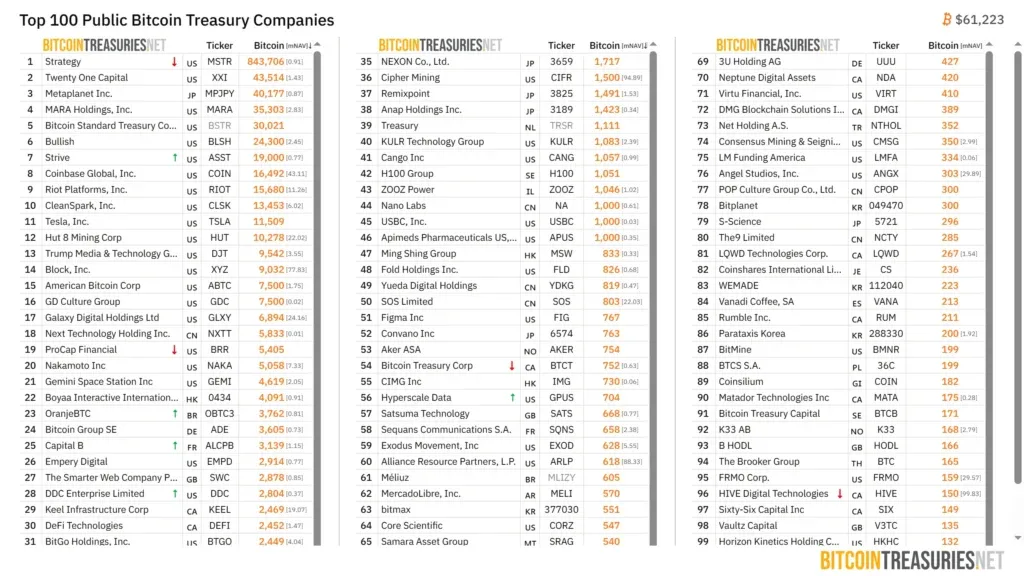
Source: Bitcoin Treasuries
The estimate is mostly derived from an analysis of the early mining done by researcher Sergio Demian Lerner, the ‘Patoshi pattern’. The results reveal that before the first halving, when the block reward was 50 BTC per block, Satoshi had mined more than 22,000 blocks.
One of the references that is popularly linked to the creation of Bitcoin is the Genesis Address. The Genesis Address refers to the first Bitcoin address that received block rewards in 2009. Currently, this address keeps receiving BTC at a slower rate from users.
Categories of Bitcoin ownership
Some of the major bitcoin owners fall under various categories, such as the following:
- Maintaining early miners and large Bitcoin holdings (whales)
- Bitcoin exchange-traded funds location information
- Public companies
- Private firms
- Government organizations
- Cryptocurrency exchanges serving as custodians
As the process behind Bitcoin transactions is pseudonymous, quite a few individual whale accounts have yet to be identified. However, there are some individual whales who have received media attention for their investments in Bitcoin.
The largest-known Bitcoin holders as of 2026.
| Holder | Estimated BTC Holdings |
| Satoshi Nakamoto | 1,100,000 BTC |
| BlackRock IBIT | 818,000 BTC |
| Strategy | 818,869 BTC |
| United States Government | 328,000 BTC |
| China | 190,000 BTC |
| Fidelity FBTC | 185,000 BTC |
| Block.one | 164,000 BTC |
| Grayscale GBTC | 150,000 BTC |
| Tether | 97,000 BTC |
| United Kingdom | 61,000 BTC |
Bitcoin ETFs are now the big players on the market.
Spot Bitcoin ETFs have been available in the United States since January 2024 and have attracted significant inflows of BTC from investors.
The main organizations holding Bitcoin tokens are BlackRock’s iShares Bitcoin Trust (IBIT), with holdings of around 818,000 BTC; Fidelity’s Wise Origin Bitcoin Fund (FBTC), with holdings of around 185,000 BTC; and Grayscale Bitcoin Trust (GBTC), with holdings of approximately 150,000 BTC.
Total holdings of the ETFs exceed 1,000,000 BTC. These assets change depending on various scenarios, such as investors buying or selling shares in the fund, and thus the ETFs’ providers need to update their Bitcoin reserves.
Public Companies increase bitcoin treasury holdings.
The use of Bitcoin has increasingly become an essential part of the strategy used by publicly listed companies.
The companies have continued adding Bitcoin through direct purchases and financing activities.
Other notable public company holders include:
- Twenty One Capital: Approximately 43,500 BTC
- Metaplanet: Approximately 40,170 BTC
- MARA: Approximately 38,600 BTC
Public disclosures indicate that at least 100 publicly traded companies hold more than 100 BTC as part of their balance sheet reserves.
Private Companies and Government Ownership
There are also a number of private companies with large Bitcoin holdings. Block.one reportedly owns around 164,000 BTC, while Tether reportedly owns around 97,000 BTC. The Stone Ridge Holdings Group has disclosed having around 10,000 BTC in its portfolio.
One prominent group of people holding Bitcoin is governments. As per Bitcoin Treasuries, the US government holds around 328,000 BTC, including some of those that have been recovered by the authorities following the hacking of Bitfinex and the case of Silk Road.
In March 2025, the president of the USA, Donald Trump, signed an executive order to form a strategic reserve for bitcoin and a stockpile of digital assets.
The PlusToken fraud reportedly has about 190,000 BTC under the control of the Chinese authorities. It is believed that there are approximately 61,000 BTCs in the United Kingdom that are associated with financial crime investigations.
According to the Bitcoin Treasuries, the UAE is estimated to have around 6,400 BTC mined by the government.
El Salvador is the only known country to have been publicly recorded as having directly purchased Bitcoin as a national reserve asset, holding around 7,600 BTC.
Crypto exchanges store Bitcoins on behalf of each user.
Some of the biggest visible Bitcoin wallets on the blockchain are held by cryptocurrency exchanges. These holdings are typically not exchange-owned reserves, however.
According to on-chain analytics, major exchanges like Coinbase and Binance hold hundreds of thousands of BTC in reserve, representing millions of accounts. The balance in the wallets might change depending on activities carried out by users in the form of deposits and withdrawals.
To ensure transparency in the balance sheet of customers’ assets and liabilities, many exchanges have opted for the implementation of proof-of-reserve.
Conclusion
Bitcoin ownership in 2026 will fall under several main categories such as early miners, ETFs, companies, government, corporations, and custodial exchanges. While Satoshi Nakamoto continues to be the biggest single holder, Bitcoin ETFs and corporate treasury programs represent growing shares of total supply.
FAQs
Who will have the largest shares of Bitcoin in 2026?
The biggest wallet is believed to be the wallet of Satoshi Nakamoto who is an alleged person who mined 1.1 million BTC during the early days of Bitcoin.
What is the amount of Bitcoin that the U.S. spot ETFs own?
Collectively, U.S. spot Bitcoin ETFs hold more than 1 million BTC. The largest individual ETF investor is BlackRock, which holds about 818,000 BTC in its IBIT.
What public corporation has the most Bitcoins?
Strategy is still the largest public Bitcoin wallet company, holding around 818,869 BTC as of June 2026.