

The adoption of the Strategic Bitcoin Reserve has seen an immense rise in recent days due to the increasing adoption of the Bitcoin network all around the world. Traditionally, strategic reserves comprise physical assets such as gold, foreign currencies, and commodities that can contribute to financial stability.
The term “Strategic Bitcoin Reserve” refers to a Bitcoin reserve held by an organization’s government or business entity as part of its strategy. Though there are different reserve models in place, the common goal remains to keep the Bitcoin reserve alongside other reserves. The introduction of a Strategic Bitcoin Reserve in the USA has become a significant trigger for this.
Why Organizations Are Creating a Strategic Bitcoin Reserve
There have been some reasons for the increasing trend of organizations creating a Strategic Bitcoin Reserve.
Fixed Supply and Rarity
One reason for this is that Bitcoin has a set supply model. Additional supply above 21 million Units cannot be created in Bitcoin’s case, unlike with other traditional forms of money.
Increasing Institutional Involvement
Institutional involvement in the creation of a Strategic Bitcoin Reserve has increased. Some companies involved include those holding corporate treasuries and that have adopted Bitcoin as part of the reserve asset on their balance sheets.
Diversification was yet another reason why organizations chose to use their reserves. Traditionally, reserve portfolios included assets such as cash, bonds, and gold. Bitcoin offers a new asset type that is independent of many conventional financial systems.
Additionally, economic security has become a significant factor in the discussion of the reserves. Since Bitcoin operates in a decentralized environment, it cannot be regulated by any state or government entity, and thus becomes an asset that can be evaluated for the creation of reserves.
Management Strategies for Bitcoin Strategic Reserves
Strategic reserves can be created using a variety of approaches. In the case of Bitcoin, strategic reserves can be accumulated via acquisitions, investments from treasuries, mining operations, and legal seizures in the case of governments.
Strategic management of Bitcoin reserves needs certain procedures, security measures, and oversight processes. Organizations tend to have mechanisms and systems in place to store their reserves safely. Processes for managing reserves will continue to evolve as institutions learn to manage digital assets effectively.
Comparison of Strategic Bitcoin Reserve with Traditional Reserve Assets
| Feature | Bitcoin | Gold | Foreign Currency |
| Reserves Supply | Fixed at 21 million BTC | Limited, but can be expanded through mining | Can be expanded by central banks |
| Mode of Storage | Digital | Physical systems | Banking system |
| Transfer Time | Takes Minutes | Require physical transfer | Dependent on banking network |
| Accessibility | network | Physical | financial |
| networks Volatility | High | Moderate | Low |
| Reserve Use | A new reserve asset | Established reserve asset | Common reserve asset |
U.S. Strategic Bitcoin Reserve Proposal
On March 6, 2025, President Donald J. Trump issued an Executive Order regarding the establishment of a Strategic Bitcoin Reserve and a U.S. Digital Asset Stockpile.
According to the Executive Order, the reserves will be composed of Bitcoin received as a result of forfeitures in criminal and civil cases. According to the initiative, Bitcoin held in the reserve will be considered as part of the reserve and will act as a means of storage without selling it.
The Executive Order has also created a U.S. Digital Asset Stockpile that should consist of various digital assets seized by forfeiture. Management of such assets was the responsibility of the Treasury Secretary. It is one of the biggest attempts on the government’s level regarding the use of reserves of cryptocurrencies and has raised much talk about the reserve policies that involve Bitcoin.
Strategic Bitcoin Reserve Holders
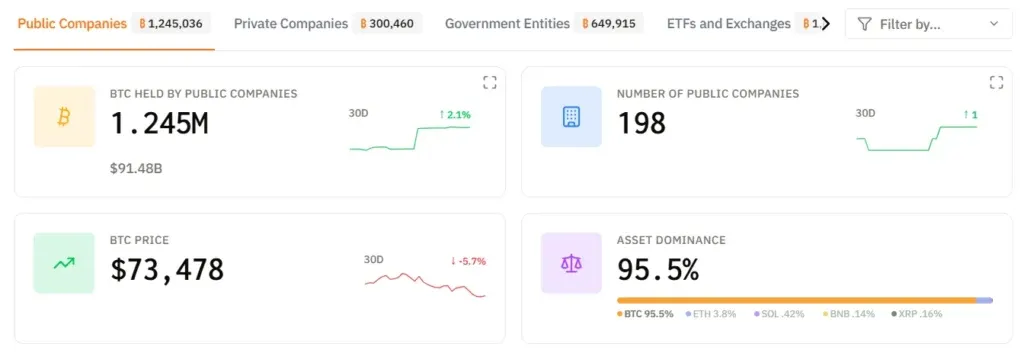
Strategy, formerly Microstrategy, has been continuously purchasing Bitcoin since the start of its treasury strategy in 2020. The amount of holdings as of May 2026 was
843, 738 BTC, or about $ 63.8 billion.
After declaring Bitcoin as its official currency in 2021, El Salvador has continued holding Bitcoin. As of May 2026, El Salvador’s BTC holdings were 7,661 BTC, or $565 million.
Source: Bitcoin Treasuries
Additionally, Tether, as of May 2026, held 97,141 BTC or approximately $7.16 Billion. These cases show how public and private institutions have integrated the use of Bitcoin for their reserve management purposes.
Challenges to Bitcoin Reserve Strategy Implementation
Despite the increased implementation of the Strategic Bitcoin Reserves strategy, there still exist some challenges that hinder this approach.
Reserve Management Criteria
Institutions keeping Bitcoin reserves need to develop custody systems, governance mechanisms, security measures, and reporting processes.
Regulatory and Policy Issues
Bitcoin reserves held by government bodies may need to incorporate other measures related to oversight. There continues to be scrutiny of the process through which Bitcoin reserves are accumulated, managed, and reported under current regulatory policies.

Source: Rhino
Issues and Criticisms
The creation of Bitcoin reserves has led to controversy between policy experts and financial analysts. One of the concerns about the Strategic Bitcoin reserve has been its volatility. Other issues that policymakers want guidance on include the governance, transparency, and supervision of reserves.
Conclusion
The strategic Bitcoin reserves have gone from being just a theory to practical use by both government entities, organizations, and corporations. The introduction of the Strategic Bitcoin Reserve of the United States has increased the awareness of using Bitcoin as a reserve asset.
FAQs
What is the Strategic Bitcoin Reserve?
Strategic Bitcoin Reserve is a Bitcoin reserve created by governments, institutions, or even individuals as a strategy.
Why do governments decide to own Bitcoin?
Governments may examine Bitcoin as a reserve currency for different reasons – portfolio diversification, management of reserves, or safekeeping assets.
How is the U.S. Strategic Bitcoin Reserve being funded?
The funding comes from Bitcoin seized in criminal and civil forfeiture proceedings under the terms of the March 2025 Executive Order.