
Key Insights:
- Recently, the leadership of Bitget has been connected to the suspicious buying and selling of LAB tokens that had been valued at more than $480 million, according to ZachXBT.
- According to the report, newly minted wallets reportedly withdrew 100 million tokens of LAB in 15 minutes from Bitget.
- Low LAB liquidity raised the risk of coordinated manipulation and sharp price movements, analysts warned.
Following the recent investigations, the cryptocurrency exchange firm Bitget has faced criticism after some suspicious LAB token withdrawals surfaced, prompting ZachXBT to step in with even more harsh criticism. The investigator charged the founder, Shawn Liu, with letting dubious trading go on without him taking direct responsibility. Blockchain analytics platform Lookonchain found that new wallets withdrew 100 million LAB tokens from Bitget. These withdrawals were reportedly completed in less than 12 hours, with an estimated market value in excess of $480 million.
Soon, the discussion went viral on social media due to investigators linking earlier volatile LAB price movement with withdrawals. But market observers questioned if insiders “pumped and dumped” the exchange activity ahead of massive price climbs of the controversial cryptocurrency. In addition, analysts pointed to a wider issue of the trading of inflated volume on centralized exchanges without any form of regulation. The charges raised scrutinized the transparency and governance protocols as well as exchange duties across blockchain trading platforms around the world.The accusations sparked further debate about transparency, trading market governance requirements, and exchange accountability across the cryptocurrency trading industry.
Bitget withdrawals spark fresh manipulation allegations online
Recently, Lookin chain claimed that withdrawn LAB holdings accounted for about 32.26 percent of the token’s circulating supply. The analytics platform correlated those wallets to an Arkham Intelligence suspicious blockchain activity tracking page. The investigators said they believed to move such large amounts of stock could have dampened the selling load on LAB as it moved up dramatically. But coordinated withdrawals often generate market conditions in advance of speculative rallies that quickly draw in retail buyers, critics said.
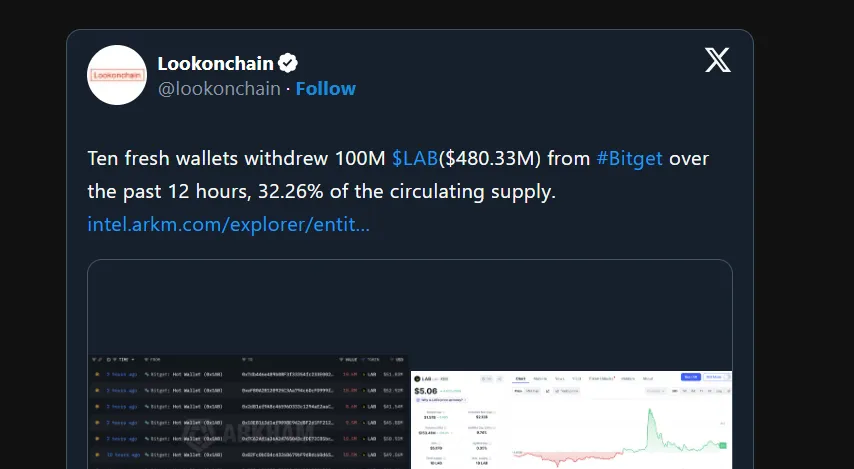
The controversy further picked up steam due to the fact that there is no history of transactions in the wallets prior to the withdrawals. According to analysts, that trend is rare, especially when new wallets come into existence during systematic token building approaches. Some market participants drew parallels between the latest activity and the earlier cryptocurrency liquidity manipulation (CLM) by insiders on exchanges. Such comparisons fuelled worries about central exchanges being able to facilitate shady trading tactics without any repercussions.
ZachXBT criticizes the leadership of exchange for LAB activity.
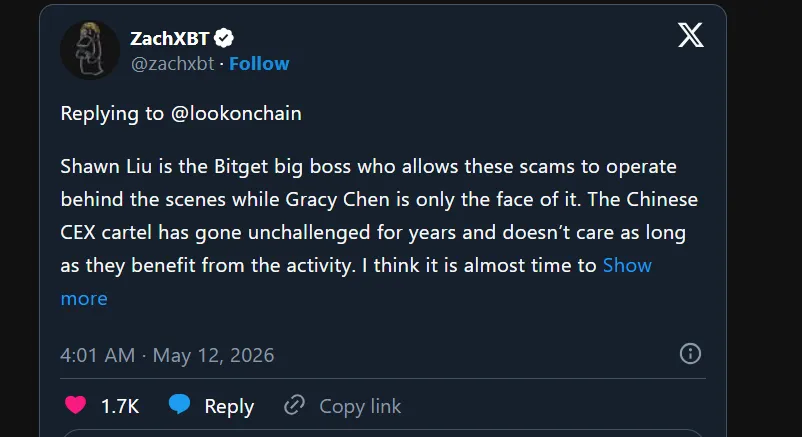
ZachXBT outright pointed out that Bitget was led to believe that although Shuan Liu did have a public facing leadership role, he engaged in manipulative trading within the house. The investigator stated that the exchange executives were making money when the tokens were used for a lot of transactions by none-suspecting traders. When the data on withdrawals was posted online the conversation was quickly picked up by cryptocurrency communities in social media posts, which criticized the exchange practices.
Some critics said this should be followed by the freezing of suspicious profits by centralized exchanges before redistributing the recovered funds to users of the affected platforms.
The investigator also revived the general allegations that several Asian cryptocurrency exchanges are all part of one “conspiracy” and are focused on trading revenue at all costs. Those claims suggest that exchanges are aware that the projects they sponsor have inflated trading volume and insider ownership concentrated in a few players. Those activities have been subjected to a fragmented approach to regulation, which critics said regulators were not doing well at the moment. That story added to the pressure on exchange executives who have already been in the crosshairs of increased questions about token listing standards, compliance and other issues.
The LAB token movements added fuel to the growing market uncertainty.
The LAB token was extremely volatile earlier in May when its price surged by over 350% in days. Blockchain investigators uncovered wallets that had been connected with the project which had moved around 96 million LAB tokens towards Bitget ahead of time. Those moves were deemed “positioning” before coordinated promotions and aggressive speculative purchase. The token then saw a dramatic drop in price, drawing the attention of short-term traders from around the world.
Even though LAB has been a huge market capitalization in recent days, its liquidity conditions were found to have structural weaknesses when additional market data was added. During peak trading times, the project had an estimated $4,750,000 worth of available on-chain liquidity. That imbalance enabled the concentrated holders to affect prices much more with relatively small transaction volumes repeatedly. The opponents claimed that low-liquidity assets are often at risk when large portions of the tokens are on exchanges in the hands of some insiders.
Investors Demand Transparency Following Massive Token Transfers
The ongoing outages and the issuance of the ban were the catalysts for the clash between Bitget and the investigators, as withdrawals were linked to earlier suspicious movement of tokens detected by investigators. Similar blockchain activity was cited ahead of previous rallies on LAB and another controversial project called SkyAI. Those results fueled speculation of coordinated trading inside the cryptocurrency market by those who had traded in the market before retail investors started in. Issues of exchanges came then into focus, resonating in online forums ranging from investor protection and ethical trading abroad.
Before recently, Bitget and Shawn Liu have not commented on the allegations in regards to withdrawals. Ongoing uncertainty over the definition of the new rules led to further rumors of in-house rules and internal knowledge of token swaps. If accusations remain unresolved, they could lead to a drop in confidence among traders facing uncertain market conditions in cryptocurrency, warned market analysts. Following that, investors were increasingly asking for clarity on exchange listing process, liquidity management practices, and institutional accountability measures.
The battle marks another major incident that could demonstrate cryptocurrency authorities discovering fraudulent activity on centralized exchanges throughout the world. Former investigations revealed significant financial losses in financial-based cybercrime, fraudulent token schemes and suspicious blockchain transactions worldwide. The historical research helped to build the confidence of those who make current claims of intentional manipulation when there is not enough public evidence to prove it definitively. The industry now waits to get more blockchain results, as well as any regulatory action on the growing concerns about exchange governance practices.
FAQs
1. Why did ZachXBT accuse Bitget recently?
ZachXBT accused Bitget after suspicious LAB token withdrawals exceeded $480 million within twelve hours from newly created wallets.
2. How many LAB tokens were withdrawn from Bitget?
Blockchain investigators reported that 100 million LAB tokens were withdrawn from Bitget through ten newly created wallets recently.
3. Who is Shawn Liu in the controversy?
Shawn Liu is Bitget’s founder and chairman, whom investigators accused of allowing questionable trading activities behind operations.
4. Why are analysts concerned about LAB token liquidity?
Analysts warned that LAB’s low liquidity made price manipulation easier through concentrated insider-controlled token movements recently.
5. Has Bitget responded to the allegations publicly?
Bitget and founder Shawn Liu had not issued official public responses before the article’s publication deadline arrived.