
Key Points:
- Arbitrum DAO received court approval to move the frozen ETH funds from the rsETH hack case.
- BlackRock expanded Ethereum tokenization through treasury and stablecoin products.
- The total collateral loss in the Ethereum ecosystem due to the rsETH hack was $174.5 million.
Ethereum news gained attention after a Manhattan federal judge approved a modification allowing Arbitrum DAO to move approximately $71 million in frozen Ether connected to Aave’s recovery process following the recent rsETH exploit linked to North Korean hackers.
Judge Margaret Garnett of the Southern District of New York issued the order on Friday, modifying a restraining order that had previously blocked the movement of 30,765 ETH held by the Arbitrum DAO.
The revised order allows the decentralized autonomous organization to proceed with an on-chain governance process that could transfer the funds to a wallet controlled by Aave LLC. The ruling also protects participants involved in the transfer process from being considered in violation of the restraining notice.
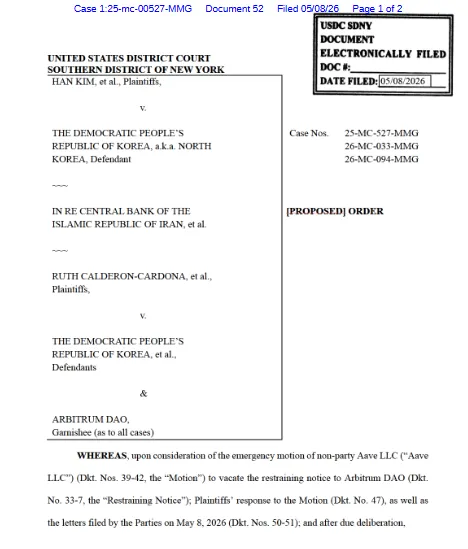
Source: Courtlisner
However, the court did not remove the legal claims tied to the funds. Families represented by Gerstein Harrow LLP continue pursuing ownership of the assets through unpaid terrorism-related judgments against North Korea totaling approximately $877 million.
According to the order, the funds could still be surrendered if the court later rules in favor of the claimants.
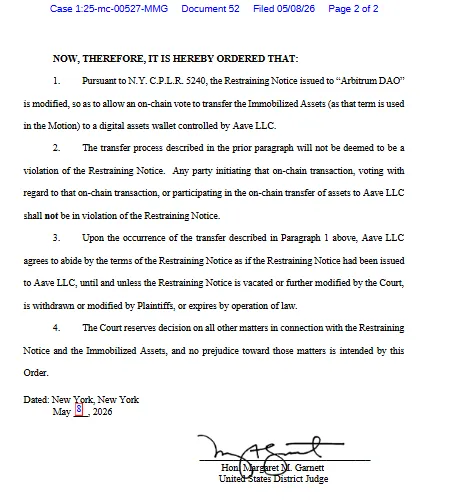
Source: Courtlisner
The ruling followed strong support from Arbitrum delegates during an off-chain Snapshot vote tied to Aave’s broader recovery proposal. Any transfer of Ether still requires a separate on-chain governance vote before the funds can officially move.
What Happened in the rsETH Exploit?
The legal dispute stems from the April 18 exploit involving Kelp DAO’s rsETH infrastructure. According to recovery documents and court filings, the exploit resulted in 116,500 rsETH being released on Ethereum without a corresponding burn mechanism occurring on the source side.
The imbalance left only 40,373 rsETH in the adapter contract against confirmed backing for 152,577 rsETH. The frozen 30,765 ETH held by Arbitrum DAO has been identified as a significant component in efforts to reduce that collateral gap.
Supporters of the recovery proposal argued that partially restoring the missing backing could help stabilize conditions affecting users connected to Arbitrum and the broader decentralized finance ecosystem.
Aave Challenges Legal Claims Over Frozen ETH
Last week, Aave filed an emergency motion in New York court seeking to vacate the restraining notice that had blocked the transfer process. The restraining notice had been served by Gerstein Harrow LLP, which represents families pursuing terrorism-related claims against North Korea.
The law firm argued that the Ether belonged to its clients because North Korean hackers allegedly stole the assets during the exploit. According to the filing, stolen property does not automatically become the property of the party responsible for the theft. Aave also questioned the evidence directly linking the exploit to North Korean actors, arguing that the attribution relied heavily on online speculation rather than judicial findings.
The protocol further warned that allowing restraining notices to interfere with recovery operations could complicate future responses to decentralized finance exploits. According to Aave, freezing recovery-related assets could increase operational uncertainty during attempts to restore collateral balances after hacks occur.
Gerstein Harrow has previously pursued related digital asset cases. In January, the law firm sued Railgun DAO, alleging that the privacy protocol had been used to launder proceeds tied to earlier North Korean-linked hacks, including the $1.5 billion Bybit exploit.
Ethereum News Also Tracks BlackRock’s Tokenized Fund Expansion
Separate Ethereum news developments emerged after BlackRock disclosed plans to expand additional tokenized financial products on the Ethereum infrastructure. The asset manager plans to introduce new tokenized money-market products connected to Ethereum, expanding beyond its existing BUIDL fund, which has reportedly reached approximately $2.5 billion.
BlackRock also plans to launch a digital share class tied to its $6.1 billion Treasury liquidity fund. In addition, the company is preparing another fund designed specifically for stablecoin holders.
According to the information released, the products will issue blockchain-based ownership tokens directly on Ethereum for transfers and settlement activity. The expansion adds more institutional financial activity onto the Ethereum infrastructure through tokenized treasury products and blockchain-based settlement systems.
The products are expected to support onchain ownership transfers and liquidity management tied to Ethereum settlement operations.
Why This Matters for Ethereum
The separate developments involving Arbitrum DAO and BlackRock highlighted Ethereum’s role across both decentralized finance recovery systems and institutional blockchain-based financial infrastructure. The Arbitrum court decision directly affects ongoing efforts to restore collateral balances connected to the rsETH exploit.
Meanwhile, BlackRock’s tokenized fund expansion adds additional institutional treasury activity to Ethereum-linked financial systems.Both developments place Ethereum at the center of ongoing legal, recovery, and settlement processes involving blockchain-based financial products.
Conclusion
Ethereum news surrounding the Arbitrum DAO court ruling and BlackRock’s expansion of its tokenized fund reflected two separate developments tied to Ethereum infrastructure. The Arbitrum recovery proposal now depends on a final governance vote, while the legal dispute involving ownership of the frozen Ether remains active in federal court.
FAQ
Did the ETH transfer take place yet?
Not yet. The court approved the change, but another onchain governance vote must occur before the transfer can proceed.
Why were the ETH funds blocked?
The ETH funds were blocked under a restraining order linked to cases involving hackers with ties to North Korea and terrorism-related judgments.
What was the shortfall of rsETH?
The shortfall in rsETH caused by the hack was about 76,127 rsETH, worth about $174.5 million at current prices.