key insights
- OKX became the first recently restricted overseas exchange to regain Google Play access in South Korea.
- Bybit remains blocked despite the restoration of the OKX application.
- Google’s enforcement extends beyond exchanges publicly identified by South Korean regulators.
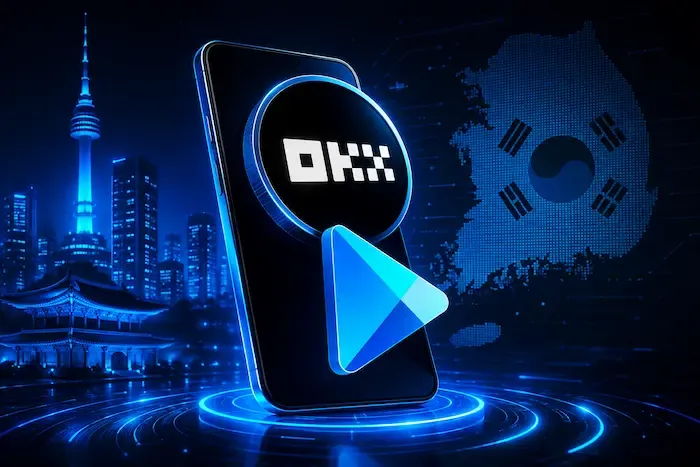
OKX has returned to South Korea’s Google Play Store after a four-day suspension, restoring Android downloads and updates while rival exchange Bybit remains unavailable. The move marks the first recent recovery by a major overseas crypto exchange since Google began restricting apps linked to unregistered virtual asset service providers in the country.
According to a July 28 report by Digital Asset, the OKX app reappeared in search results on the South Korean Google Play Store as of 8 a.m. local time. Users can once again install the exchange or update existing versions after the app disappeared from the platform on July 24.
The restoration follows several weeks of growing scrutiny over overseas cryptocurrency exchanges operating without local registration. Although Google had previously limited access to multiple exchange apps, OKX became the first affected platform to regain availability.
App access changes reshape South Korea crypto market
Digital Asset confirmed that searching for “OKX Trade Bitcoin & Crypto” now produces the official application in Google Play search results. The publication also verified that downloads and updates function normally again.
Only days earlier, the outlet reported that Android users could no longer locate the exchange through Google Play. During that period, competing exchanges such as Binance and Bitget remained searchable and available for download.
Bybit continues to face restrictions. The exchange’s Android application disappeared from South Korea’s Google Play Store on July 10 and remained unavailable for search or installation at the time of publication.
The latest change alters part of a broader enforcement picture that emerged earlier this month. On July 24, Digital Asset reported that at least 29 overseas cryptocurrency derivatives exchange apps had become inaccessible through the Korean version of Google Play.
Restriction category Number of exchange apps
Removed from search results 17
Marked unavailable 6
Region restricted 6
Total affected apps 29
Google enforcement reaches beyond regulator referrals
South Korea’s Financial Intelligence Unit classified overseas crypto firms operating without registration under the Special Financial Transactions Act as unreported virtual asset service providers earlier this year. Google later introduced restrictions on downloads and updates for affected exchange applications.
However, Digital Asset found that Google’s enforcement stretched beyond the FIU’s published referral list. Fourteen blocked exchanges had already been referred to law enforcement by the FIU. Those platforms included KuCoin, MEXC, BingX, XT.COM, LBank and CoinW.
Another 15 exchanges, including OKX, Bybit, Gemini, WhiteBIT and BitMEX, had not appeared on the FIU referral list but still became unavailable through Google Play.
According to the publication, Google indicated that the restrictions reflected its own policies rather than direct instructions from South Korean authorities. That distinction suggests platform operators may face separate compliance requirements beyond government enforcement actions.
Despite the Android restrictions, users retained access through exchange websites and Apple’s App Store, which has not imposed equivalent limitations in South Korea.
Wider regulatory pressure continues despite restoration
The return of OKX does not signal an easing of South Korea’s broader oversight of the cryptocurrency sector. Authorities continue expanding enforcement against overseas exchanges that operate without local registration.
Regulators have also strengthened market surveillance. Financial Services Commission Chair Lee Eog-won recently disclosed that officials investigated more than 40 suspected cases of unfair cryptocurrency trading during the first two years of the Virtual Asset User Protection Act. Authorities referred more than 30 cases to investigative agencies while expanding AI-powered market monitoring systems.
Outside South Korea, OKX continues advancing regulated operations. Earlier this month, OKX Europe introduced a one-way conversion service that allows customers across 30 European Union and European Economic Area countries to convert USDT into MiCA-compliant USDC. The exchange also expanded its institutional strategy after former New York Governor Andrew Cuomo joined its board following several years as an adviser.
The two different results between OKX and Bybit illustrate the flexibility of app store enforcement. Google has reinstated one exchange, but there is no indication as to when other competitors will be reinstated.
Conclusion
OKX’s re-publication on the Google Play Store in South Korea is a significant move for its Android users and the crypto trading sector in general. Despite all of this, we still have Bybit and dozens of other platforms that are just not on our radar and those platforms have not been shut down by the regulators or platform-level enforcement. The future rejections will most likely hinge on the manner in which exchanges adhere to both Google’s internal policies and the ever-changing compliance requirements set by South Korea.