
Key Points:
- Circle lawsuit alleges that the USDC freeze enabled the transfer of $230M during the Drift exploit window.
- Circle clarifies that it only complies with the law and never freezes wallets without law enforcement instructions.
- The CRCL shares fell in the post-market session after Drift obtained recovery funds
Circle lawsuit proceedings have moved into focus after a group of investors linked to the Solana-based Drift Protocol filed a class action in a Massachusetts district court following a $280 million exploit on April 1. According to the complaint, brought by Joshua McCollum through his law firm, Gibbs Mura, Circle Internet Financial could have frozen the stolen USDC, as it had the technology and contractual authority to do so.
Exploit Timeline and Cross-Chain Fund Transfers
Circle stated that the attacker gained unauthorized access and introduced a malicious asset that enabled the removal of withdrawal limits. This sequence enabled the extraction of funds from the protocol.
Drift later reported that the individuals behind the exploit had spent approximately six months posing as a quantitative trading firm before carrying out the attack. The preparation period formed part of the timeline described in the aftermath of the incident. Following the breach, large amounts of assets were transferred across networks.
Based on findings from on-chain detective ZachXBT, more than $230 million in USDC was moved from Solana to Ethereum via Circle’s cross-chain bridge. The investigator also indicated that Circle had a window of about six hours during which the funds could have been frozen. These claims are reflected in the legal filing, which focuses on the timing and execution of asset transfers during the exploit.
Prior wallet freezes cited in Circle lawsuit
The Circle lawsuit references an earlier incident in which Circle froze 16 unrelated wallets in a separate civil matter, nine days before the Drift exploit. According to the filing, this prior action demonstrates that the company had both the capability and precedent to intervene in certain situations.
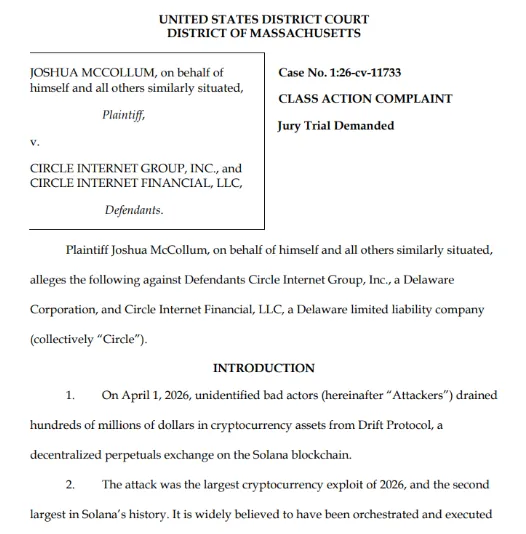
Circle Lawsuit Source: Law firm Gibbs Mura
Moreover, the plaintiffs believe that the wallet freeze before the Drift event does not compare with how the company handled the situation.
Circle response and stated policy
In response to criticism over the Circle lawsuit, Jeremy Allaire stated during a press conference that Circle freezes wallets only when directed by law enforcement agencies or by court order. He stated that taking legal matters into one’s own hands without instituting legal procedures may be problematic under the law.
Allaire described such actions as a “significant moral dilemma,” emphasizing that the company follows established legal frameworks when handling wallet freezes.
The company’s stated position is that it adheres to legal requirements rather than taking discretionary action. These statements form part of the broader context referenced in the legal complaint.
Market reaction and CRCL stock performance
The emergence of the Circle lawsuit corresponded with movements in Circle’s stock price. During regular trading hours on Thursday, CRCL shares closed 1.84% higher at $107.46. However, after reports of the lawsuit appeared, the stock declined by 1.42% in after-hours trading.
Intraday trading showed a range between $101.75 and $108.02, while overall trading volume fell below the average level of 12 million shares.
Despite the decline following the lawsuit, the stock has gained more than 22% over the past week. This increase has reduced the stock’s monthly loss to approximately 18%, while year-to-date performance has risen nearly 28%.
Compass Point adjusted its outlook on the stock by lowering its price target from $79 to $77 and changing its rating from neutral to sell. The firm cited insider selling by company directors in its assessment.
Plan of action for the recovery
As the Circle suit progresses, Drift Protocol has created a framework to offset losses from the exploit attack. In a report, the firm said it secured a deal of up to $127.5 million from Tether and another $20 million from other sources.
Drift states that the recovery structure aims to assist impacted users and relaunch the platform. The exchange announced that it will switch to a USDT-based, Solana-perpetual, decentralized exchange. This is a change following the exploit and the subsequent events regarding USDC.