
key insights
- Grayscale quarterly cash payout plans create a recurring income model, rather than holding the staking rewards within the funds.
- While fees and expenses, post-staking, are comparable, the quarterly reporting should be further harmonized between Ethereum and Solana staking products.
- Stake amounts are subject to change due to fluctuating staking returns, operating expense and tax considerations.
Quarterly cash payout options in Grayscale may change how investors can benefit from staking income on regulated crypto investment products. The asset manager has recommended changes that would enable its Ethereum Staking ETF and Solana Staking ETF to pay out staking rewards as cash distributions at least quarterly, which would make the payouts more predictable for shareholders.
>
The changes, announced in separate documents on July 17, would impact Grayscale Ethereum Staking ETF (ETHE) and Grayscale Solana Staking ETF (GSOL). The trusts would sell ETH or SOL staked and pay investors the net after costs the day the transaction is completed, assuming it does so before Aug. 7, 2026.
Trust amendments introduce a recurring payout framework
The proposal establishes a minimum quarterly distribution schedule rather than fixed payment dates or guaranteed yields. Under the revised trust agreements, both funds would convert staking rewards into cash before making shareholder distributions.
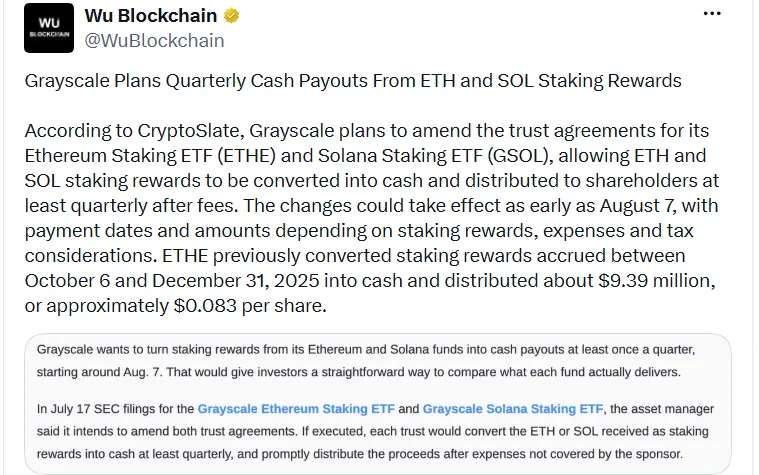
Grayscale said payment amounts would depend on several factors, including network staking rewards, validator performance, operating costs, management fees and tax treatment. The company also noted that distributions could occur more frequently than once every quarter if circumstances permit.
Ethereum and Solana staking rewards fluctuate as network participation changes. Consequently, the company stated that future distribution amounts cannot be predicted with certainty.
The proposal is a follow-up to an earlier distribution by ETHE. The fund in January 2026 sold the Ethereum staking rewards it earned between Oct. 6 and Dec. 31, 2025, for cash and paid out about $9.39 million to shareholders. Investors received about $0.083178 per share, marking the first U.S.-listed spot crypto exchange-traded product to distribute Ethereum staking proceeds directly through cash payments.
Key figures
Item Details
Proposed Effective Date: Approximately Aug. 7, 2026
Eligible funds: ETHE and GSOL
Minimum payout: Quarterly frequency
Previous ETHE distribution: $9.39 million approx.
Previous pay per share: Approximately $0.083178
The proposal is motivated by tax rules and economics of staking
The quarterly cash payout model of the Grayscale is similar to IRS Revenue Procedure 2025-31, which allows qualified grantor trusts to be structured as such and still enjoy a favorable U.S. federal tax treatment when staking digital assets.
The guidance requires qualifying trusts to distribute net staking rewards in either digital assets or cash at least once every quarter. Grayscale selected the cash distribution model for both products.
However, the company warned that receiving cash does not necessarily determine when taxable income arises. Investors may recognize taxable staking income when the trust earns the rewards rather than when distributions arrive. If ETH or SOL is sold to pay for the purchase, then the investor may experience a capital gain or loss.
Because each situation can be unique, Grayscale recommended investors obtain their own tax advice.
Broader implications for regulated crypto investment products
The proposal arrives as institutional demand for regulated staking exposure continues to expand. In October 2025, regulators were more open to staking in exchange-traded products, prompting Grayscale to include staking in its Ethereum and Solana investment solutions.
In October 2025 GSOL also changed from being a closed end trust to an ETF listed on the NYSE Arca. The fund held more than $102 million in assets at launch and held nearly three quarters of the fund’s entire Solana holdings. Originally, Grayscale was going to put 77% of the net staking rewards into the fund’s net asset value.
Competing asset managers, meanwhile, work on similar products. As competition among regulated crypto income products increases, BlackRock has come up with a new staking-based investment product for the Ethereum blockchain that could payout monthly or at least quarterly.
The Grayscale quarterly cash payout scheme might thus prove to be a significant benchmark to watch as issuers vie to lure investors looking to gain exposure to proof-of-stake assets without having to manage the staking process directly.
Market importance doesn’t just lie with the time of sale
Investors will have to wait for their first payouts to see how the proposal will play out in practice, but it does provide greater transparency on the distribution of staking income to shareholders. Investors might find it easier to gauge the performance of their funds by looking at actual cash that comes back versus estimated staking yields with regular distributions.
The Grayscale quarterly cash payout offer is also a sign of general digital asset investing trends. More and more asset managers want to integrate blockchain-based income with traditional investment vehicles that are already appreciated by institutional and retail investors.
While the framework is effective, Grayscale has to go through the trust amendments. Staking rewards, fund expenses, asset sales and relevant tax laws will continue to determine payment dates and amounts until then.