
Key insights
- Kalshi received approval for the first federally regulated Bitcoin perpetual futures contract in the United States
- Coinbase gained permission to connect U.S. clients with global perpetual futures and options markets
- Perpetual futures account for nearly 80% of worldwide crypto trading activity
Coinbase and Kalshi have received regulatory clearance tied to Bitcoin perpetual futures in the United States. The decision marks the first federally approved Bitcoin perpetual futures product under the oversight of the U.S. Commodity Futures Trading Commission.
The CFTC approved Kalshi’s Bitcoin perpetual futures contract under the ticker BTCPERP. The contract references Bitcoin’s spot price and allows traders to hold positions without expiration dates. The regulator also issued no-action relief connected to Coinbase Financial Markets and its planned perpetual futures offering through Coinbase Bermuda.
Regulated crypto derivatives move onshore
Perpetual futures dominate global crypto derivatives trading. Most activity has remained concentrated on offshore exchanges such as Binance, Bybit, and OKX.
The products allow traders to maintain leveraged positions indefinitely. That structure has made perpetuals one of the largest segments in digital asset markets.
According to market data referenced in the approval announcement, crypto perpetuals generated nearly $61.7 trillion in global trading volume during 2025. U.S. traders previously relied on offshore platforms to access those markets.
Kalshi filed its proposal under the CFTC voluntary review framework on May 29. The regulator concluded that the product complied with the Commodity Exchange Act and related federal rules.
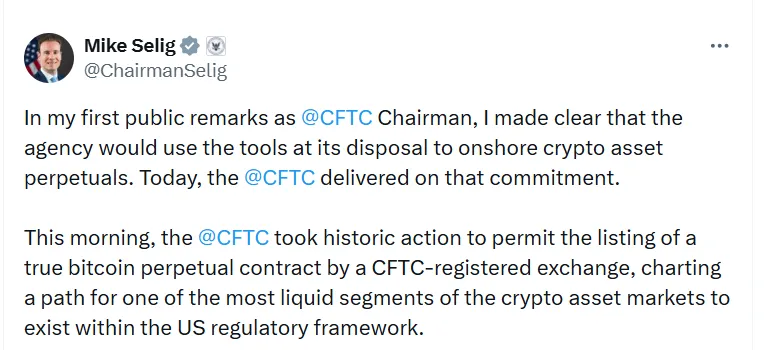
CFTC Chair Michael Selig described the approval as a major step for U.S. crypto market structure. He stated that the move supports responsible innovation while keeping customer protections within regulated markets.

Coinbase expands derivatives access for U.S. traders
Coinbase confirmed that institutional clients can now access crypto perpetuals and options through Coinbase Financial Markets. The exchange said onboarding for Prime clients started immediately after the CFTC guidance became public.
The approval allows eligible customers to use digital assets, including Bitcoin, Ether, and stablecoins, as margin collateral. The contracts will operate through Coinbase Bermuda and connect U.S. clients to global liquidity pools.
Coinbase Chief Executive Brian Armstrong stated that U.S. traders had remained excluded from a large share of global crypto markets for years. He said the latest regulatory action changes that structure.
The company’s legal chief, Paul Grewal, called the decision a major milestone for the digital asset industry. He noted that derivatives continue to represent most crypto trading activity worldwide.
Kalshi broadens its role beyond prediction markets
Kalshi has expanded rapidly beyond its prediction market business during the past year. The Bitcoin perpetual futures approval adds a new regulated derivatives segment to the company’s operations.
Chief Executive Tarek Mansour said regulated perpetual futures could improve capital allocation and risk management for American businesses. He added that the company plans to seek approval for perpetual contracts tied to more than a dozen cryptocurrencies.
The expansion arrives during ongoing legal disputes involving prediction markets. Earlier this month, Kalshi filed a federal lawsuit against the state of Minnesota over legislation targeting prediction market platforms.
The company argued that federal law gives the CFTC exclusive authority over event contracts. The dispute followed separate action from the regulator against Minnesota over the same legislation.
Kalshi has also increased policy engagement efforts through Americans for Fair Markets, an advocacy group supported by the company. The organization supports stronger know-your-customer standards, insider trading restrictions, and limits on contracts linked to violence or terrorism.
Market implications for the crypto sector
The latest approvals represent a shift in U.S. crypto policy under the current administration. President Donald Trump recently argued that earlier regulatory approaches pushed innovation and crypto perpetuals offshore.
Industry participants have viewed the CFTC approvals as an attempt to bring trading activity back under domestic oversight. The framework could reduce reliance on foreign exchanges while increasing regulatory transparency for U.S. institutions.
At the same time, perpetual futures remain highly leveraged products. Market participants have repeatedly warned that volatility can amplify losses during sharp price swings.
Several regulated exchanges introduced perpetual-style products earlier this year. However, Kalshi’s approval stands out as the first full federal sign-off for a true Bitcoin perpetual futures contract in the United States.
Conclusion
The advent of Kalshi and Coinbase approvals by the CFTC are significant milestones for the U.S. crypto derivatives market. American traders can now be regulated to access Bitcoin perpetual futures which had been previously dominated by offshore exchanges.
This ruling may affect how these leveraged crypto products are accessed by both institutional and retail investors. It also represents a broader regulatory acceptance of the growth of digital asset trading platforms in the United States.