

Key insights
- Private key compromises now drive many of the largest DeFi losses
- Liquidity shortages can reduce the financial impact of inflated token exploits
- Cross-chain infrastructure remains a recurring target for attackers
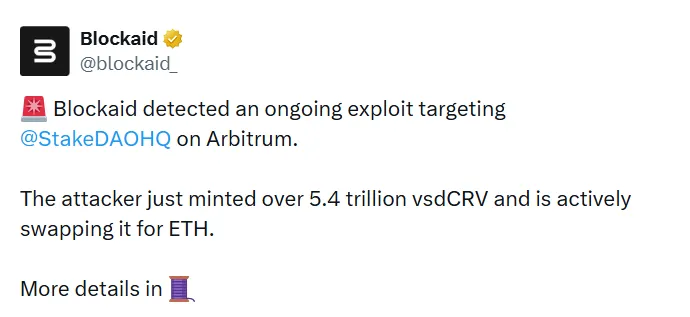
Dao platform Stake DAO suffered a major exploit on Arbitrum after attackers minted more than 5.4 trillion vsdCRV tokens through a compromised deployer key. Blockchain security firms said the attacker manipulated LayerZero cross-chain settings before swapping part of the tokens for ETH.
The incident quickly spread across the DeFi sector because the exploit involved privileged access rather than a smart contract coding flaw. Stake DAO warned users not to interact with vsdCRV while investigators tracked the attacker’s transactions across Arbitrum and Ethereum.
Compromised Key Opened Access to Token Minting
Blockchain security company Blockaid reported the exploit publicly after detecting suspicious activity linked to Stake DAO contracts. The firm said the attacker gained access to the deployer private key tied to the protocol.
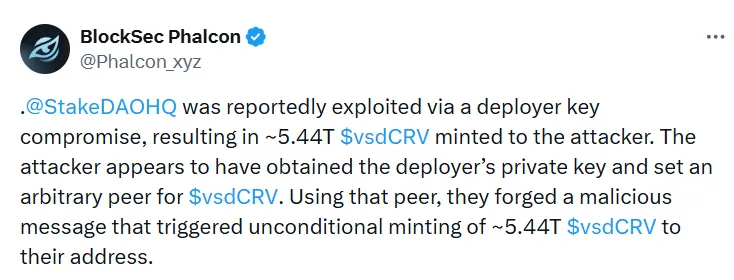
Investigators stated that the attacker reconfigured the LayerZero v2 OFT peer connected to the vsdCRV token contract. The change redirected trust away from the legitimate Ethereum adapter and toward a malicious contract controlled by the attacker.
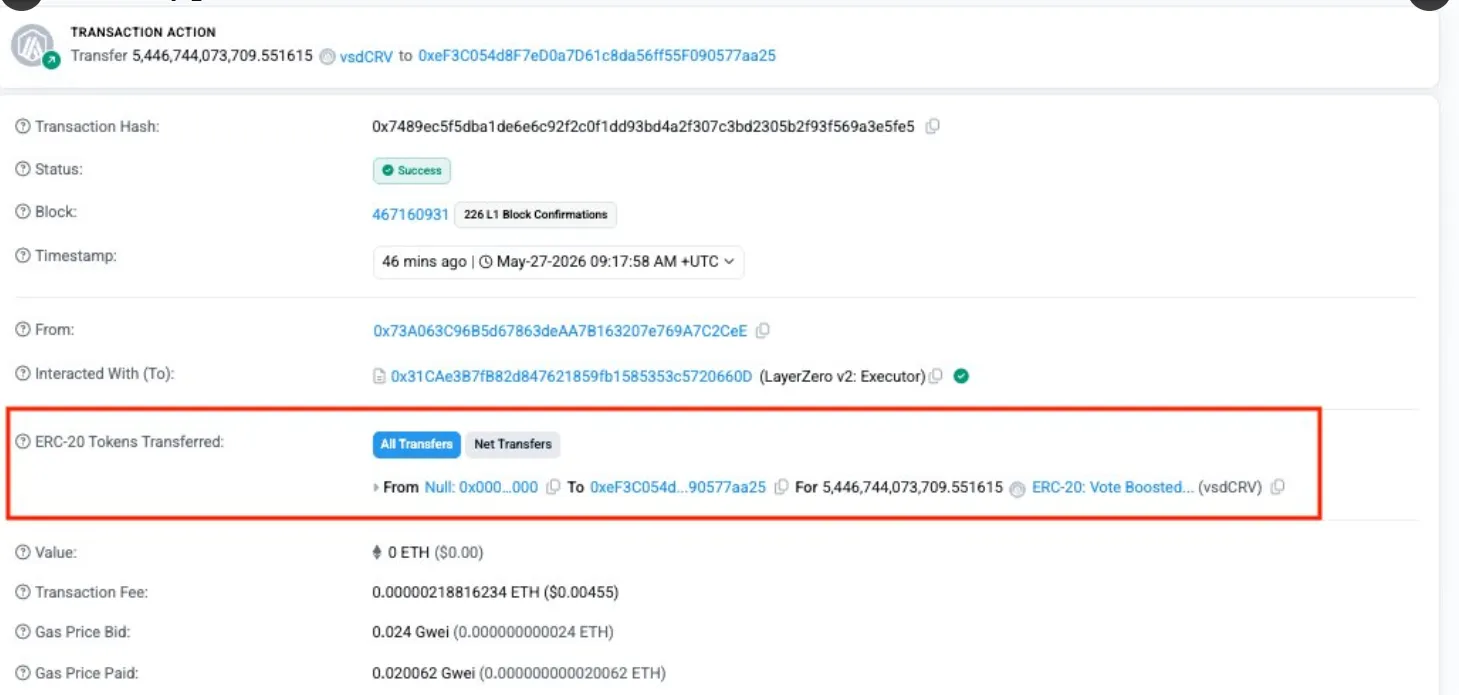
After the configuration change, the attacker allegedly sent a forged cross-chain message that triggered the minting of around 5.44 trillion vsdCRV tokens.
Security researchers from BlockSec confirmed the sequence of events. The company said the exploit appeared to rely on unauthorized deployer access and manipulated peer settings.
PeckShield also confirmed that part of the minted supply was swapped for about 43.78 ETH worth nearly $91,000 before being bridged to Ethereum.
Key developments from the exploit
- More than 5.4 trillion vsdCRV tokens were minted
- The attacker swapped part of the supply for ETH
- Funds were bridged from Arbitrum to Ethereum
- Stake DAO warned users not to interact with vsdCRV
- The exploit remained active during early investigations
The exploit carried an estimated nominal value of nearly $763 billion. However, the attacker failed to convert most of the minted supply into usable assets.
On-chain analyst EmberCN reported that vsdCRV liquidity remained extremely limited across decentralized exchanges. Pools connected to the token reportedly contained only tens of thousands of dollars in accessible liquidity.
The attacker exchanged around 16.83 million vsdCRV for approximately 43.7 ETH through Curve and KyberSwap before liquidity dried up completely.
Transaction records showed repeated swap attempts in smaller batches. The attacker moved through available liquidity until no significant exit routes remained.
This situation created a major gap between theoretical token value and actual extracted funds. There were too few trading pools for the remaining trillions of tokens to be sold.
The attack was similar to another recent one concerning the Echo Protocol. That attack resulted in large nominal gains of assets, but only small real gains, as liquidity conditions were still low.
Growing pressure on DeFi decurity models
The Stake DAO exploit is part of the increasing number of exploits attributed to private key compromise in 2026. There were a number of significant incidents in the year that were not related to coding vulnerabilities, but rather to administrative access.
In April, the Kelp DAO’s hack is estimated to have netted losses of around USD 292 million using forged cross-chain messages. A third incident with StablR was caused by a compromised multisig key.
In addition, the company had a significant setback when hackers allegedly hacked into a long-term social engineering campaign against team members and caused a major loss to the company.
The latest incident renewed concerns surrounding cross-chain infrastructure and privileged permissions in decentralized finance systems.
OpenZeppelin co-founder Manuel Aráoz recently warned that DeFi security risks were increasing. He argued that attackers now use advanced coding tools to identify vulnerabilities faster than defenders can patch them.
His remarks gained attention after April became one of the worst months for crypto exploits by incident count. Losses across multiple protocols exceeded $600 million during that period.
Cross-Chain Systems Remain a Critical Weak Point
Security firms have repeatedly identified cross-chain messaging systems as a major attack surface during 2026. Much of the recent exploits were of bridge type, peer validation systems, or administrative controls.
The Stake DAO exploit showed that even with a secure contract logic, the deployer’s credentials could be compromised and execute the smart contract with results different from what was intended. The attacker would have had enough control over the trusted settings to create forged messages.
The incident also shed light on the danger of having centralized administrative privileges on a decentralized platform.
Conclusion
The Dao exploits have been on the rise in the DeFi space, with attacks being connected to stolen credentials and cross-chain solutions. The Stake DAO incident further underscored the importance of privileged access management and bridge security in the industry.
As of this writing, Stake DAO has not released a full post mortem or recovery plan. Investigations are ongoing, and continuing with tracing of attacker activity and monitoring of affected contracts.









I got good info from your blog
thanks