

key insights
- It’s an unusual degree of transparency for Coinbase that users are openly skeptical of.
- Leadership shifts clean up blockchain infrastructure and product execution.
- Adoption will be based more on delivered products than executive statements in the future.
Coinbase Trust Crisis is a new stage in the saga that began when the Coinbase product executive, Jordan Fish, aka Cobie, came out in public and confessed that the tech giant had strayed from its crypto-native roots. His comments came only a day after he assumed responsibility for Coinbase’s trading products and the Base App, placing renewed focus on the exchange’s effort to restore confidence across its ecosystem.
Cobie made the remarks during a public discussion with crypto commentator Rune after questions emerged over how the Base App could attract on-chain users following recent community disputes. He clarified that he oversees the Base App and Coinbase trading products, while Jesse Pollak continues leading the Base blockchain.
Cobie: Coinbase Has Long Been Distant From Crypto-Native Users
KOL Rune asked Coinbase trading product lead Cobie how the Base App plans to attract onchain users after trust in the Base ecosystem was damaged. Cobie replied that he took over the Base App and Coinbase trading… pic.twitter.com/G3hw3haha5
— Wu Blockchain (@WuBlockchain) July 18, 2026
Leadership shift brings public acknowledgement of deeper issues
Cobie responded directly to criticism that Base had weakened community confidence through a series of avoidable mistakes. He acknowledged that both Coinbase and Base had lost significant trust among crypto-native users and admitted the company had operated from what he described as an “ivory tower” for too long.
His remarks marked one of the clearest public acknowledgements from a Coinbase executive that the exchange has struggled to maintain close ties with the users who helped build its early reputation.
The leadership transition followed Jesse Pollak’s decision to hand responsibility for the Base App to Cobie while focusing entirely on the Base network. Pollak confirmed the move publicly, saying the change would allow each executive to concentrate on separate priorities.
The appointment also came after Coinbase acquired Echo, the onchain fundraising platform founded by Cobie, in a $375 million deal announced in October 2025. That acquisition expanded Cobie’s role within Coinbase before his latest promotion.
Rather than promise immediate solutions, Cobie warned that rebuilding confidence would require sustained effort over many months. He said product teams must reconnect with onchain users and develop products based on direct community feedback.
Key developments
- Cobie admitted Coinbase became disconnected from crypto-native users.
- Jesse Pollak transferred leadership of the Base App while retaining control of the Base blockchain.
- Coinbase plans to strengthen communication between product teams and on-chain communities.
Product strategy faces increasing pressure
The Coinbase Trust Crisis extends beyond public perception and reflects broader changes in Base’s product strategy. Pollak recently stepped away from the Base App after its push into social products failed to generate the expected growth.
Coinbase has since shifted greater attention toward trading, payments and artificial intelligence products. Chief Executive Brian Armstrong also acknowledged earlier that Base had made mistakes surrounding content coistrategyns, prompting another strategic reset.
Operational challenges have added further pressure. Base experienced a nearly two-hour interruption in block production during June after an invalid block triggered a consensus issue. Later, Pollak said it was “unacceptable” for financial activity to be affected by the outage, which is unacceptable for protecting the assets of users.
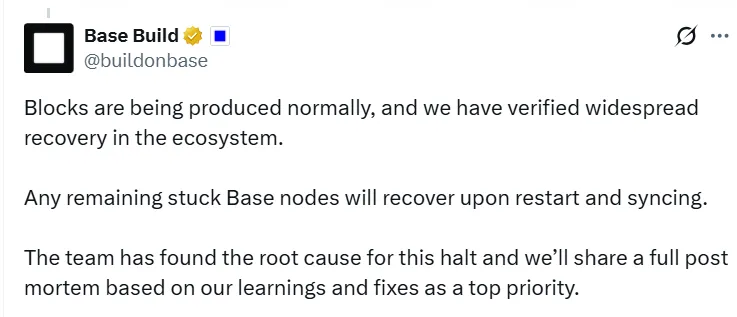
Base still managed to grow its technology capabilities, despite the challenges. After the Beryl upgrade, the network launched the B20 token standard, which allows developers to create stablecoins and tokenized assets that come with issuer controls.
| Development | Significance |
|---|
| Cobie assumes Base App leadership | Focus shifts toward user experience and trading products |
| Pollak leads Base blockchain | Separates network development from consumer products |
| June network outage | Raised concerns over operational reliability |
| B20 token standard launch | Supports tokenized assets and stablecoin issuance |
Market confidence now depends on execution
The Coinbase Trust Crisis comes in a time of growing competition on the blockchain networks. Rather than picking one or the other, projects are increasingly looking to have both institutional adoption and active crypto-native communities.
Cobie believed the only viable way forward is by listening to developers and on-chain users. He did not give any roadmap or product timeline. In contrast, he stressed the need for constant interaction and increased collaboration between builders and users.
Rune agreed that Base still possesses competitive infrastructure among leading layer-two networks. However, he argued the ecosystem must place users at the center of future decisions if it hopes to regain lost momentum.
The broader crypto market also continues shifting toward tokenized assets, institutional settlements and real-world asset infrastructure. That trend increases pressure on Coinbase to balance regulatory compliance with the needs of permissionless blockchain users.
Conclusion
The Coinbase Trust Crisis now stands as both a product challenge and a credibility test. Cobie’s frank assessment acknowledged problems that many users had been complaining about for months, while managing expectations that it would take time to recover.
Whether Coinbase Trust Crisis eases will depend less on public messaging and more on future product releases. The coming months will show whether Coinbase can rebuild lasting relationships with crypto-native users while preserving its position as one of the industry’s largest regulated platforms.