
Key Insights
- Four major U.S. law enforcement groups warned that Section 604 could weaken financial crime oversight.
- A Catholic anti-trafficking coalition urged Senate leaders to review the bill before further progress.
- Senate negotiations remain stalled, creating fresh uncertainty for the legislation’s future.
Clarity Act negotiations have entered a more difficult phase after major law enforcement organizations and anti-trafficking advocates challenged a key provision of the legislation. The renewed opposition comes ahead of a House hearing scheduled for July 17 and adds pressure on lawmakers seeking to establish a regulatory framework for digital assets in the United States.
The new attack is against Section 604, which contains the Blockchain Regulatory Certainty Act. Some opponents say the law would lead to regulatory loopholes and make it more difficult to trace illegal money-lowering operations associated with cryptocurrencies. Supporters, however, maintain that the provision protects software developers rather than bad actors.
New Coalition Expands Opposition to Section 604
The debate intensified on Tuesday when four national law enforcement organizations sent a letter to Acting Attorney General Todd Blanche and White House digital assets adviser Patrick Witt.
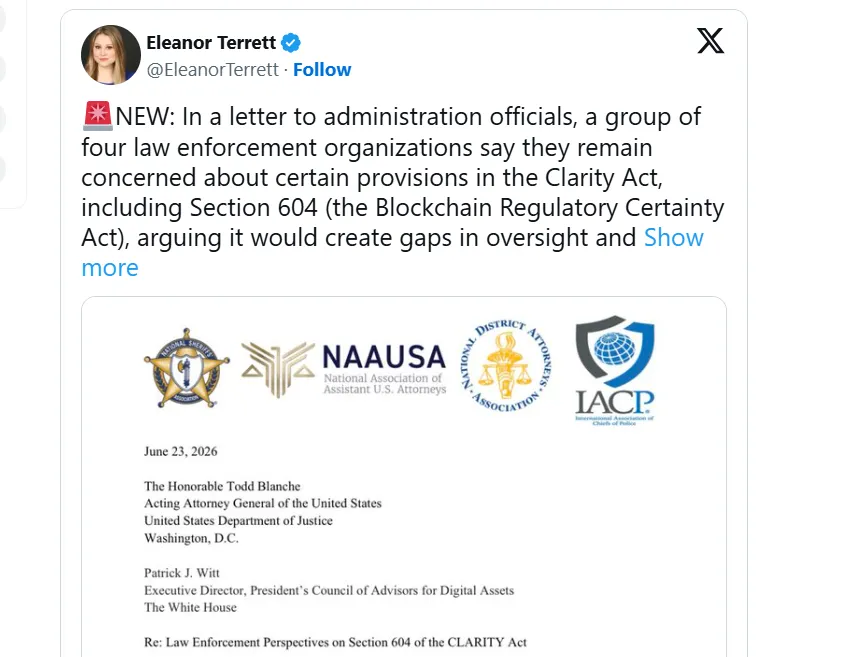
The signatories included the National District Attorneys Association, the National Association of Assistant United States Attorneys, the International Association of Chiefs of Police, and the National Sheriffs’ Association. Together, the groups represent more than 70,000 law enforcement professionals across the country.
The organizations argued that Section 604 could weaken oversight mechanisms used to track financial crime. They also warned that the bill may create exemptions that reduce Know Your Customer and Anti-Money Laundering obligations for some participants in the digital asset sector.
In their letter, the groups stated that regulatory clarity should not come at the expense of accountability, transparency, public safety, or victim protection.
Section 604 seeks to ensure that non-controlling developers, open-source contributors, self-custody software providers, and certain decentralized finance infrastructure operators are not automatically treated as money transmitters.
Supporters say the language protects innovation and prevents software creators from facing regulatory burdens intended for financial intermediaries.
Organizations Raising Concerns
| Group | Concern |
|---|---|
| National District Attorneys Association | Oversight and enforcement gaps |
| National Association of Assistant United States Attorneys | Reduced AML safeguards |
| International Association of Chiefs of Police | Challenges in investigations |
| National Sheriffs’ Association | Potential accountability risks |
| Alliance to End Human Trafficking | Risks tied to trafficking and illicit finance |
Senate negotiations encounter new obstacles
The controversy arrives as Senate discussions over the Clarity Act continue to face setbacks.
Recent negotiations involving Senators Cynthia Lummis, Kirsten Gillibrand, Ruben Gallego, and Bernie Moreno ended without an agreement. The report said the disputes concerned ethics provisions and Section 604.
Republicans and White House officials withdrew a proposal that would have allowed state attorneys general to challenge ethics enforcement related to President Donald Trump’s crypto interests. Democrats later rejected an alternative proposal that would have concentrated enforcement authority with the U.S. Attorney General.
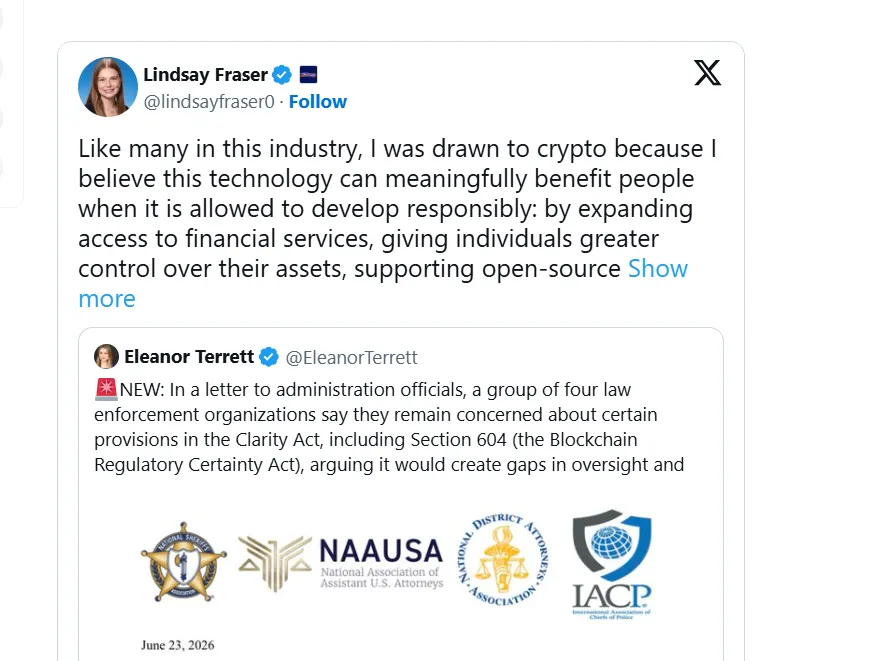
Meanwhile, Senator Lummis defended the legislation and its treatment of software developers.
According to Lummis, the bill makes clear that writing software code does not constitute money transmission. She argued that the distinction could shape regulatory certainty for blockchain developers and innovators for years to come.
Notably among the those who did not sign the latest letter were the National Fraternal Order of Police and the National Association of Police Organizations, which were part of the previous discussions. Their absence suggests that views among law enforcement groups remain divided.
Wider debate over crypto oversight intensifies
Opposition to the Clarity Act expanded further when the Alliance to End Human Trafficking sent a separate letter to Senate leaders John Thune and Charles Schumer.
The Catholic advocacy network urged lawmakers to reassess Section 604 before advancing the bill. The organization warned that broad exemptions and regulatory ambiguity could make it more difficult to monitor activity linked to human trafficking, organized crime, child exploitation, sanctions evasion, and money laundering.
Law enforcement organizations echoed similar concerns. Their letter stated that there are no safeguards “typical of the traditional financial institutions” in the bill.
The groups also asserted that some provisions may allow mixers, tumblers and some decentralized finance services to be free from regulation even though they can facilitate the laundering of illicit funds.
Those who back the measure do not share that view. They say the provision does not eliminate existing anti-money laundering authorities and only retains liability for anyone who has “actual knowledge” of criminal proceeds.
The implications of this for crypto policy
The Clarity Act is now being reviewed much more widely than in the past when it was only considered in the context of the regulation debate.
The heart of the conflict between industry advocates and enforcement bodies is Section 604. Section 604 is the spark that has ignited the debate between industry and enforcement.
Additional opposition could complicate the bill’s path through the Senate despite industry support.
Conclusion
The Clarity Act was designed to provide long-sought regulatory certainty for the U.S. digital asset industry. However, growing opposition from law enforcement organizations and anti-trafficking advocates has turned Section 604 into a major flashpoint. The outcome of the debate could shape how the U.S. balances innovation, compliance and financial crime enforcement in the crypto space as lawmakers prepare for hearings and renewed negotiations.