
Key Insights:
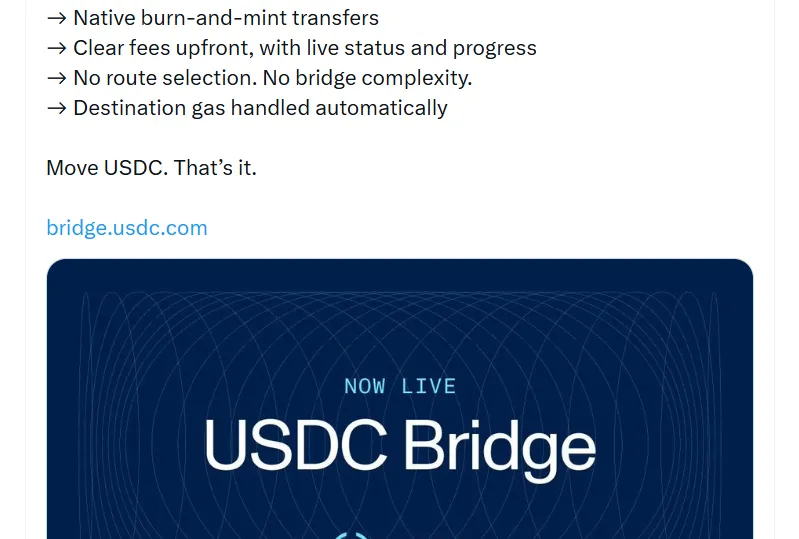
- USDC Bridge will simplify and introduce a more transparent method to move USDC between blockchains.
- Burn-and-mint system does away with the use of wrapped or synthetic tokens.
- The legal issues can affect the regulatory and operational perspectives of Circle.
Circle has implemented its native USDC Bridge solution making USDC enter a new usability phase. The new interface is based on the Cross-Chain Transfer Protocol developed by Circle, which enhances the ability of users to transfer USDC between networks. The system is set to eliminate technical friction and focus on both seasoned traders and new users trying to navigate blockchain ecosystems.
The launch suggests bigger patterns in the crypto ecosystem to integrate and simplify user experiences. USDC Bridge also offers a better user experience reducing the confusion that is related to the traditional bridging tools. These solutions will gain relevancy in scaling up the use of blockchain throughout the globe as more individuals embrace them.
The native burn and mint model improves transparency.
USDC Bridge relies on a burn-and-mint mechanism for transferring tokens in their native form. USDC is burned on the source and minted on the destination chain instead of being based on a wrapped or synthetic asset. This method avoids the risks associated with wrapped assets and still has the one-to-one value consistency.
Circle pointed out that the model enhances predictability and transparency among the users. Each of the transactions is carried out in accordance with a specific procedure, which simplifies the process of tracking the movements and checking the results. USDC Bridge will simplify the process of cross-chain transfers in order to standardize it.
Automated fee display enhances user experience.
A simplified user interface and automated processes are one of the most remarkable attributes of the USDC Bridge. Gas charges are processed in a smooth manner and the user can view the actual cost and confirm transactions. This does away with uncertainty that is usually a deterring factor to cross-chain transfers.
Preliminary testing suggested that converting $20 of Ethereum to Optimism and transferring it to USDC would cost around $0.20. Fees can however differ based on network conditions and transaction setups. Instant updates on the progress also increase the level of user confidence in the transfer process.
USDC increases its coverage on a variety of blockchains.
USDC Bridge is now compatible with transfers in at least 17 Ethereum Virtual Machine compatible networks. They are Ethereum, Avalanche, Arbitrum, Base, Optimism, Polygon, Monad, Sonic, and World Network. This wide interoperability enables the users to transfer USDC across key blockchain environments.
In the meantime, the CCTP infrastructure of Circle is not limited to EVM chains, but covers networks such as Solana, Sui, and Aptos. The recent version of USDC Bridge is however more oriented towards EVM compatible environments. It has the potential to be extended to a wider range of users in the future as the interoperability requirements become increasingly pressing.
Legal challenges emerge amid platform expansion
Circle is under legal investigation related to its cross-chain activities, despite the technological advancements. In a class action suit, the company is accused of not freezing some $230 million in USDC that was associated with an exploit. It is said that the case was related to funds sent via CCTP due to a protocol violation in early March.
The case involves over 100 plaintiffs who claim damages, and the damages will be decided at trial. Legal counselors suggest that Circle can have been a cause of negligence by not taking action. This creation brings about some degree of uncertainty because the USDC implementation is only growing.
Greater effect on crypto adoption and interoperability.
USDC Bridge is an important milestone to a more interconnected blockchain ecosystem. It simplifies cross-chain interactions and makes them more usable, as the challenges that have existed since the beginning of cross-chain interactions are resolved. The simplified bridging solutions may lead to a greater involvement, especially in users who are new to decentralized finance.
Traditionally, cross-chain bridges have been an impediment with complex interfaces and ambiguous fee models. Circle believes that these barriers can be removed with USDC Bridge and a new usability level can be developed. The competition grows and comparable innovations are likely to be seen in the crypto infrastructure field.






Thanks for the good writeup. It in fact used to be a enjoyment account it. Glance advanced to far delivered agreeable from you! However, how can we keep up a correspondence?