

- BTC level around $59,000 is very important since the traders pay attention to leveraged trades.
- The strategy claimed that it has extra funds worth $48 billion compared to liabilities and continues holding Bitcoin holdings.
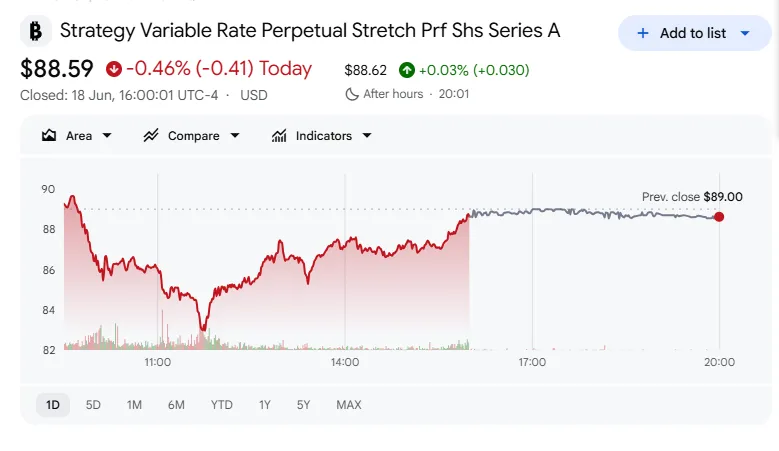
- STRC dropped to all-time lows amid arguments of its financing model from supporters and critics.
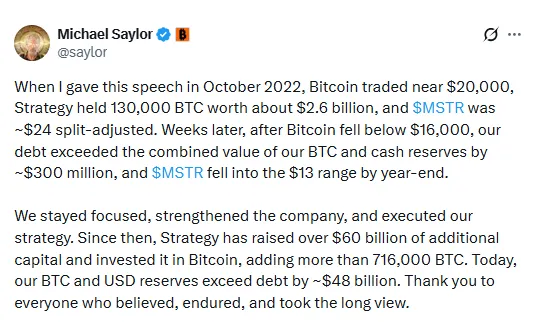
Bitcoin remains under pressure near a key support level as renewed scrutiny surrounds Strategy’s long-running approach to accumulating the cryptocurrency. The discussion intensified after Strategy co-founder Michael Saylor compared the company’s current financial position with conditions experienced during the 2022 market downturn.
The developments have brought attention to both Strategy’s capital-raising model and the broader market structure facing Bitcoin as leveraged positions continue to concentrate around critical price levels.
Saylor stated that Strategy’s Bitcoin and cash reserves currently exceed the company’s debt by approximately $48 billion. He also said the company has raised more than $60 billion in additional capital since 2022 and invested those funds into Bitcoin.
Source: Michael Saylor
His comments came as critics questioned the company’s continued issuance of MSTR and STRC securities to fund additional Bitcoin purchases during a period of market weakness.
Bitcoin Drawdown Comparison Highlights Strategy’s Position
In outlining the company’s history, Saylor pointed to conditions that existed during the 2022 crypto market decline. According to his statement, Strategy held approximately 130,000 Bitcoin at the time, valued at around $2.6 billion when Bitcoin traded near $20,000.
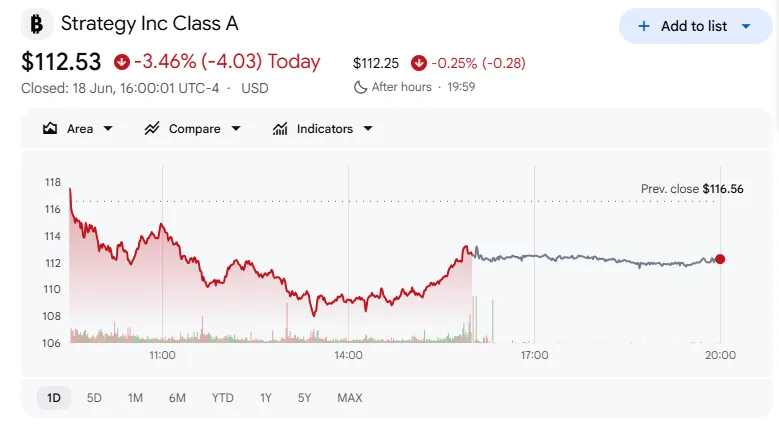
He noted that the company’s debt exceeded the combined value of its Bitcoin holdings and cash reserves by roughly $300 million during that period. Bitcoin later fell below $16,000, while MSTR stock declined into the $13 range on a split-adjusted basis by the end of the year.
 Source: Google Finance
Despite those conditions, Strategy did not sell any of its Bitcoin holdings. Saylor contrasted that period with the company’s current position, which he said includes reserves exceeding debt and additional capital raised since 2022.
The comments arrived as debate continues over the company’s financing structure and its reliance on capital markets to expand Bitcoin holdings.
Criticism Emerges Following STRC Decline
Attention has also focused on Strategy’s preferred security, STRC, which recently fell to approximately $83, marking a record low and trading significantly below its $100 per value.
 Source: Google Finance
The decline prompted criticism from Bitcoin skeptic Peter Schiff, who suggested that investors could pursue legal action against Strategy and Saylor. Schiff also argued that Saylor may have violated Securities and Exchange Commission marketing rules through the promotion of the STRC security.
The criticism follows growing discussion about the sustainability of Strategy’s Bitcoin acquisition strategy, particularly during periods when both Bitcoin and company-linked securities experience price weakness.
Others publicly disputed those criticisms. David Gokhshtein stated that Bitcoin’s current market value is not dependent on Saylor and rejected comparisons between Strategy and the Terra Luna collapse. The comments followed after Ali Martinez, a crypto analyst, pointed out some similarities between STRC and LUNA and warned of possible dangers.
However, Bitcoin maximalist Samson Mow made a case for STRC, saying it was an investment vehicle that was created under the assumption of rising prices of Bitcoin.
Bitcoin Faces Key Technical Levels
While discussion around Strategy continued, Bitcoin remained focused on important technical support levels following a failed recovery attempt.
BTC has failed to close the daily fair value gap that exists between $67,500 and $70,500 due to buyers losing control of the market. BTC price has been facing resistance at both the 50 EMA and 100 EMA.
The rejection pushed Bitcoin below an ascending channel pattern and confirmed what analysts described as a bearish break of structure on the four-hour chart.
As a result, traders are monitoring an internal liquidity support zone near $60,700. Below that level, the yearly low near $59,000 has become the next major area of focus.
Liquidation Data Concentrates Around $59,000
Market data shows a substantial amount of leveraged positioning near Bitcoin’s yearly low.
Approximately $4 billion in cumulative leveraged long positions are concentrated around the $59,000 level. Analysts noted that a move into this area could trigger forced liquidations and increase selling activity as leveraged traders are removed from the market.
Beyond that support zone, another major concentration of leveraged positions exists near $68,000. Data indicates that more than $4.75 billion in cumulative positions are clustered around that level, making it a notable liquidity area on the upside.
The distribution of leveraged positions has increased attention on Bitcoin’s next directional move, particularly as price continues to trade between major liquidity zones.
Momentum Indicators Approach Oversold Territory
Additional technical indicators show momentum weakening as Bitcoin moves closer to yearly lows.
RSI is on the verge of becoming oversold. Observers have observed that the fall to the $59,000 range can drive the RSI below 30, which is generally considered as a zone where markets become extremely sold off.
According to Crypto analyst Killa, Bitcoin may drop down to the liquidity zone below $60,000 without getting into the most well-known level of liquidations. This is because previously price actions have been witnessed before liquidity zones got completely cleared out.








excellent post.Never knew this, thankyou for letting me know.