Key Insights:
- The Bitcoin developers focus on securing the ownership of Satoshi wallets even with the increasing security issues of quantum computing.
- The 22,000 distributed wallets by Satoshi means that the chances of a large-scale breach attempt that happens simultaneously is reduced.
- To maintain the central idea of decentralized property rights that Bitcoin is all about, markets might allow a lot of volatility to pass through.
Bitcoin has once again been thrown into a very critical argument on how its first coins should be handled.
The increasing interest in quantum computing is prompting a new wave of debate over existing laws on the security and ownership of wallets.
The developers and crypto enthusiasts keep saying that the holdings of Satoshi Nakamoto cannot be intermedled despite the risks. This stance is part of a larger initiative to defend the original idea of Bitcoin of decentralized and neutral ownership of financial assets.
Developers defend property rights in Bitcoin against change.
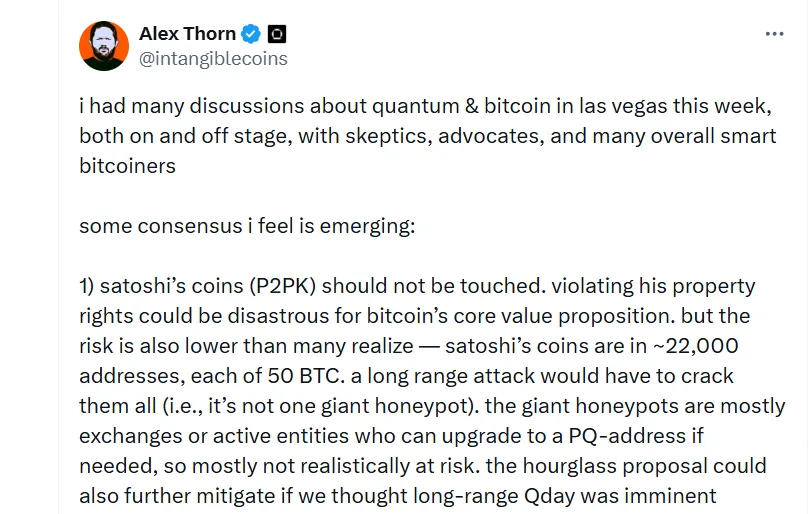
Alex Thorn, the leader of firmwide research at Galaxy Digital, recently gave an overview of industry points of view. He verified that there is a large number of participants who are strongly opposed to any action to interfere with the original Bitcoin holdings in the possession of Satoshi.
Thorn underlined that the problem is not limited to technical vulnerability and reaches the fundamental ownership tenets of Bitcoin. Any modification of these untouched wallets might diminish the trust in the system and reduce its credibility as neutral money.
He elaborated that property rights will continue to be the core part of the long-term value proposition of Bitcoin and user trust. Breaking those principles might cause confusion and break the perceived fairness of the network of rules.
Quantum computing threat sparks wallet security concerns
A major factor in the debate has been the fear of the advancement in the quantum computing capabilities Early Bitcoin addresses, especially Pay-to-Public-Key addresses, can be vulnerable in future cryptographic breakthroughs.
The older forms reveal the public keys in a different way and hence may be easier targets in the event that quantum systems are developed. Thorn pointed out, though, that the perceived danger is not as great as many might assume in the wider crypto society.
The estimated holdings that Satoshi has are divided into about 22,000 addresses, each with approximately 50 BTC. Such disjointed design makes it extremely difficult to organize any kind of attack to crack all related wallets at once.
Market impact and risk of potential wallet movement.
One of the biggest issues is the fact that the coins of Satoshi can be transferred or accessed at any time. This would unleash a wave of market panic, as these assets have not been used since the start of Bitcoin.
Although there is this risk, Thorn has pointed out that the Bitcoin markets have in the past accommodated big scale sell-offs successfully. He cited examples of more than 1 million BTC going into markets with no irreparably damaging structural consequences.
In his estimation, a lot of volatility would be acceptable to many investors to assure the integrity of Bitcoin. Even a hypothetical 50% fall in prices can still be thought of as acceptable in case property rights are safeguarded.
This view highlights a firm ideological commitment in the community towards a concept of decentralization as opposed to stability in the short term. Preservation of trust in the rules of Bitcoin seems to be out of proportion with the worry over temporary disruptions in markets or liquidity shocks.
Future Outlook For Bitcoin And Security Innovation
Although there is still a high level of resistance to the idea of changing the wallets of Satoshi, developers still do not overlook the emerging technological risks. Current studies on post-quantum cryptography are also increasingly finding favor among Bitcoin developers.
The active consumers like exchange, custodians and institutions still have a chance to enhance the security of wallets proactively. They are able to transfer money into newer forms of addresses that can resist the possible quantum-based attacks in future.
Dormant wallets are however a special challenge in that their owners might never go back to update the security measures. This difference has already turned into one of the key aspects in the development of the further debate concerning risk management strategies.
The wider agreement is that innovation should be oriented towards the future solutions without repealing the past ownership regulations. The strength of Bitcoin can eventually rest on the ability to adjust to changes in technology and remain devoted to the principles that form the foundation of Bitcoin.
FAQs
1. What are the significance of the Bitcoin wallets of Satoshi?
They are early mined coins and reflect the early ownership principles of Bitcoin and the spirit of decentralization.
2. What is the risk of quantum computing in Bitcoin?
It is possible that quantum computers will be able to crack older cryptographic techniques employed in the early Bitcoin wallet designs.
3. Do you think Satoshi can easily be hacked in terms of his wallets?
Experts reckon that the risk is minimal as the risk is distributed in 22,000 addresses and the technical complexity involved.
4. Why wouldn’t developers prefer to change these wallets?
Any changes might infringe property rights and undermine confidence in the decentralized system rules of Bitcoin.
5. What is Bitcoin doing to prepare against future dangers?
The developers are exploring post-quantum cryptography and are promoting upgrades to more secure and up-to-date wallet formats.