

The cryptocurrency market is fast, but not everyone is willing to observe the chart for the whole day. Swing trading is a widely used technique among cryptocurrency traders. It allows for earning profits from minor fluctuations in price that occur for a couple of days or weeks.
Swing traders do not react to each price fluctuation in cryptocurrency exchanges, but rather, they look for ways to earn more profit through trends. As for day trading, most trades are closed within hours, and sometimes even minutes. Unlike day trading, swing trading involves holding trades for longer and focuses on medium-term trends.
Swing trading strategies are mostly applied in the cryptocurrency trading environment for the largest cryptocurrencies, including Bitcoin, Ethereum, and Solana. It is possible because of higher liquidity and stable volumes for trading those cryptocurrencies.
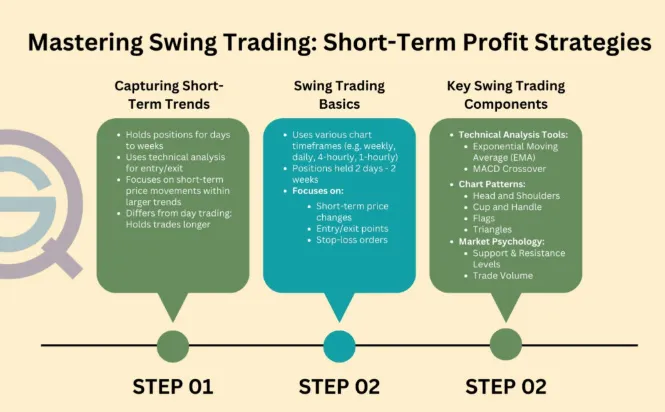
Source: Quantified Strategies
High volatility of cryptocurrency markets forces swing traders to apply predetermined risk management techniques.
What Is Swing Trading In Crypto
Cryptocurrency swing trading involves identifying trends which are believed to last for several days before reversing. This involves joining in on the trend at an early stage while still gaining from momentum. This means that if a breakout occurs at a particular resistance point and then higher highs and lower lows are formed, one could stay in the trade up until the momentum runs dry.
In most cases, swing trading is conducted using 4-hour and daily charts as opposed to intraday charts favored by day traders. Many swing traders also make use of alerts or auto-execution programs in order to perform trades even when not present in front of the computer.
Swing Trading vs Day Trading
There is a major distinction between swing trading and day trading in terms of the time involved and execution rates. While day traders execute trades that may run multiple times on the same day, swing traders hold their positions for longer periods.
Some of the key distinctions between the two can be seen from the following table below:
| Criteria | Swing Trading | Day Trading |
| Duration of Trade | Several days to weeks | Minutes to hours |
| Chart Used | 4-hour and daily charts | 1-minute to 30-minute charts |
| Screening Time | Moderate | High |
| Number of Trades | Lower | More frequent |
| Intensity of Work | Relatively lower | Intense |
The longer time frame used in swing trading provides traders more time for analysis and controlling their exposure. Nevertheless, unexpected changes can happen due to the overnight price movements or even weekend activity.
Common Swing Trading Crypto Trading Strategies
A number of strategies are known as common swing trading crypto strategies.
Trend Following
A strategy that follows the existing market trends. Traders check if an asset keeps rising above the previous high prices if the trend is up, and drops below the previous low if the trend is down. In Bitcoin markets, trending setups are commonly employed on breakout formations above resistance areas and volumes increasing.
Support and Resistance Bounces
The concepts of support and resistance areas continue to be fundamental elements for most swing trading strategies. This includes looking at the reaction of price action on old support areas and rejection of resistances. For instance, when Solana bounces off a past support level with momentum increasing, then traders can take long positions towards the next resistance zone.
Crossovers of Moving Averages
Crossovers of moving averages can be used to detect signs of trend reversal. A crossover between a short-term moving average and a long-term moving average is an indication of increased momentum. Many traders use combinations such as the 9-day exponential moving average crossing above the 20-day exponential moving average as part of trade confirmation systems.
Breakout Trading
Breakout trading focuses on assets leaving consolidation ranges with increased volume. In cases where cryptos range for a prolonged period of time before breaking resistance, the move tends to indicate the beginning of an overall trend.
Popular Tools Used in Crypto Swing Trading
Swing traders normally use tools such as charting platforms, exchange liquidity, technical analysis tools, and news trackers.
Charting software can be found on TradingView, and on these software platforms, traders keep an eye on price action and indicators on different time frames. Another important factor in which traders show preference is higher liquidity because there is less slippage for large cap stocks.
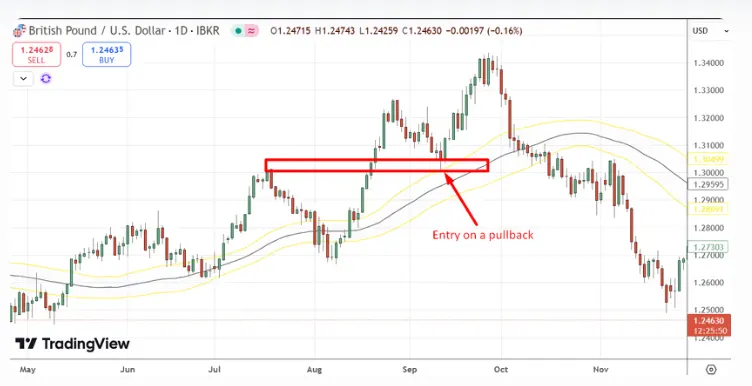
Source: Funding Pips
Below is a list of some of the tools that swing traders make use of:
| Category of Tool | Purpose |
| Charting Platforms | Trend analysis |
| Technical Indicators | Momentum detection |
| Stop-Loss Orders | Risk management |
| Price Alerts | Market tracking |
| News Monitoring | News tracking |
Risk Management in Swing Trading
Risk management is an integral component of most swing trading strategies. Traders typically employ stop-loss orders in their target risk to reward ratios.
Even though it is not as stressful as day trading, swing trading cryptocurrency is still quite risky. The markets for cryptocurrencies tend to turn around suddenly after major economic announcements.
Overnight trades or trades over the weekend can also increase risk due to the element of surprise volatility. Moreover, emotions continue to affect decisions, especially when prices are strongly retracted or consolidated.
Conclusion
Swing trading cryptocurrency is still quite popular among traders looking to participate in medium-term price movements without having to follow them at lower timeframes.
Frequently Asked Questions
Is swing trading cryptocurrency good for beginners?
Swing trading is usually regarded as being easier for newbies since trades take longer to evolve as compared to scalping or day trading.
Which charts do swing traders use?
Swing traders utilize mostly the 4-hour charts and daily charts when analyzing trends.
What kinds of indicators do they employ?
Among others, some indicators used by swing traders are RSI, MACD, moving average, Bollinger Bands, and volume indicators.
How risky is it to trade cryptocurrencies?
Yes, it is highly risky as volatility exists in the crypto market too, with trend reversals that can lead to huge losses even in a favorable trend condition.