Poisoning attacks on crypto wallet addresses have become quite prevalent in recent times in blockchain systems, owing to the ability of the scamsters to take advantage of the fact that users copy their wallet addresses when transferring digital assets. The method involves using spoofed wallet addresses that look similar to genuine ones.
Moreover, no hacking is involved in such an attack. Instead, scammers manipulate transaction behavior by placing visually similar addresses into a victim’s transaction history. The method has appeared across major blockchain ecosystems, including Bitcoin, Ethereum, BNB Chain, Polygon, and Solana.
As self-custody wallets and decentralized finance activity continue expanding, more users are manually handling blockchain transfers.
How Do Crypto Address Poisoning Attacks Occur?
Crypto address poisoning attacks generally start with the monitoring of publicly accessible wallet addresses to determine the addresses that are commonly used by the target entity.
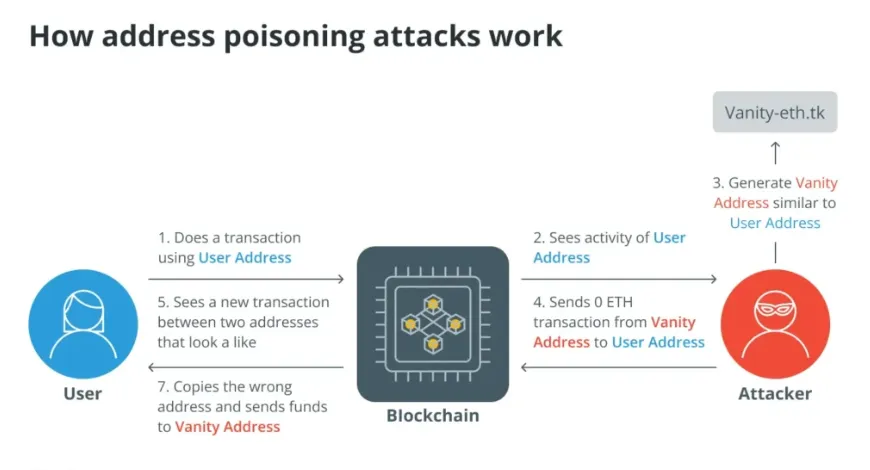
Source: Klever
Afterward, attackers will employ automated tools to develop vanity wallet addresses that would be almost similar in appearance to the beginning and ending of the actual addresses.
Wallet addresses for blockchain have alphanumeric strings, which make them hard to remember. It is because of this that people only check the first few characters and those at the end when verifying an address before sending funds.
Once the malicious wallet address is created, the attacker sends some cryptocurrency, valueless tokens, or zero transactions to the wallet belonging to the victim. This will result in those transactions being reflected on the recent transaction page of the wallet, along with the normal transactions.
The entire strategy is developed to ensure that the malicious wallet address becomes a part of the transaction history of the victim’s wallet. Once the payment is made, the funds are irreversibly sent because blockchain transactions are not cancellable.
The Reasons Behind the Persistence of These Wallet Attacks
Attacks targeting crypto addresses are highly dependent on user actions rather than on any weakness in the underlying technology. The wallet user interface usually displays shortened wallet addresses, showing only the first few characters at the start and end.
These are some behaviors that make one susceptible to the wallet scams:
- Copying wallet addresses from transaction histories
- Checking only the first characters of wallets
- Continuing to use the same wallets many times
- Making quick transactions when the markets are volatile
- Using mobile wallets with less display of wallet addresses
It has been observed that frequent exposure to such poisoned addresses can result in familiarity with them. As soon as the poisoned address shows up multiple times during transactions, the user starts believing that the address pertains to the same wallet or recipient from which they had received something earlier.
Real World Examples Demonstrate the Dangers
In one example reported in May 2024, a crypto whale mistakenly sent nearly $68 million in wrapped Bitcoin to a poisoned wallet address on Ethereum. In this case, the attacker was said to create a fake wallet address with identical initial characters to the previous wallet of the target.
After receiving the funds, the attacker moved the assets across multiple cryptocurrency wallets. Several days later, most of the assets were reportedly returned following negotiations, although reports stated that the attacker retained several million dollars in proceeds from price appreciation during the holding period.
Blockchain investigators connected the operation to a broader campaign involving tens of thousands of fake wallet addresses targeting high-value crypto users.
Observers noted that some of the victims were experienced traders with substantial wallet balances. Security companies and blockchain analytics firms have noted that crypto address poisoning attacks rise when the decentralized finance system is highly active and the number of transactions on Ethereum is high.
How Users Can Minimize the Threat
Security experts have provided several ways to minimize the risk of becoming a victim of crypto address-poisoning attacks. The most frequently recommended practice is to check the full wallet address before making a blockchain transaction.
Certain cryptocurrency users also conduct test transactions before moving large sums of money. This makes it possible for the user to verify the correct destination address before sending their cryptocurrencies.
This function is provided by companies like Ledger and Trezor through which they show the user their whole wallet address on an external screen. Other suggested protective measures include increased transparency into addresses, alerts when wallet strings appear similar, and methods to detect zero-value transactions that are part of an address-poisoning scheme.
Conclusion
Crypto address poisoning is a growing scam method targeting wallet users by exploiting transaction behavior rather than wallet security flaws. With the growing number of blockchain operations through self-custodial wallets and decentralized financial applications, security experts keep stressing transaction validation as one of the key measures for preventing unintentional transactions in connection with cryptocurrency address poisoning.
FAQ
Is it possible for crypto poisoning to steal private keys?
No. The scheme doesn’t involve theft of private keys nor accessing the victim’s wallet.
Are wallets on Bitcoin and Ethereum at risk?
Yes. Cases of cryptocurrency poisoning have been reported on Bitcoin, Ethereum, BNB Chain, Polygon, Solana, and various other blockchain networks.
Can poisoned transactions be rolled back?
No. Poisoned blockchain transactions are not reversible after they have been confirmed, unless the receiver chooses to refund the transaction.
Why do scammers make the same wallet addresses?
Scammers generate wallet addresses that resemble other wallet addresses in order to exploit the victims’ practice of depending only on certain characters while checking the destination address.