

Key Insights:
- The breach was not through direct entry into the system, but through the use of the authorization.
- The combination of identities and bitcoin history only exacerbates privacy and security concerns.
- This incident further reinforces the argument for data minimization and zero-knowledge verification.
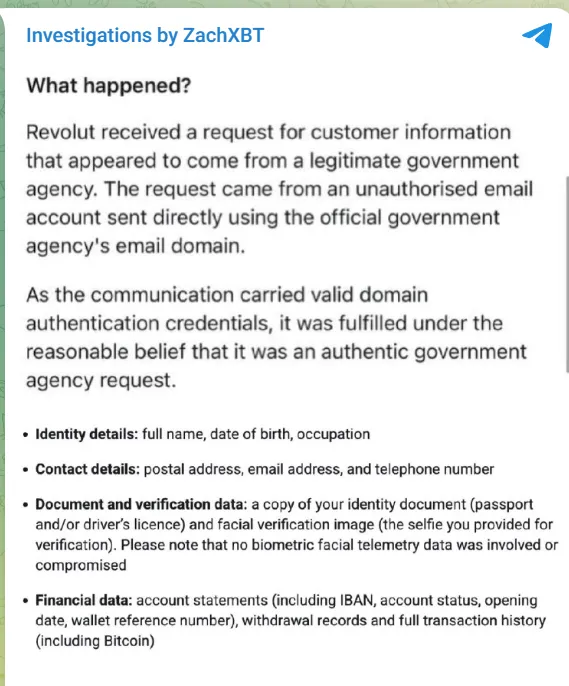
Revolut exposed sensitive customer information after responding to a fraudulent government request that passed its email authentication checks. The disclosure included identity documents, addresses, verification selfies, account records and Bitcoin transaction histories, raising fresh concerns about how financial firms verify official data demands.
A legitimate domain concealed an unauthorized sender
Revolut said the request came from an unauthorized email account operating within an official government agency’s domain. The message also carried valid domain authentication credentials, which made the request appear genuine to its internal process.
The company thus acted upon the request, assuming that it was from a government official. It later discovered that the request was informed affected customers and regulators.
The notice does not name the government agency involved. Say how the unauthorized sender got access, to its email systems. It also does not give a confirmed date for when the request happened or when the disclosure took place.
However, the available notice does not confirm either the number of affected customers or their financial profiles.
Customer records contained extensive financial details
The information potentially disclosed went well beyond basic contact information. According to the notice the records had names, dates of birth, jobs, postal addresses, email addresses and phone numbers. The disclosure also covered copies of passports or driving licences and selfies submitted during identity verification. Revolut said biometric facial telemetry data did not form part of the exposed information.
Financial records created a separate concern for crypto users. The disclosed material included IBANs, account statements, withdrawal records and full transaction histories.
The statements also contained Bitcoin wallet reference numbers. That combination could connect identifiable individuals with their cryptocurrency activity, although the notice does not establish that every affected customer had every listed record.
There is also no indication that private wallet keys, passwords or complete payment card details were disclosed. Likewise, the available information provides no evidence that attackers entered Revolut systems or withdrew customer funds.
Bitcoin records create a wider privacy risk
The incident highlights a distinct problem for cryptocurrency users because blockchain activity can remain publicly visible. Financial institutions can connect that activity with information that users normally keep separate from their on-chain identities.
That creates several potential risks for customers whose records were disclosed.
- Identity documents could support targeted impersonation attempts.
- Contact information could make subsequent phishing messages more convincing.
- Bitcoin histories could reveal patterns of cryptocurrency activity.
- Address information could expose additional personal security concerns.
The UK Information Commissioner’s Office says personal data breaches can create risks including identity theft, fraud and financial loss. However, that guidance does not establish that any such harm occurred in this incident.
ZachXBT’s assessment of a possible high-net-worth target group also remains unconfirmed. Revolut has not publicly established how the affected customers were selected.
The episode instead demonstrates how a trusted verification process can become a vulnerability. Strong encryption cannot prevent disclosure when an institution believes an unauthorized requester has legitimate authority.
Privacy technology faces a stronger practical case
The incident also strengthens the argument for data minimization across financial services. Institutions increasingly hold extensive customer information because compliance rules require detailed identity and transaction records.
Zero-knowledge proofs offer one possible alternative for some verification processes. They can allow a party to prove that a requirement was satisfied without revealing every underlying document.
Such systems could reduce the information available to an attacker who successfully deceives a verification process. Instead of receiving a passport copy and residential address, a requester could potentially receive only proof that a required check had passed.
However, zero-knowledge technology cannot replace every regulatory disclosure requirement. There is still a need for financial institutions to have reliable identity checking and lawful processes for government requests.
The larger question then is how companies are verifying authority and how much info customers are sharing once it is verified. Those controls are increasingly challenged as phishing continues to get more sophisticated.
Revolut is also expanding its financial and digital-asset operations. The company has been granted conditional approval by the company to set up a U.S. national bank, but additional regulatory approvals need to be obtained.
That’s growing brings customer data management to the fore of thought. This new leak proves that data security goes beyond system security, it’s about trusted access to customer data as well.
Conclusion
There was no reported hack into the system or theft of customer data that led to the disclosure by Revolut. Instead, a malicious sender got through the technical authentication tests and used a legitimate government domain name.
The case exposes a big challenge in financial compliance processes. With digital credentials playing a large role in identity verification, attackers can target the trust in digital credentials.
It can have far-reaching impacts for crypto users. The personal identification of transactions with the Bitcoin history can lead to dangers not only of financial fraud.