Key Insights
- The company opted for legal action over closing down in the face of heavy financial and regulatory pressure.
- This lawsuit leads to one of the most impactful court rulings of XRP trading in the cryptocurrency space.
- Ripple went global as the U.S. legal dispute raged on.
After the U.S. Securities and Exchange Commission sued the company in December 2020, Ripple CEO Brad Garlinghouse has admitted that the situation was serious and they were considering shutting down the company. Decision had far-reaching implications as the case later became a pivotal moment for the U.S. regulators, courts and crypto industry’s understanding of digital assets.
Instead of dissolving the business, Ripple’s leadership chose to challenge the regulator in court. That decision led to a legal battle lasting several years and eventually produced one of the industry’s most significant court rulings on digital assets.
Ripple rejected an easier exit despite mounting pressure
Garlinghouse said Ripple’s executives weighed whether to close the company shortly after the SEC accused it of selling XRP as an unregistered security. He explained that Ripple could have distributed its XRP holdings to shareholders, declared it no longer held the token, and ended the dispute by winding down operations.
However, Garlinghouse and co-founder Chris Larsen concluded that closing the business would leave hundreds of employees without jobs while allowing the SEC’s legal position to go unchallenged.
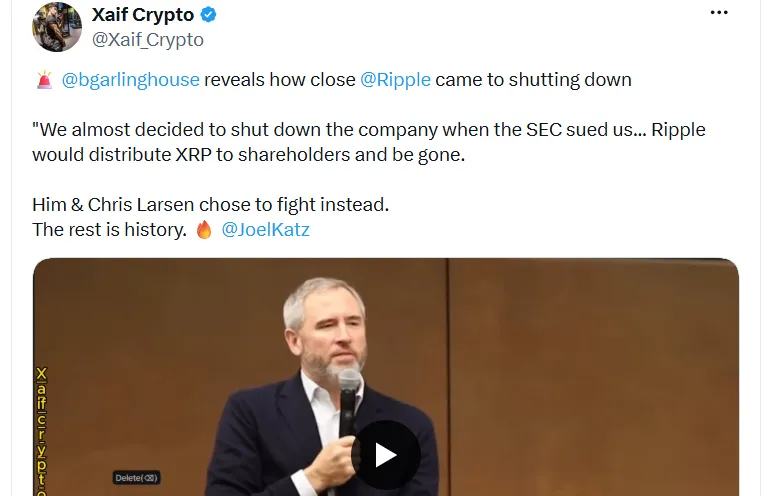
Speaking during an appearance at the University of Kansas School of Business, Garlinghouse admitted the choice was difficult because the company faced a regulator with extensive legal resources. Even so, Ripple believed the lawsuit would influence the future of the wider cryptocurrency market.
The legal dispute also became personal. Garlinghouse said regulators pursued claims against him individually while offering to settle his case separately from Ripple. He rejected that proposal and continued defending both himself and the company.
Before the lawsuit, Garlinghouse said he met SEC officials several times between 2017 and 2019 without legal representation. According to him, officials never suggested XRP might qualify as a security during those meetings.
Key case milestones
| Event | Outcome |
|---|---|
| December 2020 | SEC sued Ripple over XRP sales |
| July 2023 | Court ruled XRP itself is not a security in secondary market sales |
| Final judgment | Ripple ordered to pay a $125 million civil penalty for certain institutional sales |
| 2025 | Both parties dropped appeals, ending the litigation |
Court battle reshaped Ripple’s business strategy
The lawsuit disrupted Ripple’s U.S. operations almost immediately. Several major cryptocurrency exchanges suspended or removed XRP trading, while institutional partnerships slowed because of regulatory uncertainty.
Garlinghouse estimated Ripple spent roughly $150 million defending the case. Despite those costs, the company continued expanding outside the United States instead of reducing operations.
Ripple improved its enterprise payment system, recruited overseas partners, put money into infrastructure in the blockchain, and eventually created the RLUSD stablecoin. The company also obtained regulatory approvals in a number of markets, such as Europe via MiCA license.
Garlinghouse persistently maintained that XRP tokens are not considered to be equity shares since the token holders have no voting rights, do not get dividends, and do not own Ripple. He insisted that Ripple is developing payment technology for banks and financial institutions and works with the open-sourced XRPL.
Industry consequences continue beyond Ripple
The case established an important legal distinction between institutional token sales and secondary market trading. That interpretation now influences how exchanges, investors, and blockchain companies evaluate digital assets.
Former Ripple executive David Schwartz also said company leaders genuinely considered shutting down because early legal advice suggested the company faced severe risks. He argued that naming Garlinghouse and Larsen personally increased pressure on Ripple’s leadership to settle quickly.
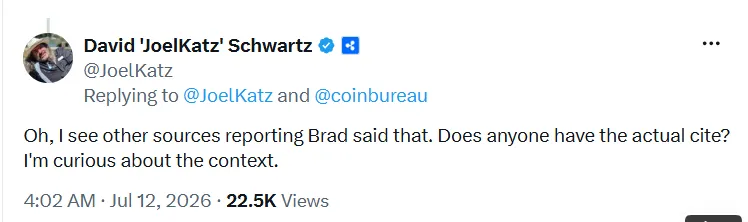
Although Schwartz suggested competing interests may have influenced the enforcement action, he acknowledged he had no evidence supporting that theory.
Meanwhile, lawmakers continue debating federal legislation that could provide clearer rules for digital assets. Ripple’s experience has become a reference point during those discussions because many companies argue they need defined regulatory standards instead of enforcement through litigation.
The case also showed how long legal battles can change corporate strategy. Rather than focusing primarily on the United States, Ripple accelerated expansion into jurisdictions offering clearer regulatory frameworks.
Ripple emerged stronger after years of uncertainty
Ripple CEO Garlinghouse said choosing to fight instead of shutting down became the defining decision in the company’s history. While much of Ripple’s U.S. operations ground to a halt, Ripple maintained its staff and kept investing throughout the litigation.
Garlinghouse sees this shift as a tipping point that enabled Ripple to bounce back, solidify institutional relationships and carve out regulated services globally. While regulators are still finalizing crypto regulations, Ripple’s CEO account of the SEC case sheds light on the future of the company and the entire digital asset sector.