
Key Insights
- The Protocol 25 upgrade will be compulsory for all mainnet node operators by June 18, 2026.
- If nodes don’t get upgraded they may not be able to connect to the network.
- The migration will be as low impact as possible to most participants.
As announced by Pi Network, the upgrade to Protocol 25 is a major change that needs to be completed by all the mainnet node operators to ensure they continue to be on the Pi Network by June 18, 2026. This requirement is the next phase of the project’s mainnet development roadmap, which has been steadily climbing from node version 19 up to 26.
The update already created a lot of buzz within the community. As the deadline nears, node operators, developers, and ecosystem participants are gearing up for another network-wide migration.
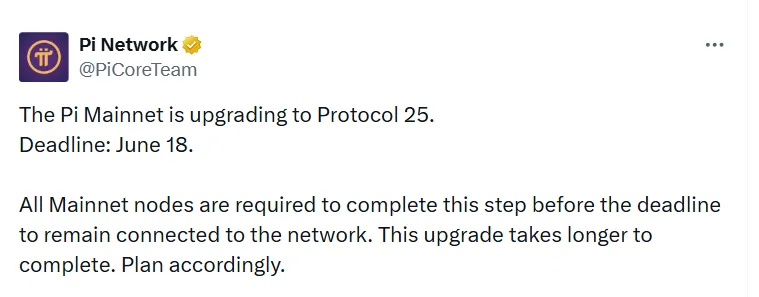
The next milestone on the roadmap is protocol 25
The new update comes after the implementation of Protocol 24, which had faced some issues and was completed earlier this month. The development team stated that during the migration process one node should upgrade one by one and should not skip versions.
The current transition moves nodes from version 24.1 to version 25.2. Protocol 26 is expected to follow once the network achieves sufficient adoption of the current version.
According to the project team, Protocol 25 is expected to be less disruptive than the previous upgrade cycle. Most node operators are expected to experience less than five minutes of downtime while completing the migration.
The team advised operators against upgrading all nodes simultaneously. Instead, traffic should be redirected to alternative nodes or supported through the network’s mainnet API infrastructure during maintenance periods.
Upgrade Requirements Vary Across Node Configurations
The upgrade process differs depending on the type of node software being used.
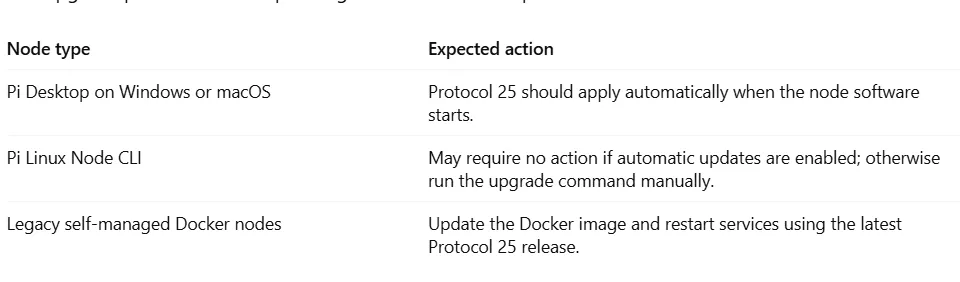
The development team also suggested checking the synchronization status after upgrading to the operators. This step can be set to verify that nodes have migrated successfully and are still in sync with the network.
The guidance builds on the experience of previous protocol transitions, such as the implementation of Protocol 24, which would take more processing time inside their systems and require some optimizations before reaching its target.
Community reaction and network participation
This announcement got immediate response from the community. At least a few advocates have recommended that operators of nodes upgrade them in phases before the deadline to help avoid network disruptions during the transition.
Meanwhile, there have been queries about wider network expansion. Another topic that came up in discussion was the level of participation of nodes and if the total number of nodes is approaching 400,000. Community members also asked for improved testnet stats and other signs of ecosystem activity.
There are no official numbers available on those questions, but the discussion reflects a growing interest in the scale at which the network operates and is growing in the longer term.
It has now gone beyond infrastructure improvements. While some community members believe protocol upgrades are necessary for success in the future, many think that ecosystem applications will be important, too.
The payment solutions, online marketplaces, and applications that are decentralized were mentioned by several members as potentially influencing the growth of adoption. Others suggested that “technical progress needs to be paralleled with regular user engagement and business involvement.
Infrastructure Progress and Market challenges
For developers, Protocol 25 is another milestone on the road to further fortifying the network and readiness for the future expansion of the ecosystem. Ensuring reliable node participation continues to be crucial for matters such as scalability, security, and the ability to support decentralized applications.
The upgrade, from the investors’ perspective, is essentially a technical achievement and not a market catalyst in and of itself. However, it shows ongoing progress within the project’s development timeline in spite of market adversity.
The token unlocks have put some pressure on the asset in recent months, and there has been some declining sentiment towards the asset. This has led to continued discussions as to whether ecosystem expansion will be able to meet with the growing circulating supply.
Despite those concerns, it seems like development is continuing, as evidenced by the completion of Protocol 24 and the launch of Protocol 25. But many are still waiting for the “real world” utility and adoption numbers to improve.
Conclusion
As the June 18 deadline nears, Pi Network is moving into another significant period of the evolution of its mainnet. The mandatory Protocol 25 upgrade will help ensure the network is able to continue smoothly ahead of protocol releases.
The migration isn’t likely to impact markets in the short term, but it does confirm the project’s technical plan. To-date, the focus is on the node operators, and their capacity to make a successful transition. With continued ecosystem development, there will be a lot of participants keeping an eye on the possibility of infrastructure enhancement translating to adoption, and long term network growth.