Key Insights:
- Pi is a people-powered AI network after 526 million tasks.
- Pi has more than a million validators for scalable identity.
- Market opinion differs as token movement shows signs of hope for growth, and scarcity.
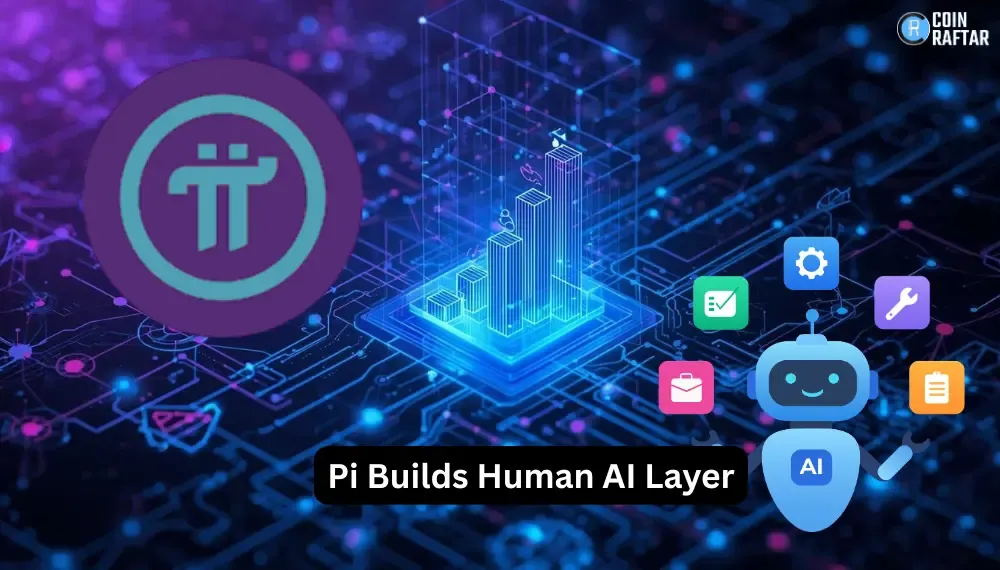
Pi starts the conversation with a change of use from blockchain to artificial intelligence. It reinforces the value of human intelligence in machine learning.
Pi’s latest update that over 526 million KYC tasks were verified globally.This was achieved through the efforts of over one million verified users in its decentralized network.

The volume is more than a reflection of growth, it demonstrates that a system is in place and is being powered by human coordination.Pi sees this network as a platform that can underpin AI systems that need to be verified in the real world and be contextually accurate.
Humans still have a key role in AI development
Pi emphasizes that artificial intelligence cannot function without human supervision and only data. The researchers observe that complicated reasoning, contextual analysis and judicial reasoning are beyond an automated system.
While models’ predictive accuracy has improved, AI systems heavily rely on human corrections and assessments. This presents an opportunity for Pi, which it believes its network is already well positioned to fulfill.
Pi’s verified human contribution and machine automation creates an amalgam approach to scalable intelligence systems. This enables AI systems to incorporate human verification and also enjoy computational speed and efficiency.
Pi network hits 526M verified tasks milestone
Pi notes that the completion of more than 526 million validation tasks indicates continued use of its system. The network also claims that more than 18 million verified users, or Pioneers as they are known, are part of the network.
These users constitute a reliable workforce ready to assist with AI-related processes. With KYC verification, the network avoids potential bot and duplicate accounts and poor-quality data sources.
Pi has referred to this as a distributed workforce, separate from traditional employment or a centralized workforce. Such a workforce could be used for labeling, validating, and ensuring quality in the data used to train artificial intelligence models.

Success In Market And Token
Pi’s foray into AI brings a fresh dimension to the project, and may have implications on use, and investment. The token’s price has recently surged from $0.165 to $0.20 in a short time.
The higher price pushed its market capitalization to almost $2 billion, boosting its position among the world’s largest altcoins.However, unlocking of the token, totalling nearly 21 million tokens on May 1, could result in a short-term price dip.
The market is waiting to see what the effect of AI integration efforts is on a long-term basis.However, some are optimistic, predicting future growth if the project develops according to its schedule.
Blockchain Linked to AI in the Future
Pi is developing its ecosystem, with enhancements such as Protocol 22 and preparing new features like smart contracts.It will also be more visible at conferences, where its focus will be on identity and AI.
This is in line with the trend of blockchain and AI technologies to create hybrid digital ecosystems.Pi seeks to tap into this convergence, using its verified user community and operational coordination technology.
But it faces challenges with the progress of mainnet, scalability and user retention.Pi will be judged by its ability to transform its human network into actionable applications powered by AI.
Conclusion
Pi showcases a new direction by focusing on humans as a key part of future AI.The fact that it has completed more than 526 million KYC tasks is a testament to its ability to harness and organise human verification on a global scale.
The concept is strong, but it will need to be executed and have some more value to be a success.If successful, Pi could revolutionise AI.
FAQs
1. How will Pi help AI?
Pi will offer a network of people to help AI that needs human verification.
2. Why 526 million KYC tasks?
They are a sign of a high level of coordination in Pi.
3. How will Pi combine human and AI?
It utilizes human verification and AI to enhance data.
4. What could go wrong for Pi?
Challenges include scalability, retention and adding value.