
The world of crypto prediction markets is doing well in the year 2026, where Polymarket has become one of the most successful prediction markets. Millions of people have already wagered on various elections, sports matches, Bitcoin, and other events.
Polymarket allows its customers to wager on various real-life events through blockchain technology. Unlike other sportsbooks or casinos, prices in the Polymarket market are determined by buying and selling shares of outcomes.
The exchange runs on Polygon, a blockchain network linked to Ethereum, but the settlement currency is USDC. Before participating in the exchange, users generally link their cryptocurrency wallets, such as MetaMask and Phantom. Shares on a trading exchange can be set up as binaries, where people trade shares on “Yes” or “No.”
Prediction markets have become popular because they transform public opinion into tradable assets. For instance, if a position such as Yes costs $0.70, then there is an expectation of 70% of that occurrence.
How Does Polymarket Trading Work?
Polymarket operates on a centralized limit-order book, just like traditional financial trading platforms. A trader can place his or her own order at the price he or she wishes or take orders placed by other traders on the platform.
Most contracts trade between $0.01 and $1.00, depending on perceived probability. If a trader purchases a “Yes” share at $0.65 and the event resolves positively, the share settles at $1.00. In that example, the gross gain would equal $0.35 per share before costs.
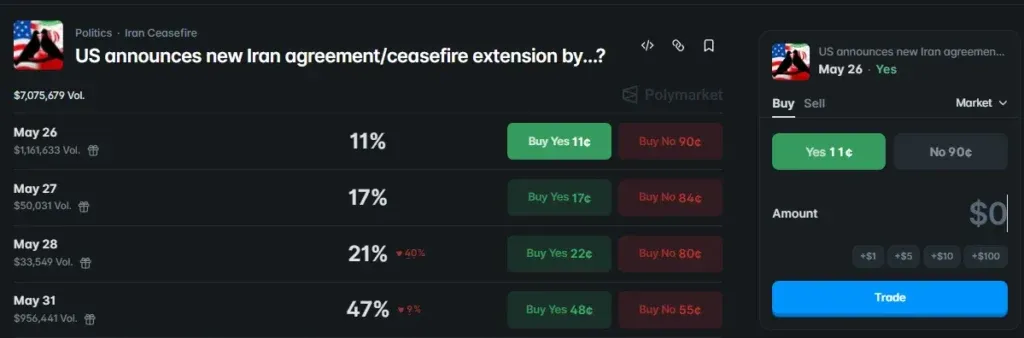
Source: Polymarket
Markets do not require users to hold positions until final settlement. Positions can be closed ahead of schedule if the price action turns in their favor, or to cut losses if sentiment shifts against them.
Moreover, the software is also capable of accommodating the market with different resolutions ranging from contracts expiring within a few minutes to yearly events. The popularity of short-term contracts has increased owing to the volatility resulting from fast price changes.
Polymarket Trading Platform vs. Traditional Betting Platform
| Feature | Polymarket | Traditional Sportsbook |
| Mode of Trading | User to user betting | Betting against the bookmaker |
| Type of Money used | Stablecoin (USDC) | Fiat money |
| Type of System | Blockchain-based | Systemic |
| Type of Odds | Used Market odds | Odds determined by bookmakers |
| Wallet Requirement | Crypto wallet | Conventional wallet/log in |
| Transaction Logs | Blockchain logs | Systemic logs |
| Method of Payout | Smart contract | Payouts by the operator |
| Ownership of Accounts | User owned accounts | Platform owned accounts |
The comparison shows how prediction markets differ from conventional gambling through structure. The Polymarket platform uses market forces to determine prices, and the blockchain transactions are public.
Blockchain Technology and USDC Settlement
The Polymarket platform uses the Polygon blockchain as well as USDC for transactions and settlements. Blockchain technology ensures that the transaction history becomes publicly accessible.
Decentralization is mentioned by its proponents through such traits of its architecture as an open ledger, minimal need for intermediaries, and immutability. Moreover, self-custodial wallets place responsibility for their security on the owner.
However, loss of access to a wallet or approval of a fraudster will lead to the loss of funds. Threats related to smart contracts remain present due to the inherent properties of blockchains as code-based systems.
While Polygon trading costs may be lower than those on the Ethereum network, repetitive trading on the platform will still incur network costs in the long run. Additionally, trades come with bid-ask spreads that make trading even more expensive.
For instance, where the offer is $0.64, but the ask price is $0.66, the loss in the trading process will be around $0.02 per share.
Important Risks and Operational Considerations
The important operational considerations associated with prediction market trading include:
- Risk of wallet security associated with self-custody
- Weaknesses associated with smart contracts
- Vulnerabilities of short-duration markets
- Costs incurred from bid-ask spread trading
- Uncertainties regarding regulations in different regions
- Market response to newsworthy events
- Disputes on subjective outcomes
The short-term markets that run from five to fifteen minutes have gained visibility on prediction platforms due to their settlement speed and quick responsiveness to current affairs. These markets are likely to be subject to wide price fluctuations over short periods.
In light of the above information, price variations in such contracts make it harder to make decisions amid volatility.
How Polymarket Resolves Market Outcomes
One of the most important operational areas for prediction markets involves determining final results. Polymarket uses the UMA Protocol’s optimistic oracle system to resolve contracts.
After an event concludes, a proposed outcome is submitted alongside collateral. After that, there is an open challenge period during which issues arise if market participants disagree with the proposed outcome.
In the case where there are no challenges, the contract ends itself and the winners’ tokens pay off at $1.00 each. If any disputes arise, there is a next level where the Dispute Resolution Mechanism kicks in, and voting by UMA token holders determines the right answer.
Simple occurrences, such as sports results or open price information, tend to be resolved relatively quickly. On the other hand, more difficult or unclear occurrences may require extended dispute resolution before they are finally resolved.
Polymarket Revenue Structure Change and Growth of the Market
One of the defining aspects of Polymarket was that it started not charging any trading fees. Nevertheless, in 2026, Polymarket decided to change its revenue structure.
The platform also drew institutional interest due to funding news. Based on the information provided, the firm known to be connected to the New York Stock Exchange, Intercontinental Exchange (ICE), is reported to have invested $2 billion in 2025 at an estimated valuation of about $9 billion.
Sporting deals were said to make up a large proportion of the site’s transactions, at roughly 39%. Just the 2026 Super Bowl was worth an estimated $795 million in total market value.
Regulatory Oversight and Legal Framework
Polymarket had faced regulatory challenges in the United States. For instance, in 2022, the company settled with the Commodity Futures Trading Commission after failing to register and was charged $1.4 million.
Based on CFTC data, Polymarket received regulatory approval to return to the U.S. market via a Designated Contract Market, QCX LLC, in December 2025.
The regulation of prediction markets is still inconsistent among different countries, where some have regulated it according to their gambling laws or securities laws, but many countries have undefined categories regarding the regulation of prediction markets.
Conclusion
Polymarket is continuing to grow as prediction markets built on blockchain technology become better known within both cryptocurrency trading and event gambling communities.
FAQs
Is Polymarket a sportsbook?
No. Polymarket is an online prediction market exchange wherein traders buy and sell outcome shares against each other and not the house odds.
On which blockchain does Polymarket run?
Polymarket is built on Polygon and pays out in USDC.
Are there any fees associated with Polymarket?
Yes. Polymarket has now started collecting fees since 2026.