

Key Insights:
- Volatility futures for Bitcoin could offer institutions more advanced hedging instruments without having to have direct holdings of bitcoin.
- Some new CME plans to launch June 1, 2026, subject to approval by the Commodity Futures Trading Commission.
- After recovering back to the important $81,000 resistance zone, analysts are split on market direction.
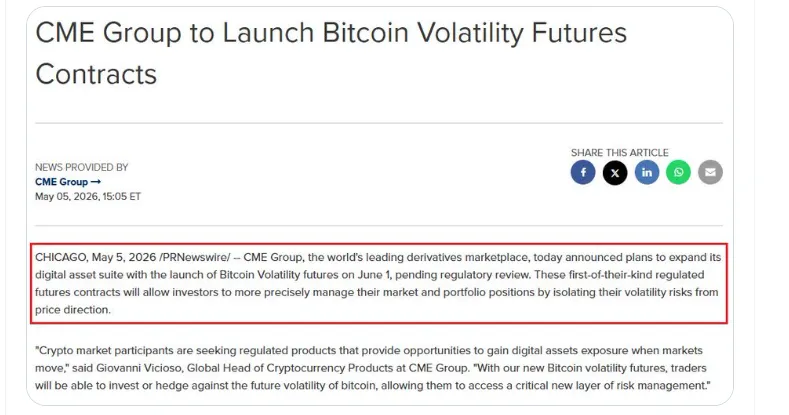
Bitcoin derivatives markets are approaching another milestone after CME Group revealed ambitious expansion plans recently. The leading derivatives marketplace intends launching regulated volatility futures contracts beginning June 1, 2026, pending approval.
The proposed contracts would allow traders managing exposure without depending entirely upon directional market movements. CME Group confirmed settlement would reference the CME CF Bitcoin Volatility Index measuring expected thirty-day volatility.
CME launch plans attract growing market attention
The volatility index derives pricing expectations directly from CME Bitcoin options markets using real-time orderbook information. Unlike traditional futures contracts, the benchmark isolates implied volatility rather than tracking immediate cryptocurrency price fluctuations.
CME first introduced the volatility index alongside CF Benchmarks during November 2025, preparing eventual derivatives expansion carefully. Officials confirmed upcoming contracts would integrate existing cryptocurrency clearing systems, trading schedules, and margin infrastructure seamlessly.
The proposed contract size equals $500 multiplied against current volatility index readings during settlement calculations. Institutional participants might hence be able to trade around expected volatility swings without having to trade direct exposure to the underlying cryptocurrency on exchanges.
Bitcoin traders pay attention to key recovery signals.
Bitcoin recently moved to the $79,168 level but bounced back in significant fashion to take out key resistance levels during weekend trading. Prices rallied back above $81,000 during recent trading sessions, as buyers aggressively bought into the lower levels.
Technicals are mixed for this stock as several indicators are currently showing opposing trading scenarios for the future.Several technical signs are giving conflicting trading scenarios for the future, which is raising doubts among market analysts about sustainability. Recently, CryptoQuant researchers stated that higher confirmation would need to be achieved by holding the price at around $88,880 and above for a longer period.
Consequently, people who are stuck in between $85,000 and $88,000 might push through a temporary selling pressure on exchanges after that, analysts warned. Several investors reportedly may exit positions near breakeven levels after enduring significant volatility throughout previous correction phases.
However, Bollinger Bands creator John Bollinger shared considerably different expectations regarding current market structure during Thursday discussions online. Bollinger explained his proprietary trend model recently turned positive, encouraging him toward establishing fresh cryptocurrency exposure immediately.
Bitcoin additionally closed above its upper Bollinger Band twice recently, strengthening optimism surrounding broader market momentum substantially. Traders now closely monitor whether continued buying pressure sustains recovery momentum or triggers another aggressive retracement phase.
Regulated contracts could strengthen crypto market confidence
Volatility futures contracts serve specialized purposes compared with conventional directional cryptocurrency trading instruments across global derivatives platforms. Volatility products are often used by portfolio managers to shield their investments from significant fluctuations in the market during volatile trading periods in different countries around the world.
Market-making firms additionally trade differences between implied volatility expectations and actual realized volatility measurements during trading sessions consistently. CME currently has a number of existing, successful volatility products tied to traditional financial benchmarks, such as the widely popular VIX futures.
The upcoming cryptocurrency volatility contract amends the same institutional structures and expands them to the latest crypto markets that have seen more and more institutional players actively participate in recent times. There were already a number of CME cryptocurrency futures and options trading products that saw considerable trading volume and growing institutional open interest.
The regulatory review process is still essential prior to launch.
In 2026, institutional derivatives demand surged and several firms, including Coinbase, boosted their cryptocurrency treasury allocations. This could provide traders with ample flexibility to hedge their positions against the volatility of cryptocurrencies while simultaneously maintaining their spot market investments.
Regulatory supervision is still very critical as the CFTC continues to closely scrutinize self-certified derivative products. Current system allows regulators to raise objections before a contract enters active trading on a public exchange during specified review periods.As is, regulators can voice objections prior to any contract going public before it enters into active trading.
Another key evolution that bridges the gap between traditional financial systems and the fast-changing digital asset landscape is Bitcoin volatility futures. Successful implementation of planned contracts could give institutional traders valuable tools to navigate the volatile cryptocurrency markets.
FAQS
What are Bitcoin volatility futures contracts?
These derivative contracts allow traders speculating upon expected cryptocurrency volatility instead of immediate directional price movements.
When could CME launch these futures contracts?
CME Group currently targets June 1, 2026, subject to successful Commodity Futures Trading Commission regulatory review.
How does the volatility index calculate expectations?
The benchmark uses real-time information collected directly from CME Bitcoin options orderbooks and trading activity.
Why are institutional investors interested currently?
Institutions can hedge market uncertainty efficiently without purchasing underlying cryptocurrency holdings through traditional exchange platforms.
Could regulators delay the scheduled launch date?
Yes, regulators retain authority challenging self-certified products during review periods before official public market availability.