
Key Insights
- South Korea will hear Polymarket’s response before deciding on possible access restrictions.
- Regulators are investigating whether the platform violates the country’s strict gambling laws.
- The review adds to growing international scrutiny of crypto prediction market operators.
South Korea has given Polymarket an opportunity to respond before regulators decide whether to restrict the prediction market platform over alleged gambling law violations. The move marks a significant step in the country’s regulatory review and could influence how prediction markets operate across one of Asia’s largest cryptocurrency markets.
The Broadcasting, Media and Communications Review Committee voted on July 6 to allow the platform’s operator to present its position before authorities determine whether corrective action is necessary. Officials said the additional review will help them assess both the legality of the service and its operating model before reaching a final decision.
South Korea expands review into the platform itself
The latest action moves South Korea’s scrutiny beyond complaints and into a formal regulatory process. Although the platform remains accessible, authorities have indicated that the review could eventually lead to internet access restrictions if they determine the service breaches domestic law.
According to the committee, the additional hearing will allow regulators to verify whether Polymarket operates within legal boundaries under South Korean legislation. Authorities continue examining whether the platform’s event-based markets amount to speculative gambling rather than legitimate forecasting.
Gambling is illegal in South Korea with the exception of a few games sponsored by the state such as horse racing and national lottery games. The National Gambling Control Commission Act allows regulators to act on online services which facilitate speculative gambling.
The review is about issues with the platform’s structure. Yes/No bets are sold by users on the real-world events using stablecoins like USDC. Critics argue that the financial incentives resemble wagering despite the company’s description of its markets as forecasting tools.
Regulators have also examined the platform’s country-specific markets, which include contracts covering South Korean politics, monetary policy, exchange rates and entertainment events.
Regulatory timeline
| Event | Development |
|---|---|
| May 2026 | South Korea began reviewing whether the platform violates gambling laws |
| June 5, 2026 | Gangwon Provincial Police launched an investigation into local users |
| July 6, 2026 | Media regulator invited the company to submit its formal response before any enforcement decision |
Enforcement risks continue to grow
The current review follows an earlier police investigation involving South Korean users. In early June, the Gangwon Provincial Police opened what local media described as the country’s first investigation into individuals accused of participating in illegal election-related gambling through prediction markets.
The National Police Agency reportedly requested the investigation.
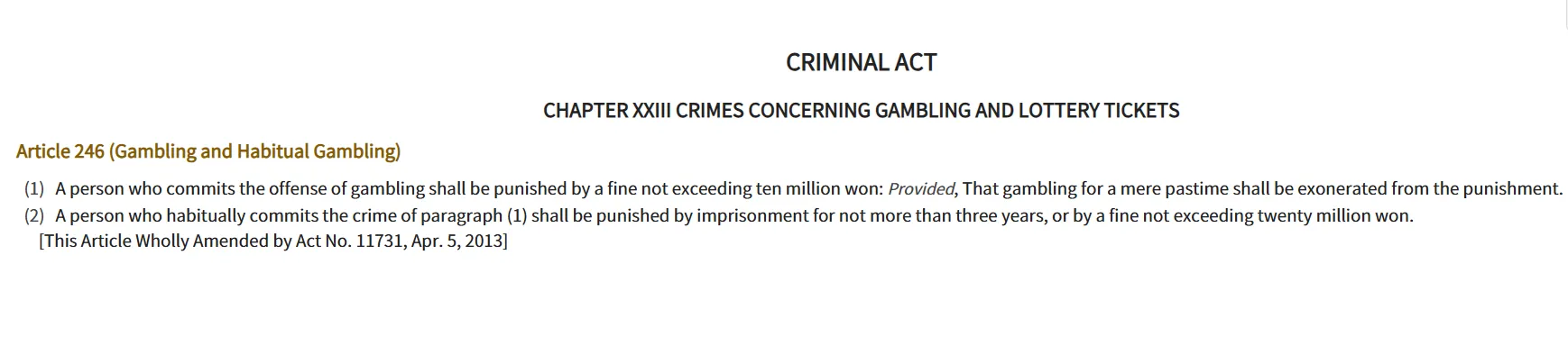
South Korean law imposes substantial penalties for gambling offences. Individuals may receive fines of up to 10 million won, while habitual gambling carries prison sentences of up to three years or fines reaching 20 million won. Authorities can also impose up to five years in prison or fines of 30 million won on operators who run gambling businesses for profit.
Meanwhile, Polymarket maintains that its geographic restrictions comply with sanctions, financial regulations, anti-money laundering requirements, Know Your Customer rules and local gambling legislation.
The company currently blocks users from 33 countries, including the United States, the United Kingdom, France, Germany, Brazil, Singapore, Japan and Australia. It also restricts access from selected regions within Canada and eastern Ukraine.
Global oversight of prediction markets intensifies
South Korea’s review reflects broader regulatory pressure facing prediction market operators worldwide.
Earlier this month, the European Securities and Markets Authority said certain event-based contracts may already fall under existing financial market rules if they qualify as financial instruments. That interpretation could subject some products to existing European retail restrictions without introducing new legislation.
In the United States, reports from Bloomberg and CNBC indicated that the Commodity Futures Trading Commission has expanded its review of Polymarket, including its marketing activities on social media.
The reported inquiry followed allegations that paid promotional content lacked sufficient disclosure. The company later said it had started reviewing its promotional practices to ensure compliance with internal policies and applicable regulations.
Separately, blockchain analytics firm Allium estimated that wallets linked to the United States traded roughly $571 million in political contracts over the past year despite domestic restrictions. The research firm noted that its attribution covered only a portion of wallets and should be viewed as directional rather than definitive.
Predictions markets have become popular enough to capture the eyes of regulators, with more and more investigations coming in. Various countries are still trying to figure out whether these sites are financial products, a prediction service or gambling.
Conclusion
South Korea has put a halt to any measures for now while regulators deliberate on its response and legal counter arguments.This could mean the difference between Polymarket being available in one of the world’s most bustling markets for digital assets in Asia and what the future of digital asset prediction market regulation looks like globally.