
Key Insights
- The CEO of Arthur Hayes has refuted claims that he bought Hype as a result of his $2.09 million withdrawal from Bybit.
- The controversial transaction sparked fears around the validity of on-chain wallet attribution.
- Market pressure increased following Hayes’ earlier exit and a major token unlock event.
Hype returned to the spotlight after reports claimed Arthur Hayes had re-entered the market through a multi-million-dollar token withdrawal. The claims emerged days after the BitMEX co-founder exited his entire position, triggering a sharp reaction across the market. Hayes quickly dismissed the reports and denied making any new purchase.
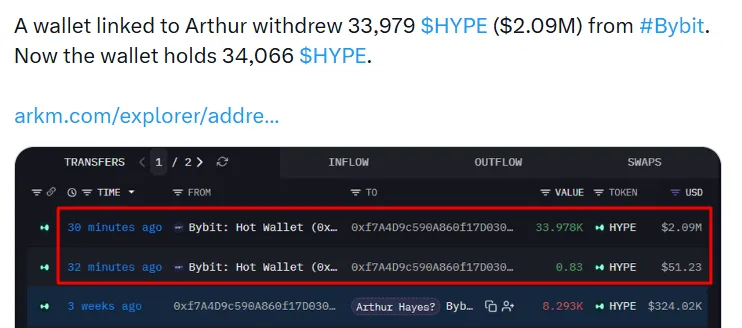
The controversy began when blockchain tracking platforms reported that a wallet linked to Hayes withdrew 33,979 tokens from Bybit. The transaction was valued at approximately $2.09 million. The report spread rapidly across crypto social media and fueled speculation that Hayes had quietly returned to the asset after selling at higher levels.
Hayes pushes back against wallet attribution claims
On-chain analytics firms identified a wallet they believed was associated with Hayes. According to the reports, the address withdrew 33,979 tokens from Bybit on June 8. Some trackers reported that the wallet held slightly more than 34,000 tokens after the withdrawal.
Hayes responded directly to the claims on X. In a brief post, he stated that he had not purchased any tokens. He also said no it was not his wallet.
His answer generated some uncertainty regarding the deal. It is possible to see the activity on blockchain, but it is not that easy to establish the owners of wallets. Analysts are able to detect patterns and relationships, and sometimes can confirm without the owner, but not always.
The feud came as an illustration to a standard issue confronting the cryptocurrency business.Public figures are frequently linked to wallets through data analysis, yet those links can remain disputed.
Earlier exit set the stage for market speculation
The reports gained attention because of Hayes’ recent decision to liquidate his holdings. On June 4, he announced that he had sold all of his positions in Hype and NEAR.
The move surprised many traders. Only weeks earlier, Hayes had described Hype, ZEC, and NEAR as some of the strongest conviction holdings within Maelstrom’s portfolio. He had also maintained a positive long-term view on digital assets.
Blockchain data later showed that a wallet associated with Hayes sold more than 247,000 tokens for roughly $18 million. At the time, the asset traded above $72.
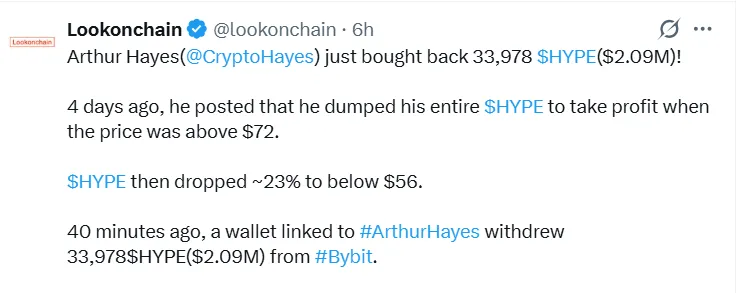
Following the sale, the market reacted sharply. The token declined by more than 20% over the next day and briefly traded below $57. Seemingly, the timing of the exit was important for many traders, since it came right after the announcement.
Multiple pressures added to selling activity
The market was already struggling with other issues before the withdrawal issue arose.
The big unlock event was on June 6th. The total number of tokens that were released into circulation was approximately 237 million, which amounts to nearly 24% of the total supply. That released event was responsible for most of the token unlock activity in the broader crypto market in that time.
The gains coincided with a drop in investor confidence. Spot selling further accelerated and some individual leveraged transactions were traded off. These liquidations pushed down even more and drove prices lower.
Earlier, Hayes had mentioned the macroeconomic issues when he announced his resignation. He cited higher energy prices, upcoming public offerings of artificial intelligence firms and the possibility of changing political attitudes toward the AI industry.
All this combined with the fact that the market was very sensitive to any bulletin that involved large investors, made it a difficult situation for Hype.
The wider lessons that can be drawn by traders and analysts.
The conflict has reignited the debate on data interpretation on-chain. While blockchain transactions are transparent, wallet ownership is a different matter.
The episode is a cautionary tale for traders to heed: Be wary of attribution reports. When some of the big names seem to be associated with major deals, it usually gets market participants all kinds of attention. Those reactions can shape sentiment even before claims have been substantiated.
Despite denying the alleged purchase, Hayes has not abandoned his positive outlook entirely. Days after selling his holdings, he stated that he still believed Hype could outperform Solana before the end of the year.
That position has left traders balancing two narratives. One involves his decision to exit the market. The other is the confidence in the asset’s long term potential that he has still maintained.
Conclusion
In response to the report, Arthur Hayes stated that he didn’t buy Hype, which was allegedly associated with a Bybit withdrawal of $2.09 million. The claim came out days after his big drop from the token and the wallet still hasn’t been verified as his.
The whole incident underlines the difficulty in the wallet attribution and the impact of large investors on crypto sentiment. With the growing number of on-chain analysis tools, verification is essential for traders and analysts.