

key insights
- The Senate vote delays statutory market-structure rules without ending federal crypto regulation.
- Agency rulemaking could address some gaps but cannot replicate congressional authority.
- The bill remains technically alive despite limited legislative time before the elections.
CLARITY Act negotiations hit a major setback on September 15 after the Senate rejected a procedural motion. The vote shifted immediate attention toward federal regulators that can pursue digital asset rules without new legislation.
The vote to cloture was made 49 to 50 in the Senate. Under Senate rules, it required 60 votes to progress towards debate. The motion was opposed by all the Democrats who voted and by four Republicans. Josh Hawley, Thom Tillis, Jerry Moran and Susan Collins were the only ones who were opposed.
Tillis said he had preserved the option for reconsideration with his procedural vote. Senator Chris Coons was not a vote taker. It was a more than year-long process of negotiation by the Republican and Democratic lawmakers. Republicans released a revised proposal on September 14.
The revised text incorporated 126 substantive changes requested by Democratic negotiators. But some objections were raised regarding the ethics rules and other rules.
Democratic legislators had complained the ethics restrictions were not strong enough.They came out with concerns regarding the crypto interests of president Donald Trump and his family.
Republicans disagreed about the negotiations, and said that Democrats were not willing to make big changes. Attendance of the competing positions prevented the legislation from getting support.
Giancarlo points toward federal regulators
Former CFTC Chairman J. Christopher Giancarlo addressed the setback shortly after the vote. He spoke with journalist Eleanor Terrett about the Senate’s decision and its regulatory consequences.
Giancarlo said SEC Chairman Paul Atkins and CFTC Chairman Michael Selig remain committed to their responsibilities. He said both agencies can continue developing frameworks under existing authority.
He argued that regulatory work can support financial innovation and market modernization. He also said such activity should occur within U.S. law.
🚨NEW: Former @CFTC Chairman @giancarloMKTS tells me the Senate’s failure to pass the Clarity Act is a disappointment but will not stop the “march of innovation” in the U.S.
“@SECPaulSAtkins and @ChairmanSelig are determined to do what their jobs require them to do and put in…
— Eleanor Terrett (@EleanorTerrett) September 16, 2026
Giancarlo was the chairman of the CFTC from 2017 to 2019, and is a known as CryptoDad. From September 2021 until April 2026, he was a retired private practitioner dedicated to legal practice, especially in the area of digital assets, AI and public policy.
His comments matched positions he has expressed for months. Giancarlo has argued that agency action can continue without congressional market-structure legislation.
Meanwhile, several industry leaders made similar calls after the vote.
Coinbase CEO Brian Armstrong said that the industry can no longer wait for Congress.
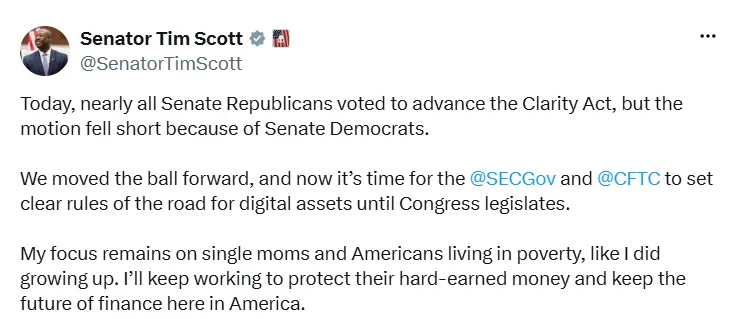
Atkins CEO Selig and Ripple CEO Brad Garlinghouse don’t have much to do with one another, but they both wanted to see the law filled in. Senate Banking Committee Chairman Tim Scott made a similar appeal after midnight. Scott said the SEC and CFTC should establish clearer rules until Congress passes legislation.
Existing agency work gains greater importance
The failed vote increases attention on regulatory initiatives already underway at both agencies. Those efforts could address parts of the uncertainty surrounding digital asset markets. The SEC proposed Regulation Crypto Assets on August 18. The 402-page proposal includes registration exemptions and a conditional safe harbor for certain crypto investment contracts.
The proposal includes different fundraising limits and disclosure requirements for qualifying projects. It also outlines conditions that could allow certain tokens to move beyond investment-contract treatment.
Atkins has indicated that the SEC’s work will continue regardless of congressional action. However, agency rules cannot fully reproduce every provision contemplated by legislation. The CFTC has also explored digital asset market-structure rules under existing authority. Selig has indicated that the agency’s work can continue without the CLARITY Act.
The legislation would have formally divided responsibilities between the SEC and CFTC. It also would have established registration paths for exchanges, brokers and dealers. The bill included provisions involving decentralized finance and stablecoins. It also addressed restrictions affecting senior government officials involved with digital assets.
Key developments now include
- Senate cloture failed by 11 votes.
- The House-passed bill remains on the Senate calendar.
- SEC and CFTC rulemaking can continue independently.
- Congress still has an issue with ethics and regulatory control.
Industry faces a longer regulatory transition
The Senate setback leaves digital asset firms facing continued uncertainty over federal oversight. While Congress has the final say on the structure of markets, the SEC and CFTC can offer rules.
House Financial Services Committee Chairman French Hill and House Agriculture Committee Chairman Glenn Thompson made that point. They called for agency action, but also urged Congress to eventually give them permanent legal clarity.
The bill may be sent back to the Senate. Senator John Kennedy stated that he felt that the legislature could bring it back at their lame-duck meeting. Senator Ted Cruz had a more negative outlook, referring to the bill as “mostly dead.” The House calendar also creates another obstacle.
House Republican leaders removed eight voting days from the September schedule. The chamber was scheduled to leave Washington on September 17. Any Senate changes would require additional House action before lawmakers could send legislation to the president. Therefore, timing remains a significant barrier to passage.
The immediate policy path now rests heavily with the SEC and CFTC. Their decisions could shape digital asset oversight while Congress remains divided.
Conclusion
The CLARITY Act setback moves U.S. crypto policy into a period of greater regulatory uncertainty. Federal agencies may keep on doing their thing, and Congress has the power to make permanent rules in statute.
The SEC and CFTC may play a more significant role in the months ahead for companies in the digital asset space. Congressional negotiations could restart later, but the conversation now is at the agency level.