Key Insights:
- Independent liability verification would be a method to determine if there is sufficient usable assets to cover for claims by customers.
- Compliance processing speed will help determine whether a compliance review is a routine review or a more stringent one.
- The quality of disclosure in management reports could have an impact on the ease of withdrawals and/or the continued stay of customers in the bank.
BitMart faces an August 19 deadline from users and employees demanding reserve disclosures, repayment terms, and unpaid salary settlement. The dispute threatens customer confidence as the exchange moves toward its scheduled August 26 trading cutoff.
Withdrawal controls emerge before closure
Withdrawal complaints surfaced before the exchange announced its shutdown. In June, management linked some restrictions to risk controls targeting an alleged subsidy exploitation scheme. The company said connected accounts had attempted to exploit platform incentives. It later warned that withdrawals could require added compliance reviews.
Those reviews could include identity, device, wallet, source-of-funds, and sanctions checks. The company maintained that legitimate customers could still withdraw after verification.
In May, the exchange had also promised a proof-of-reserves report following earlier complaints. By mid-August, that report had not appeared publicly.
On July 26, the exchange announced plans to wind down operations after nine years. It stopped new registrations, deposits, and new trading activity that day.
The company set August 26, 2026, as the end of spot and futures trading. Final closure remains scheduled for January 31, 2027. Management cited operating conditions, the market environment, and future strategy. It did not identify one event as the reason.
Customer complaints intensify in August
Pressure increased after the shutdown announcement. On August 8, co-founder Sheldon Lee rejected suggestions that management planned to disappear.
He said the core team was conducting an asset inventory and system maintenance. However, his remarks included no audited asset figures.
Two days later, OpenGradient co-founder Matthew raised concerns about funds held by his market-making team. He said the team could not remove its balances.
Scandic Coin separately reported pending withdrawals submitted on July 26. The project cited about 21,898 USDT and 926,635 SNC. It also listed another 256 USDT request. The project stopped short of declaring the exchange insolvent.
Instead, it called for verifiable evidence that available liquidity could meet customer obligations. That distinction remains central to the dispute.
Milestone Date Significance
Proof-of-reserves pledge May 2026 Exchange promised a reserve disclosure
Risk-control explanation June 2026 Management linked restrictions to connected accounts
Wind-down announcement July 26, 2026 New activity stopped and closure timetable began
Open letter published Aug 17, 2026 Users and employees issued public demands
Response deadline Aug 19, 2026 Group expects financial disclosure and repayment terms
Trading cutoff Aug 26, 2026 Spot and futures trading are scheduled to end
Final closure Jan 31, 2027 Company operations are scheduled to cease
Open letter demands verifiable numbers
On August 17, users and employees published an open letter on X. They addressed Sheldon Lee and executive Yi Li. The group demanded wallet disclosures, total assets, liabilities, and usable reserves. It also requested an independent third-party review.
Employees added claims that some staff had not received their previous month’s salary. Those claims broadened concerns beyond customer withdrawals. The letter asked when executives first learned about withdrawal restrictions. It also sought the identity of decision-makers behind those controls.
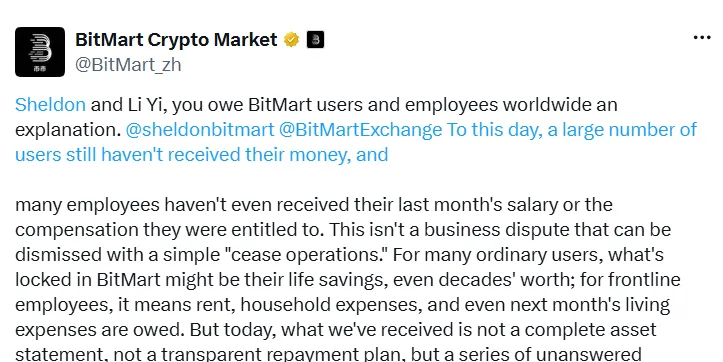
Furthermore, the group questioned whether customers were encouraged to deposit or trade after management recognized withdrawal problems.
BitMart now faces pressure to provide more than wallet balances. A reserve snapshot can be used to verify the assets at a particular point in time. It doesn’t show, however, assets that have been borrowed or debts held outside the accounts or other debts. A repayment schedule could therefore carry greater weight.
Exchanged companies come under increased focus.
The controversy comes at a time when centralized exchanges are expected to demonstrate more transparency in custody. As the markets become uncertain, more and more competitors are putting their reserve reports online.
MEXC published an audit report in August that reported reserve ratios of more than 100 per cent for all major assets. It has a Bitcoin ratio of 288%.
That comparison provides customers with a standard to use when comparing the reserve claims. It also puts pressure on exchanges that have lesser figures.
BitMart has not declared bankruptcy or declared any insolvency. Thus, its planned closure is different from the formal creditor protection. But the open letter calls for escalation if executives don’t show up on August 19. Authors can contact regulators, law enforcement, lawyers, and media.
Conclusion
BitMart enters the deadline with its credibility tied to evidence rather than assurances. Customers want verified liabilities, usable reserves, and repayment dates.
The response will shape perceptions of whether the shutdown remains orderly.It could also impact the transparency of expectations of the centralized crypto exchanges.