
Key Points:
- World Liberty Financial’s governance is under scrutiny following the control issues raised by Sun and his demand for clarification.
- The concentration of voting power was also a concern, as 10 wallets held three-quarters of it.
- It focused on treasury activities and lending exposure, and WLFI tokens underpinned big borrowing positions.
World Liberty Financial’s governance has come under increased scrutiny after Justin Sun, co-founder of the Tron blockchain, raised concerns about the control structure governing the platform’s smart contracts. In recent statements on X, Sun called on the project to disclose the identities and authorities of the parties managing its externally owned account (EOA) and multisignature wallets.
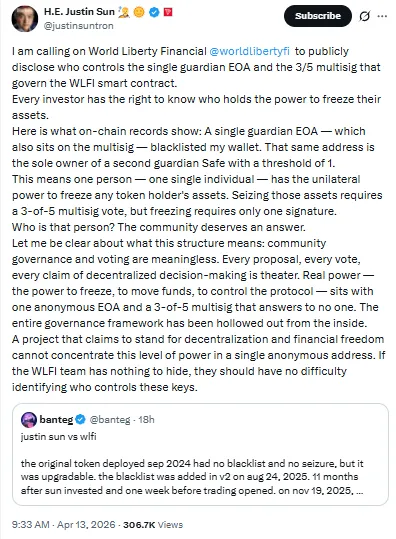
Source: H.E. Justin
World Liberty Financial’s governance structure under scrutiny
Sun stated that a guardian EOA connected to the World Liberty Financial governance system appeared to control a second guardian safe within the multisignature framework. He linked this structure to the blacklisting of his wallet, which occurred in September 2025 after blockchain monitoring platforms flagged a $9 million transfer.
Sun said his presale token holdings were frozen without sufficient procedural clarity and called on the platform to restore access. He further stated that governance procedures lacked transparency and restricted participation.
World Liberty Financial has not publicly addressed the technical aspects of the guardian EOA structure cited in Sun’s statements. The platform, however, replied that Sun was baselessly accusing them and that they might even sue him.
Voting Concentration Raises Governance Concerns
The governance debate at World Liberty Financial has also attracted attention regarding the distribution of voting power on the platform. In a March vote on governance, 10 wallets accounted for 76% of the overall voting power.
Sun, an early investor in the project, cited this concentration as an indication of a lack of dispersal of decision-making power. He reported that the results of governance mentioned to justify enforcement actions were achieved, where the conditions were not balanced participation.
According to Sun’s account, some information was suppressed from voters, and the voting process’s format did not allow participants to meaningfully participate. The platform has not provided additional details regarding the voting structure in response to these claims.
Activity and lending exposure arise in treasury.
Simultaneously, blockchain data has highlighted transaction activity associated with wallets linked to the project’s treasury. Data identified by Arkham indicated that approximately 5 billion WLFI tokens were deposited as collateral on Dolomite, a decentralized lending platform associated with chief technology officer Corey Caplan.
According to the Arkhama data, the wallets borrowed approximately $75 million in USD1 and USDC stablecoins. In addition, more than $40 million was transferred to Coinbase Prime.
Moreover, positions in DeFi carry potential consequences, especially regarding the amount of collateral required.
Token performance and market developments
As reported earlier by CoinRaftar, WLFI token declined to approximately $0.077 on Saturday, marking a new low. The price movement occurred during a period when attention on governance, treasury management, and collateral use was increasing. The decline extended the token’s broader downward movement observed over recent sessions.
Other tokens associated with Donald Trump have also recorded declines during the same period. The Official Trump and Official Melania tokens were at new all-time lows, mirroring the market’s situation.
Furthermore, lawmakers have also been attracted to the developments. The project has been criticized by Democratic officials for its structure and activities.