
- Hyperliquid made a case for its on-chain transparency after CME and ICE questioned their practices.
- HYPE jumped after the spot Hyperliquid ETF, launched by Bitwise, began trading on the NYSE.
- CME and ICE are said to be asking Hyperliquid to register itself under CFTC regulations.
Hyperliquid moved to defend its market structure and transparency practices after a report stated that major derivatives operators Intercontinental Exchange (ICE) and CME Group were urging U.S. regulators to take a closer look at the blockchain-based trading platform.
The debate emerged as Hyperliquid continued to expand its role in commodities-linked trading activity and as new U.S.-listed investment products tied to its native token entered the market. At the center of the discussion are concerns about how decentralized trading venues fit within existing U.S. derivatives laws, particularly as trading volumes tied to oil and metals continue growing on blockchain-based platforms operating outside traditional exchange hours.
Bloomberg reported Friday that ICE and CME have been engaged in discussions with lawmakers and regulators regarding risks they believe could arise from Hyperliquid’s operations. According to the report, the conversations focused in part on concerns about the possible manipulation of global oil prices through decentralized derivatives markets.
Hyperliquid has become increasingly active in commodities-linked perpetual futures trading, attracting users partly because its platform operates continuously, including during weekends and periods when traditional exchanges are closed. The development has coincided with growing institutional interest in the protocol and the launch of exchange-traded products tied to the Hyperliquid ecosystem.
Hyperliquid Highlights Onchain Transparency
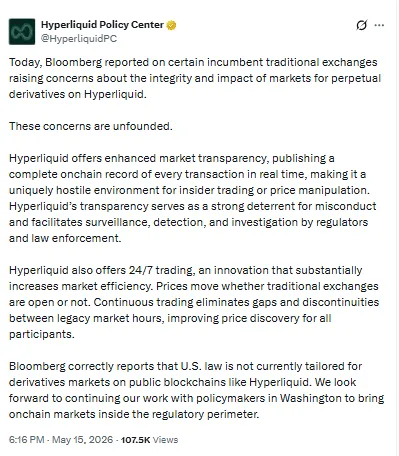
In response to the report, the Hyperliquid Policy Center, a U.S.-based advocacy organization led by crypto industry lawyers and lobbyists, issued a public defense of the platform’s market structure. The organization stated that Hyperliquid provides a different framework for transparency and oversight because all trading activity is recorded publicly onchain.
The group argued that the platform’s structure creates a real-time record of transactions that can be reviewed by regulators, investigators, and market participants. According to the statement published Friday on X, Hyperliquid’s design makes insider trading and market manipulation more difficult because all activity is permanently visible on the blockchain.
Source: Hyperliquid
The organization also emphasized Hyperliquid’s continuous trading model, stating that 24-hour access improves market efficiency by reducing pricing gaps between trading sessions on traditional exchanges. The statement noted that asset prices continue moving even when legacy exchanges are closed, adding that uninterrupted trading may improve price discovery across markets.
The Hyperliquid Policy Center further stated that current U.S. derivatives regulations were not specifically designed for public blockchain-based markets such as Hyperliquid. The organization said that existing laws may not fully account for decentralized trading systems operating with transparent onchain records.
CME and ICE Reportedly Seek Regulatory Registration
According to Bloomberg’s sources, CME Group and ICE have been advocating for Hyperliquid to register with the U.S. Commodity Futures Trading Commission (CFTC). Such registration would place the platform under U.S. regulatory oversight and require expanded responsibilities related to customer monitoring, compliance, and trade surveillance.
Neither exchange publicly detailed the discussions referenced in the report, but the issue highlights the growing regulatory focus on decentralized trading venues offering derivatives products tied to commodities and other financial assets.
ICE and CME remain among the world’s largest traditional derivatives exchange operators, particularly in energy trading markets. The debate also comes as centralized crypto exchanges continue adding traditional financial products to their offerings. Binance, along with exchanges including Coinbase and Kraken, has introduced additional trading products linked to commodities such as oil.
However, derivatives-related offerings in the United States have generally expanded more slowly than in several international markets because of regulatory requirements. ICE also maintains involvement in the digital asset sector through its financial backing of Polymarket, a prediction market platform that offers commodities-related exposure through binary event contracts. Polymarket is currently pursuing full CFTC approval to expand access to its global platform within the United States.
Hyperliquid Token Climbs Following ETF Launches
The regulatory discussion unfolded alongside a sharp rally in HYPE, the native token connected to Hyperliquid. The token rose more than 23% over a 24-hour period on Friday, climbing toward $47 and reaching its highest level since October 2025.
This week, asset managers 21Shares and Bitwise introduced exchange-traded funds tied to Hyperliquid, with both firms referencing increased commodities trading activity occurring on the platform.
On Friday, Bitwise launched its spot Hyperliquid ETF under the ticker BHYP on the New York Stock Exchange. The fund provides investors with regulated exposure to HYPE and plans to stake a portion of its token holdings through Bitwise’s internal staking operations.
Bitwise stated that the ETF carries a sponsor fee of 0.34%. The firm also said the fee would be waived during the first month for the initial $500 million in assets