Key Insights:
- Revolut will remove USDT for affected European users by Aug. 31 under MiCA compliance measures.
- Customers can buy USDT until July 6 and deposit it until July 30 before restrictions take full effect.
- Circle’s USDC strengthens its position in Europe as regulated platforms shift toward MiCA-approved stablecoins.
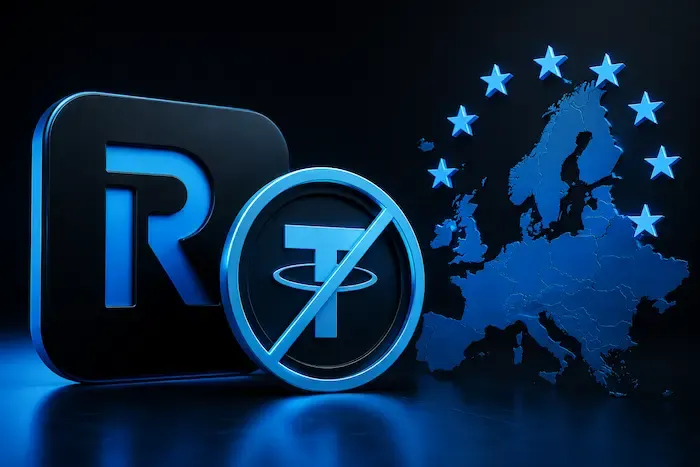
Tether will lose support on Revolut for affected European Union customers as the fintech aligns its crypto services with the bloc’s Markets in Crypto-Assets regulation. The phased withdrawal begins this month and ends on Aug. 31, marking another major shift in Europe’s regulated stablecoin market.
The decision is a sign of MiCA’s rising influence across the region. Regulated exchanges and fintech firms now continue adjusting digital asset offerings to meet the European Union’s new compliance standards.
| Milestone | Date | Customer Impact |
|---|---|---|
| USDT purchases end | July 6 | Customers can no longer buy USDT |
| New deposits end | July 30 | Revolut stops accepting USDT deposits |
| Final deadline | Aug. 31 | Users must sell, transfer, or withdraw USDT before automatic fiat conversion |
Revolut rolls out phased withdrawal for USDT holders
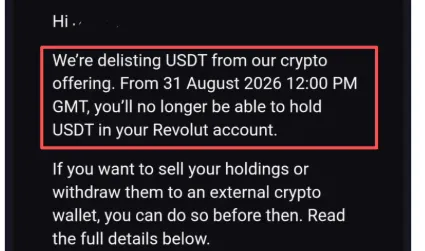
Revolut informed affected customers through email that it will gradually discontinue support for USDT over the coming weeks. Customers may continue purchasing the stablecoin until July 6 before the platform closes that option.
The company will stop accepting new USDT deposits on July 30. However, customers may still sell their holdings or transfer tokens to supported external wallets until Aug. 31.
Revolut urged users to review their balances before the deadline. After Aug. 31 at 12.00 PM GMT, unsupported balances will automatically convert into each account’s base fiat currency using the prevailing market price.
The company also clarified that the restrictions only apply to notified European users. Customers in jurisdictions where USDT remains available will continue accessing the token without interruption.
MiCA accelerates changes across Europe’s stablecoin market
The withdrawal follows full implementation of the European Union’s Markets in Crypto-Assets framework, which entered enforcement on July 1. The regulation requires stablecoin issuers and crypto service providers to meet licensing, reserve management, disclosure, and supervisory obligations before offering products across the bloc.
Tether has not obtained authorization under the framework. Chief Executive Officer Paolo Ardoino previously argued that MiCA’s reserve requirements create unnecessary liquidity risks during periods of heavy redemption activity. He also maintained that the framework does not suit the operational structure of the world’s largest stablecoin.
The company already retired its euro-denominated stablecoin EURT during 2024 instead of adapting the product to MiCA requirements.
Meanwhile, European regulators continue expanding the list of licensed crypto firms.The expanding register reinforces compliance needs, and pushes platforms to focus on approved digital assets.
The pressure from regulators redefines the competition between stablecoins
After MiCA enforcement, Revolut is adding to a list of crypto platforms that have limited access to Tether USDT. The transfer will bolster the competitive landscape for regulated alternatives, including Circle’s digital dollar USDC, which already meets MiCA requirements and is already easily accessible on most licensed European platforms.
In the United States and the rest of the world outside Europe, Tether is also reacting to regulatory moves. Recently, the US Treasury Department’s Office of Foreign Assets Control (OFAC) extended the sanctions against ISIS-K, which led to USDT being frozen in 131 wallets on the TRON blockchain.
On July 1, OFAC listed 134 cryptocurrency wallet addresses, 131 of which were TRON addresses, with 13 of them being associated with the sanctioned organization, and three were Monero addresses. The sanctions are not directly related to MiCA, but they are clear evidence of the ability of the issuer to freeze tokens at law enforcement’s request.
The stablecoin issuer is also still under fire for lack of transparency of its reserves. Consumer advocacy group Consumers’ Research recently condemned the firm for only being able to do quarterly attestations and not a full independent audit. Ardoino has said that all stakeholders in the cryptocurrency industry are still nervous about auditing stablecoin issuers after various notable failures in the industry.
Compliance continues to be the industry’s focus.
As MiCA comes into effect to regulate digital assets, Europe’s stablecoin market remains evolving towards the fully authorized products. The pressure is on for fintech companies to match their product lines with regulators’ expectations, while minimizing their risk exposure regarding non-supported tokens.
The withdrawal by Revolut points to the business implications of not being in Europe’s licensing framework. The phased timeframe will also ensure that impacted consumers have enough time to move their assets before the end of the support period, significantly minimizing disruption and upholding the European Union’s principles of compliance first when it comes to digital asset markets.
Conclusion
Revolut’s choice is another step in enforcing the MiCA regulation on regulated platforms. The gradual liquidation of USDT provides customers impacted by the decision with enough time to adapt, while solidifying the stability coin oversight stricter in the region.
The delisting is a sign of the commercial influence of being unregulated in Europe without MiCA’s approval, according to Tether. The more financial platforms adopt to the regulation, the more stablecoins are expected to establish themselves in the European digital asset market.