
Key Insights
- Lefteris Karapetsas argues the proposal could allow major validators to dominate funding decisions.
- The Ethereum developer linked his criticism to concerns about technical complexity and development priorities.
- In addition, he suggested burned ETH could be a more acceptable funding source than validator rewards.
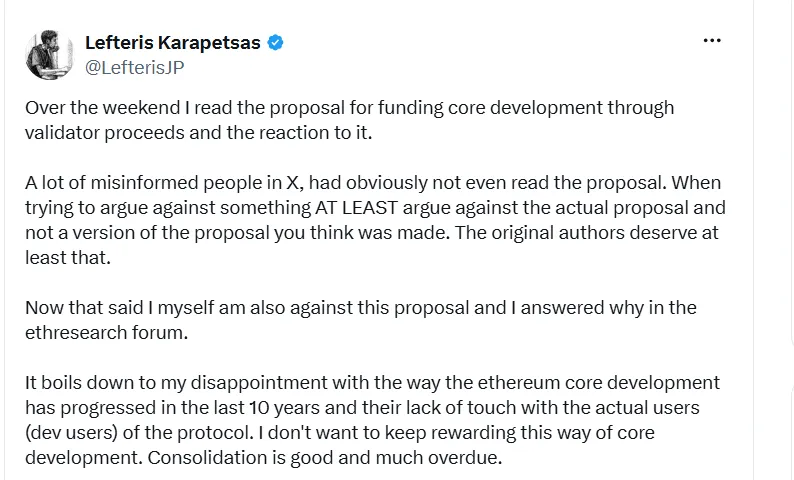
Ethereum developer and Rotki founder Lefteris Karapetsas has challenged a proposal that would channel part of validator rewards toward ecosystem funding. The proposal now has become a major governance discussion, as it has the potential to impact financing of development, infrastructure and public goods throughout the network.
Karapetsas, who had been reading the proposal and the public response to it, was pleased to share it with his position. He said he is against the real mechanism being considered—not the incorrect one proliferating on the Internet—and criticized the latter.
Funding Model Sparks Governance Concerns
This idea, dubbed Validator Redirected Revenue, came from the Ethereum research forum as a possible remedy to the ecosystem funding issues. Backing the validators, proponents believe they directly benefit from the expansion of the network and should contribute to funding its infrastructure for sustainable adoption.
The validation will be able to distribute up to 10% of the rewards between different funding projects, which will be approved by the validators themselves. The decision would be carried out by the validator set if over half of the validators voted for a non-zero contribution rate. The preferences of the recipients would be chosen by addresses and sent via smart contracts.
Karapetsas claimed the design causes an imbalance in governance. He cautioned that there could be big stakers who can collude and exert excessive influence over the direction of redirected funds.
His opinion is that a majority coalition can make decisions on funding for the entire network. Smaller validators would then contribute to projects that were selected by the larger validators themselves, not necessarily based upon their own preferences.
Proposal Snapshot
| Metric | Details |
| Proposal Name | Validator Redirected Revenue |
| Reward Allocation | 0% to 10% of staking rewards |
| Approval Requirement | Majority validator support |
| Intended Recipients | Public goods and infrastructure projects |
| Current Stage | Research forum discussion |
The argument is whether stake-weighted voting will be fair if voting power is directly linked to a staked ETH.
Increased general discontent over direction of development
Karapetsas went beyond the mechanics of the funding and raised technical questions about the future of Ethereum. He said core development has become increasingly complex and less connected to the needs of developers who build on the network.
He cited technologies such as RLP, SSZ, and RLPx as examples of growing complexity. In his view, development efforts have accumulated layers of technical design that have not always improved usability.
The developer also alleged that a cross-over of research and core development may need to be considered. He proposed more accountability and user-oriented alignment could be brought about by a funding squeeze.
His remarks come amid a wider discussion in the ecosystem around determining priorities for development. As the network develops and evolves the question of efficiency, governance, and technical direction are becoming more prominent.
Notable Points Raised
- Large validators could have greater impact on funding allocation.
- There might be a need for increased responsibility with respect to users when developing the core.
- Issues of governance continue to be a key issue for future reform.
The funding issue is still a question mark
The push for the proposal is based on a long history of a funding imbalance. While a large number of projects share infrastructure and security research, not many would have a direct contribution to the cost.
The research that accompanied the proposal estimated that a 5% to 10% of validator rewards could bring in a total of 50,000 ETH to 70,000 ETH for ecosystem projects yearly. Advocates argue that such funding could strengthen public goods and support long-term network growth.
Karapetsas acknowledged that alternative funding models may be necessary. However, he said a system based on burned ETH would be preferable to redirecting validator proceeds.
He noted that such an approach would create separate challenges related to gas usage and network activity. Even so, he considers those issues less concerning than the concentration of decision-making power among major staking entities.
Another unresolved question involves project selection. Karapetsas asked: “Who would say who’s going to be funded and what would be the standards for governance?”
Conclusion
There is now a wider governance and incentives and ecosystem financing conversation around Ethereum. The Validator Redirected Revenue proposal seeks to tackle funding issues, though critics say it may focus on the most influential Validators.
The proposal is in the research phase and hasn’t been incorporated into the protocol rules. Nevertheless, the discussion exposes increasing concerns about the sources of funds for development and the allocation of decision-making power on Ethereum.
Stakeholders will closely examine how innovation can be supported in the future with new funding mechanisms without losing the concept’s decentralized approach. The outcome could prove to be the template for the future funding of public goods on Ethereum and influence the governance discussions across the wider Ethereum ecosystem.