
Key Insights
- Despite recent market volatility, Bitcoin remains in a bull market for Brian Armstrong.
- The CEO of Coinbase highlighted Bitcoin’s historical four-year market cycles as a key framework for understanding long-term trends.
- Armstrong believes that the growth of crypto is now moving beyond Bitcoin to stablecoins and derivatives.
Bitcoin has picked up the pace above $65,000 and Coinbase CEO Brian Armstrong again expressed his belief in the Bitcoin asset. His remarks arrived as investors continued assessing whether the recent correction marked a local market bottom or merely a temporary pause in broader price trends.
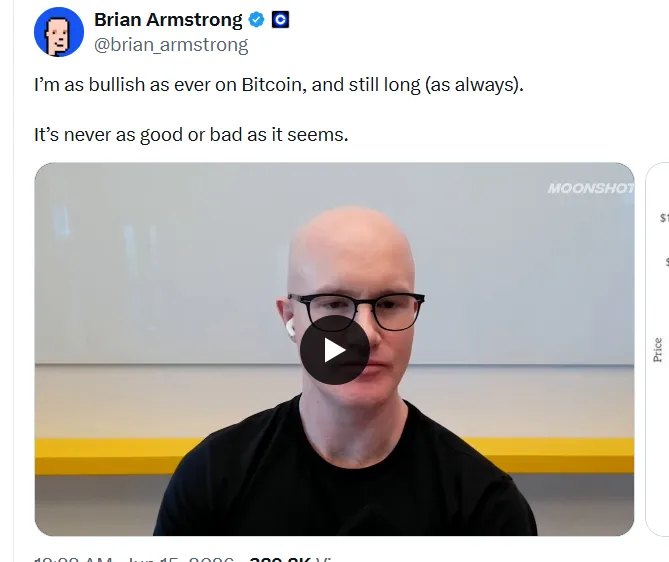
In a June 15 post on X, Armstrong stated that he remains “as bullish as ever” and continues to hold his position. The comments came after weeks of uncertainty that pushed market sentiment lower and sparked debate over the next direction for digital assets.
Market recovery revives long-term debate
Armstrong used the latest rebound to reinforce a message he has repeated during previous downturns. He said that the market also gets addicted to the short-term price fluctuations and ignores the trend of adoption in the long term.
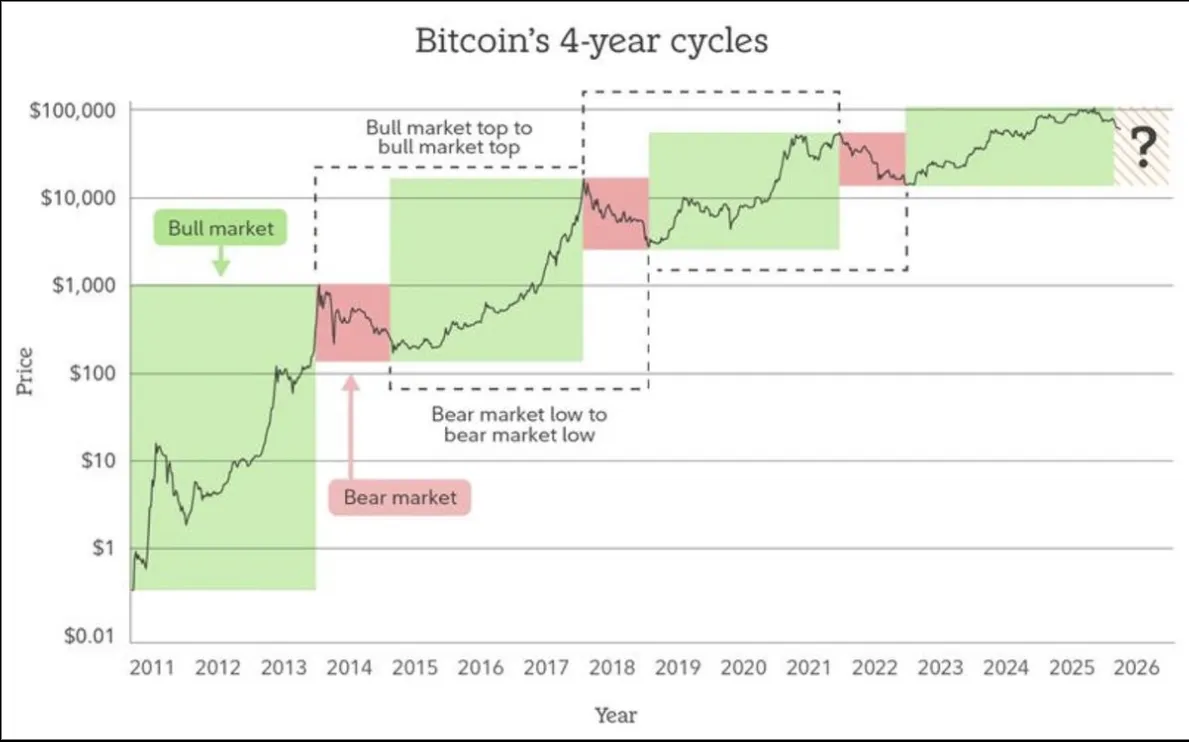
He also released a chart of Bitcoin’s past 4-year market cycles with his remarks. The graphic emphasized the bull/bear market cycles since 2011, and the forecast for extended bull and bear markets until 2026.
Armstrong says investors tend to get too bullish on rallies and too bearish on corrections. He said that volatility is a typical investor’s overreaction, especially during high volatility times.
The Coinbase executive later expanded on those views in a video attached to the post. He described Bitcoin as digital gold and maintained that its role within the financial system is likely to increase over time.
Signals behind Armstrong’s market view
While acknowledging that no one can accurately predict short-term price action, Armstrong indicated that recent market weakness may have already reached its lowest point.
He said his instinct suggests the market has likely found support around the $60,000 level. However, he stopped short of presenting that view as a certainty and emphasized that future movements remain difficult to forecast.
The recent recovery followed a period of geopolitical uncertainty that weighed on risk assets. Market sentiment improved after reports of progress toward a diplomatic agreement involving the United States and Iran, helping support broader risk appetite across financial markets.
Recent market snapshot
Metric Latest Development
- Recent low area; Around $60,000
- Current trading zone: Above $65,000
- Key resistance: Near $68,000
- Long-term outlook: Bullish according to Armstrong
Armstrong also pointed to the growing number of long-term holders. He noted that investor profitability has historically moved through recurring cycles of fear, accumulation, optimism, and expansion.
Crypto industry growth: more than one asset
Armstrong rejected the notion that Bitcoin alone is a measure of the overall health of the broader digital asset sector. He said the industry has grown far beyond its original focus.
According to him, stablecoins, derivatives markets, perpetual futures, and prediction platforms continue to record growth. Those segments have attracted increasing participation even during periods when Bitcoin experienced price weakness.
- Stablecoin adoption continues to expand across payments and trading.
- Derivatives markets remain among the fastest-growing crypto sectors.
- Prediction markets have gained visibility as new on-chain products emerge.
Armstrong said the market still tends to treat Bitcoin as the primary indicator for the entire crypto economy. He believes that approach is becoming less relevant as blockchain-based financial services diversify.
What the four-year cycle could mean
The four-year cycle remains central to Armstrong’s analysis. Historically, the pattern has featured powerful rallies followed by deep corrections before a new expansion phase begins.
The chart he shared places the current market within another cycle stage rather than identifying a definitive peak. The view taken there places the recent softness in perspective and suggests that it is more of a normal adjustment than a shift in LT demand.
Armstrong also restated his conviction that Bitcoin will be hugely higher valued by 2030. He did not name specific price targets, but he did say that “long-term fundamentals are still intact.
The impact of bitcoin on the market goes far beyond its immediate scope
Armstrong’s comments come at a time when investors are looking for any indication that the recent correction is over. His ongoing confidence is likely to further encourage sentiment among long-term investors after weeks of indecision, as the price of Bitcoin continues to stay above important support areas.
The comments also point to a general trend in the digital asset space. Although Bitcoin is still the leading cryptocurrency, the rise of stablecoins, derivatives and prediction markets indicates that the space is becoming more diversified away from Bitcoin. Therefore, if this trend persists, market dynamics might be increasingly influenced by several financial products on the blockchain, not just one, Bitcoin.
Conclusion
Bitcoin has bounced off its recent lows but the short-term trajectory of the price remains unclear. Brian Armstrong’s recent remarks reiterate a sentiment that he’s been expressing for quite some time that market cycles need to be measured using years, not weeks.
Bitcoin is still in a “long-term growth” phase, argues Armstrong as traders remain on the lookout for support and resistance levels. His sentiment also demonstrates his confidence in the overall digital asset industry, as well as in the asset itself.