
- Bitcoin index options were approved by the SEC, while tokenized asset exemption proposals were delayed.
- The Nasdaq QBTC will be a cash-settled product awaiting CFTC approval for trade.
- The SEC examined issues related to tokenized stocks regarding voting rights and record-keeping.
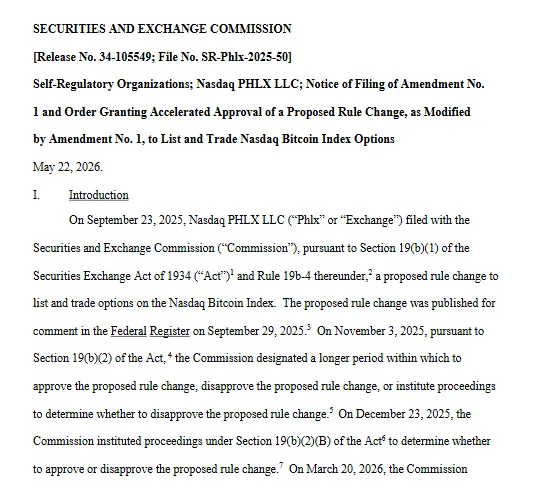
The Securities and Exchange Commission approved Nasdaq’s proposal to list cash-settled Bitcoin index options on the Philadelphia Stock Exchange while separately delaying a planned exemption tied to tokenized assets, according to filings and reports published Friday.
The two developments arrived as regulators continued reviewing how digital asset products fit within existing securities and commodities frameworks. The approved options contracts will track the Nasdaq Bitcoin Index and trade under the ticker QBTC on the Philadelphia Stock Exchange (Phlx).
Source: Securities and Exchange Commission
At the same time, the SEC paused work on a proposed innovation exemption that was expected to clarify how tokenized securities and blockchain-based equity products could operate in U.S. markets.
The SEC approved the Nasdaq filing on an accelerated basis, according to the order published on the agency’s website. The contracts are tied to the Nasdaq Bitcoin Index, which reflects one one-hundredth of the CME CF Bitcoin Real Time Index. The benchmark updates every 200 milliseconds using pricing data from several major cryptocurrency exchanges.
SEC Approves Bitcoin Index Options on Phlx
The newly approved Bitcoin index options are structured as European-style contracts, meaning they can only be exercised at expiration. The contracts are also cash-settled, allowing traders to receive the value difference between the Bitcoin spot price and the strike price without handling physical Bitcoin.
According to the SEC order, the contracts will trade with a minimum increment of $0.01. The regulator also established a position limit of 24,000 contracts per side, which the SEC said represents roughly 0.12% of Bitcoin’s total outstanding supply. The structure differs from options linked to spot Bitcoin exchange-traded funds because the new product does not involve the delivery of Bitcoin or ETF shares.
The SEC filing stated that the cash-settled design eliminates the possibility of early assignment while providing market participants with another regulated instrument tied to Bitcoin price movements.
Despite the SEC approval, trading cannot begin immediately. The Commodity Futures Trading Commission must still grant exemptive relief before the contracts can launch, as Bitcoin is classified as a commodity under federal law.
CME Group, which has offered Bitcoin futures options since 2020, previously submitted a comment letter arguing that the contracts fall under the CFTC’s exclusive authority.
The SEC addressed that issue in its filing, citing Section 717 of the Dodd-Frank Act, which allows overlapping jurisdiction in certain cases when the CFTC grants exemptive relief. “The concept of shared jurisdiction between the Commission and the CFTC is not new,” the SEC stated in the filing while referencing other financial products such as mixed swaps and security futures.
Tokenized Asset Exemption Delayed by SEC
While the SEC moved forward with Bitcoin index options, the agency delayed a separate proposal related to tokenized assets and blockchain-based equities.
Bloomberg Law reported that SEC staff had prepared draft language for an innovation exemption before discussions with market participants led to additional review. According to the report, SEC staff recently met with stock exchange officials and industry participants to evaluate concerns surrounding tokenized securities.
The proposed exemption was expected to function as a regulatory sandbox for onchain equities and other tokenized financial products. SEC Chair Paul Atkins previously stated that the agency planned to introduce the exemption framework before the end of last year.
Former regulators cited concerns about whether tokenized securities would guarantee the same shareholder rights attached to traditional regulated securities.
According to Bloomberg Law, questions remain regarding how token holders would consistently receive benefits such as dividends and voting rights when blockchain-based assets can move across decentralized networks. Several firms operating in the tokenization sector have already developed infrastructure designed to address those concerns.
The report noted that companies including Securitize, Ondo Finance, and Superstate have integrated SEC-registered transfer agent functions intended to maintain shareholder records for tokenized products. The SEC’s handling of both Bitcoin index options and tokenized asset exemptions reflects the agency’s broader review of digital asset regulation under the current administration.
Under Chair Paul Atkins, the SEC has moved away from several enforcement actions launched against crypto firms during the previous administration. The agency has also publicly stated the need for clearer regulatory frameworks for blockchain-based financial products and digital asset trading infrastructure.