Key insights
- Shielded wallet balances could increase private transfer activity
- Private reads reduce metadata exposure from RPC providers
- FOCIL strengthens censorship resistance at the validator layer
Co-founder Vitalik Buterin has stated the short-term roadmap for Ethereum will emphasize privacy protection with native privacy features and censorship resistance. The proposal adds wallet-level privacy features, guarantees transaction inclusion and infrastructure improvements to mitigate surveillance risks throughout the network.
The roadmap arrives as blockchain privacy becomes a larger concern for institutions and retail users. Buterin framed the effort as a technical requirement for digital money rather than a niche privacy feature.
Ethereum shifts focus toward practical privacy upgrades
The roadmap centers on three main upgrades that target different parts of blockchain activity. These include AA plus FOCIL integration, keyed nonces, and private access-layer tools linked to Kohaku wallets.
FOCIL, or fork-choice enforced inclusion lists, is expected to become a major part of the Hegota network upgrade scheduled for 2026. The mechanism gives the validators a greater power to add pending transactions to the blocks.
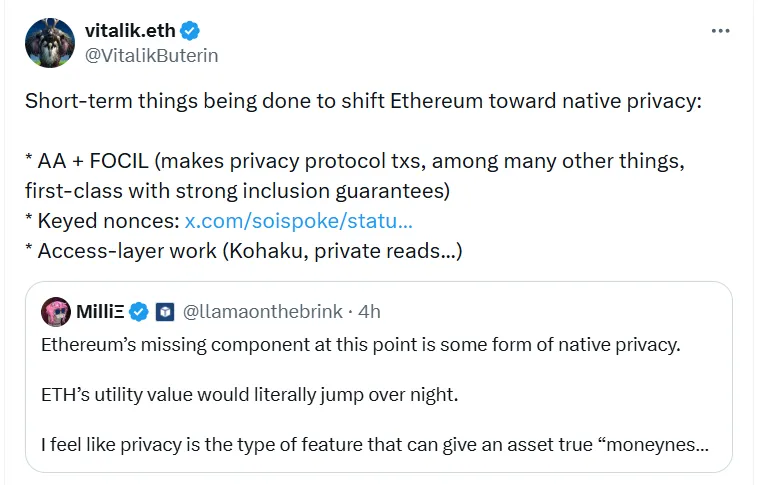
That approach reduces the ability of block builders or centralized intermediaries to quietly block transactions. Private withdrawals and shielded transfers would gain stronger inclusion guarantees under the proposal.
Keyed nonces solve another long-standing issue. Traditional sequential nonces can stall transactions when multiple transfers originate from the same infrastructure path.
EIP-8250 introduces nonce domains, replacing the single transaction queue. Independent transfers do not need to wait for the earlier transactions to go through.
For privacy systems, this avoids any single transaction from blocking other transactions that are queued on the same system but not related to it.
The roadmap’s key developments
- FOCIL is designed to improve the guarantees of transaction inclusion.
- In a privacy system, keyed nonces mitigate transaction conflicts.
- Kohaku wallets are intended for off-public balance requests and private reads.
The privacy of wallets becomes a more significant protocol concern.
The roadmap also broadens privacy rights beyond transactions. Wallet activity and balance queries currently expose user behavior through RPC providers.
Even when transactions use privacy tools, wallet requests can reveal address histories and search patterns. Private-read infrastructure would reduce this exposure by hiding balance and smart contract queries from node operators.
Kohaku wallet development supports this direction. The project includes privacy-focused tooling linked to Railgun, Privacy Pools, and provider abstraction systems.
The wallet strategy also connects with account abstraction upgrades. Native smart-wallet support would allow programmable spending rules, recovery systems, sponsored transactions, and stronger privacy integration.
Wallet privacy is increasingly seen as essential for wider adoption of Ethereum by developers. Public settlement remains important, but users also want protection from constant tracking.
Institutional flows remain tied to privacy improvements
Privacy discussions have also expanded into institutional adoption. Public blockchain activity exposes trade sizes, entry points, and transaction intent to competitors and front-runners.
That transparency has limited larger capital deployment on-chain. Buterin’s roadmap attempts to reduce those barriers through default shielded balance functionality and private transaction flows.
The proposal would move privacy from an optional feature into a standard wallet setting. Users could send assets privately without additional configuration steps.
Industry estimates linked to the roadmap indicate private transfers could rise sharply if wallet experiences match standard public transactions.
Garbled circuits and MPC gain larger relevance
The roadmap also highlights encrypted computation technologies. Garbled circuits and multi-party computation are becoming important parts of private decentralized finance infrastructure.
COTI launched a production-ready implementation earlier in 2025 through its Ethereum-compatible Layer 2 network. The system reportedly processes encrypted computations faster than fully homomorphic encryption systems.
The technology allows users to compute data collaboratively without exposing underlying information. Treasury management, private trading strategies, and institutional transactions become harder to monitor externally.
Developers argue this could remove one of the largest barriers preventing larger institutions from increasing blockchain participation.
The roadmap also links privacy upgrades with zkEVM development and AI-related transaction systems. ERC-8004 proposals could eventually support private machine-to-machine payments and automated settlement tools.
Market attention remains fixed on long-term utility
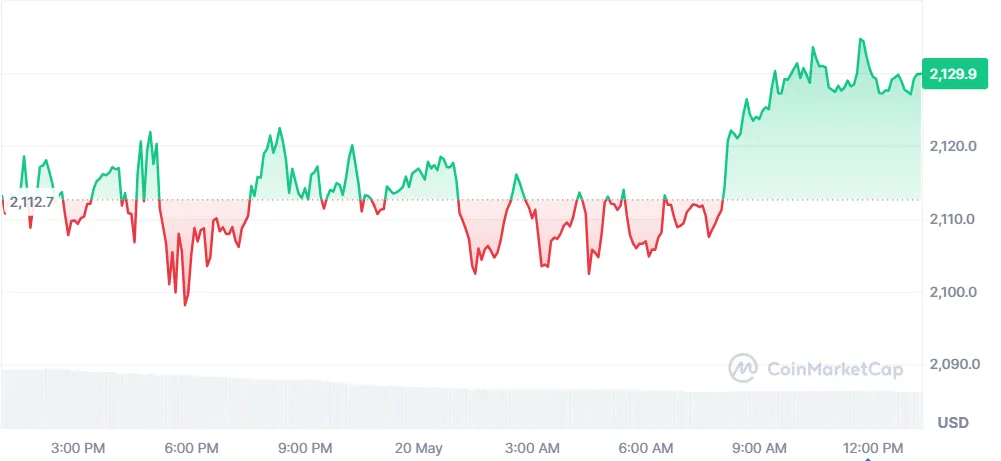
Ethereum traded near $2,127 as the privacy roadmap circulated across the market. The proposal did not trigger a direct price rally, but it renewed discussion around network utility and adoption.
The roadmap presents privacy as a core network property instead of a separate application layer. That distinction could shape future adoption as regulators, institutions, and developers evaluate blockchain infrastructure.
Buterin’s plan also reconnects several existing upgrade tracks into one direction. Account abstraction, censorship resistance, smart-wallet design, and post-quantum preparation now sit within the same broader privacy narrative.
The roadmap does not promise immediate implementation. Still, it offers a clearer technical path toward private transactions, protected wallet activity, and censorship-resistant settlement across the network.