Key Insights:
- Circle has actively been establishing quantum-resistant infrastructure in proactive protection of blockchain systems before quantum computing is a reality threat.
- The implementation that Arc provides in stages will enable smooth integration of improved cryptography methods that will not interfere with the current blockchain activities.
- The problem of quantum risk is still under divergent opinions in the industry, not all the major blockchain ecosystems have the same readiness and timing.
Circle has introduced a new quantum-resistance roadmap of its Arc blockchain, a step that finally marks the decision toward digital infrastructure as being future-proof.The news is indicative of increased apprehension among scientists at Google and California Institute of Technology who opine that quantum breakthroughs are imminent sooner than the market can anticipate.
Circle cautioned that passivity or passive strategies can put blockchain systems under long term vulnerabilities especially in the event that encrypted data is collected today but it will be decrypted later.Circle can ensure these risks are avoided by ensuring this is part of its design, to build a security-first base of decentralised financial infrastructure.
Launching Arc mainnet incorporates post quantum signatures.
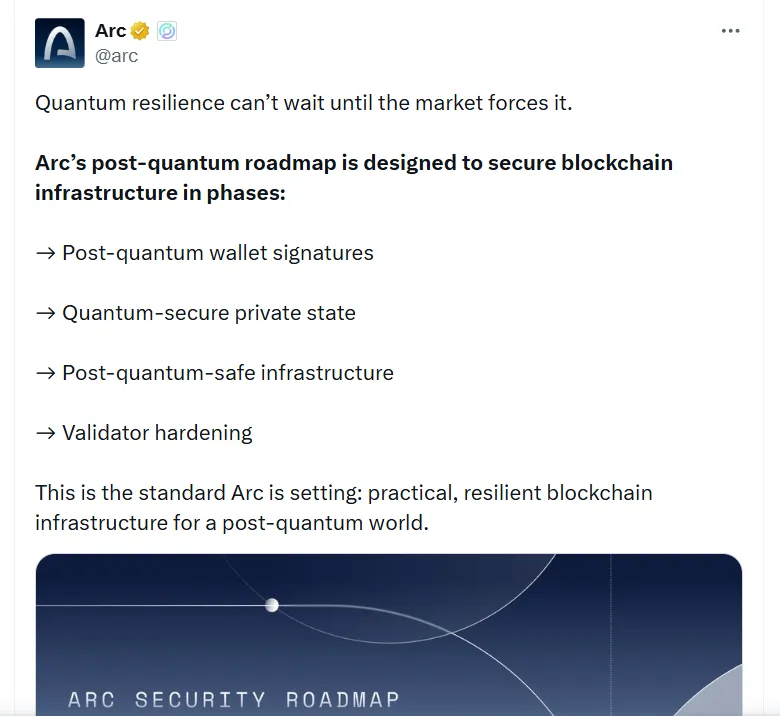
Circle affirmed that Arc will have support for post-quantum signature schemes in its mainnet, which is due in 2026, but this was already enabled in the first rollout.
This functionality will be supported by an opt-in system where developers, validators, and users can make a step to quantum-safe cryptography at a comfortable rate.Circle has mentions that such a flexible design reduces the risk of disruption and thus the ecosystem participants can upgrade the systems without affecting the existing operations or network stability.
The roadmap contains the merging of lattice-based and hash-based cryptographic algorithms which are generally believed to be resistance to quantum computation attacks.Beyond wallets, while carrying out these protections, Circle will eventually extend these protections to the entire infrastructure, gradually rolling them out to more layers of the infrastructure over a time frame.
The debates in the industry mount on the blockchain quantum risks.
The wider blockchain ecosystem is split regarding the threat of quantum threats and its imminence as well as the scale and various opinions exist on the timeline and also mitigation measures.To illustrate, the Bitcoin cryptography is based on ECDSA and some researchers are of the opinion that with quantum machines that are powerful enough, it may be hacked in a relatively short time.
Simultaneously, some specific ecosystems like Ethereum or Solana are exploring upgrades, and in any case, quantum preparation is frequently considered as more advanced in Algorand.Adam Back has been able to posit in the community of Bitcoin that quantum risks are over consequences, implying that the risks are at a low level.
On the other hand, there are initiatives espoused by Ethan Heilman like the BIP-360, but the timelines of its implementation may be many years ahead.This deviation underscores the ambiguity of the quantum developments, which supports the business case of Circle taking an active and proactive security policy.
Arc institutional blockchain attractiveness is reinforcing privacy characteristics.
In addition to quantum resistance, Circle is also bringing by it enhanced privacy features to Arc to enable the institutional adoption and regulatory compliance requirements.
Such improvements will involve privacy concepts on transaction data, accounts balances and smart contract implementation and this will enhance confidentiality within the blockchain-based financial systems.According to Circle, its testnet already supports institution based use cases with USDC integration, which implies that the network will be ready to use by business enterprises before entering the mainnet.
The roadmap further presents roadmap on the personal virtual machine environments through which one can undertake safe computation without compromising with the available decentralized application environments.Privacy combined with quantum-resistance design is the focus of placing Arc as a platform that can enable decentralized finance to connect with conventional financial infrastructure, which is what Circle aims to do.
Circle strategy emphasizes on infrastructure resilience in the long run.
The strategy of Circle has the wider focus of developing flexible blockchain frameworks capable of adapting to the new technological issues and emerging.Instead of compelling people to immediate, en-masse migrations Circle is facilitating a gradual integration of quantum-resistant technologies into a model of implementation that is flexible and gradual.
This plan guarantees that current ecosystem participants will be in a position to continue with operations as it plans to counter any effects that might be brought about by the new technology in quantum computers.Circle underlined that the protection of the entire stack will be engineered to go through wallets, validators, private state mechanisms, and infrastructures, to form a defence system.
It was also emphasized by the company that in the present day, it is necessary to consider long-term risks, as it might put to jeopardy the ability of systems to implement quantum-resistant protection in the future.The move to value resilience-oriented blockchain design in the industry is indicated in the roadmap of the Circle as the context of the potential effect of quantum computing develops.
Circle also intends to make Arc become a new platform of secure digital finance by combining advanced cryptography, privacy-focused solutions, and scalable infrastructure.