
Highlights:
- Aave X Layer allows users of the OKX Wallet to provide assets and borrow money without bridging or setting up at the moment.
- On X Layer, the user earns compound yield and can borrow collateralized and uncollateralized assets.
- Lido DAO will conduct a $20M buyback when LDO is trading much lower than before, using protocol position.
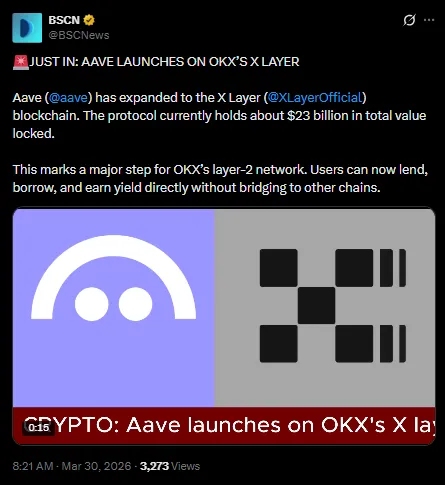
Aave X Layer has become a new point of access for on-chain lending after Aave launched on X Layer, the Ethereum Layer 2 developed by crypto exchange OKX. The deployment allows OKX Wallet users to access Aave directly on the network, where they can supply assets, borrow against collateral, and earn yield without setting up a separate wallet or moving funds through a bridge, according to OKX.
Aave X Layer deployment expands lending access on OKX Wallet
The launch of Aave X Layer gives OKX Wallet users a direct route into one of the largest decentralized lending protocols in the market. OKX said Monday that users can now supply digital assets to earn compounding yield and borrow supported assets against collateral on X Layer.
Source: BSCN
The company said the deployment eliminates the need for a separate wallet setup or a bridging process, allowing users to interact with Aave directly from within the wallet.
OKX described the deployment as a step that brings Aave’s non-custodial and permissionless lending infrastructure into its Layer 2 ecosystem. In a blog post, the company said Aave’s arrival on the network makes the protocol accessible directly through OKX Wallet. Stani Kulechov, founder of Aave Labs, said the expansion connects Aave’s liquidity to a growing group of users and applications on X Layer.
Aave had about $23.8 billion in total value locked as of Monday, according to DeFiLlama data cited in the announcement. OKX said the launch marks an expansion by a top-tier lending protocol aimed at deepening liquidity on the network.
Aave X Layer supports collateralized borrowing and yield products
Under the rollout, users can supply USDT0, USDG, GHO, xBTC, xETH, xSOL, xBETH, and xOKSOL to earn yield that compounds automatically while remaining in control of their assets, according to the blog post. The list of borrowable assets includes USDT0, USDG, GHO, xBTC, xETH, and xSOL.
OKX said borrowing on the platform is collateral-based and does not involve a credit check or an intermediary. That framework follows the standard on-chain lending model used by decentralized protocols, in which users lock supported assets and draw loans against them according to predefined collateral parameters.
The company also said X Layer has launched six eModes calibrated to its asset ecosystem. These efficiency modes are designed to support borrowing conditions across related assets. According to OKX, the settings allow loan-to-value ratios of up to 88% for liquid staking pairs. The use of eModes adds a defined structure to asset categories on the network and sets borrowing thresholds based on those groupings.
The Aave X Layer deployment, therefore, adds both asset supply and collateralized borrowing functions to the wallet environment while also extending the network’s DeFi infrastructure.
OKX continues wallet-based DeFi expansion
The latest launch follows OKX’s earlier efforts to expand access to DeFi in its wallet product.
With Aave now live on the network, OKX Wallet adds a lending layer alongside its existing trading functions. The move places on-chain borrowing and yield generation inside the same product environment that already supports decentralized exchange activity.
In this case, Aave X Layer serves as the lending component of that strategy. The deployment adds protocol-based borrowing and asset supply to the list of services available to users interacting with X Layer through OKX Wallet.
Lido DAO proposes a one-time LDO buyback from treasury assets
Alongside the Aave launch, Lido DAO is considering a separate treasury action tied to the price of its governance token. A proposal submitted Friday seeks permission to swap 10,000 stETH, currently valued at about $20 million, from the DAO’s treasury for LDO tokens. The DAO said the proposal aims to address what it described as a price dislocation in LDO relative to Ether. According to the proposal, this dislocation stands at historically depressed levels.
The DAO said, “This is not a routine fluctuation. It represents one of the most significant dislocations between LDO’s market price and its underlying protocol fundamentals in the token’s history.”
Lido DAO said LDO is trading at an Ether ratio of $0.00016, roughly 63% below its two-year median. The proposal argues that a similar deterioration does not match the gap in protocol performance. LDO was trading at $0.30 at the time referenced in the proposal, according to CoinGecko data. That price leaves the token down 95.9% from its all-time high of $7.30 set in August 2021. CoinGecko data also placed LDO’s market capitalization at $255 million, making it the 141st largest token by market value at the time of writing.