- XRPL proposes an indigenous lending system in which pooled funds can be used to fund fixed-term loans on the chain.
- A validator must approve the amendment, and it currently has approximately 17% approval.
- Kurv XRP ETF filing Launches March 11, 2026, with an income strategy utilizing derivatives.
The XRP Ledger (XRPL) is moving closer to expanding its decentralized finance (DeFi) capabilities, while XRP-related investment products in traditional finance are also advancing toward launch.
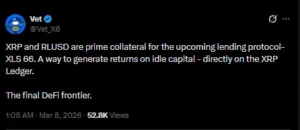
Source: XRP Ledger dUNL Validator Vet
In the meantime, the filing of an ETF indicates that the new XRP-oriented investment product will become effective in March 2026. Although these initiatives operate in different segments of the financial system, both relate to the evolving infrastructure surrounding XRP.
XRP Ledger Proposal Native Lending Protocol
The XLS-66 proposal seeks to introduce native lending functionality to the XRP Ledger by allowing fixed-duration loans to be facilitated by pooled funds on the network. The specification, formally titled “Lending Protocol,” was introduced in XRPL version 3.1.0 and co-authored by Ripple developers Vytautas Vito Tumas and Aanchal Malhotra.
According to the proposal documentation, the system is designed to support straightforward on-chain credit origination. The GitHub proposal explains that the protocol enables “straightforward on-chain uncollateralized fixed-term loans, utilizing pooled funds with pre-set terms for interest-accruing loans.” This structure would allow lenders to earn returns on capital held on the ledger while borrowers obtain access to funding through the same system.
XRPL community member and validator Vet described the lending feature as a milestone for the network’s decentralized finance system. According to Vet, the addition of a native lending framework represents what he called “the final DeFi frontier” for the XRP Ledger.
Under the proposed structure, lenders would rely on off-chain credit assessments rather than automated collateral enforcement within the ledger itself. The vet explained that financial institutions or lenders would conduct identity verification and risk evaluation before issuing funds
“The lender wouldn’t give you XRP in the first place without knowing who you are and doing some off-chain checks on you,” Vet said. He added that the XRP Ledger would primarily serve as a settlement logic system, an ownership-tracking mechanism, and an auditable record of lending activity.
Validator Approval Before Activation.
The lending protocol has not been enabled on the XRP Ledger yet. Like the other amendments in the network, the XLS-66 proposal must be supported by trusted validators to become operational.
The XRPL amendment process requires an 80% supermajority vote among trusted validators. In addition, the approval threshold must remain continuously at 2 weeks before any new feature is activated on the ledger. Current voting data shows that the proposal remains far from that requirement. The amendment has 17.14% consensus, with six validators voting in support and 29 voting against or abstaining.
Until the necessary voting threshold is achieved, the lending functionality will remain inactive on the network.
Kurv XRP Enhanced Income ETF Sets Effective Date
While the XRP Ledger is exploring new financial tools internally, developments in regulated markets are advancing as well. The launch of the Kurv XRP Enhanced Income ETF has been scheduled in a filing with the U.S. Securities and Exchange Commission.
The filing, which was filed as a post-effective amendment on March 3, 2026, covers two exchange-traded funds operating under the Kurv ETF Trust. These include the Kurv Ether Enhanced Income ETF and the Kurv XRP Enhanced Income ETF.
According to the regulatory document, both funds are scheduled to become effective on March 11, 2026. The filing states that the funds will operate under the legal frameworks established by the Investment Company Act of 1940 and the Securities Act of 1933.
ETF Structure Specializes in Income Generation.
According to the filing, the ETF will invest in derivatives, including options, to provide organized returns on XRP market activity. The approach is aimed at generating steady earnings rather than following XRP’s footsteps.
The design converts price volatility in the XRP market into structured income distributions. This approach focuses on producing recurring payouts for investors through active portfolio management.
According to Crypto market analyst ChartNerd, the ETF framework enables the XRP volatility to be converted into monthly income payments. The framework translates price changes into yield using derivative-based strategies.