Key Insights:
- Pi begins Protocol 21 upgrade with a strict April 6 deadline, pushing node operators to act quickly or risk disconnection.
- Upcoming upgrades in April and May aim to introduce smart contracts, decentralized exchange features, and broader application support.
- Pi price remains weak near $0.174, with technical indicators reflecting subdued momentum and continued seller dominance.
With Protocol 21 deployment, Pi Network has started its second round of migration, which is the first important step in the series of upgrades.The update presents version 21.2 as a replacement of the previous 20.2, and with a deadline of April 6 to all the mainnet node operators.
The shift aims at ensuring the network stability and bettering the performance of the node with the activity levels still increasing in the ecosystem.Developers of Pi affirmed that the upgrade is already in place and majority of the nodes will be able to complete the upgrade within a short time with minimum operational interference.
The phase is not an introduction of significant features but rather a precursor to the infrastructure in the future of functionality related to smart contracts.The relocation can be attributed to a calculated strategy because Pi is still developing to become a more sophisticated blockchain model.
Protocol upgrade deadline puts nodes under pressure
Pi Network has cautioned that operators of nodes that do not upgrade by April 6 will not be connected to the mainnet at all.This demands first-hand pressures on participants to upgrade systems regularly and continue seamless participation in the network.
Upgrades can be done by simply installing the most recent version of software, and restarting nodes, and this process normally consumes less than fifteen minutes.It is also a step that operators should not upgrade all the nodes at the same time due to disognifications; the entire network stability would also be realized in the process of transition.
This time-based system helps to have synchronous implementation throughout the network, which lessens the chances of fragmentation and uneven performance of the nodes.Consequently, this makes the upgrade an important operation need and not a technical enhancement.
Roadmap reveals smart contracts and DEX plans.
Pi Network provided an upgrade roadmap that goes beyond Protocol 21, and includes other versions that are already scheduled in the next few weeks.Refer to Protocol 22.1 which will be released on April 22 and Protocol 23.0 which should be released on May 18.
These future developments will have the effect of introducing smart contract functionality, which will relegate the use of the network to a new functionality.Plans of a decentralized exchange, on-chain liquidity solutions and expansion of decentralized applications are also included in the roadmap.
This kind of development is meant to diversify Pi applications past transactional uses to allow developers to create applications directly on the network.This development is an indication of a shift to a more utility based ecosystem oriented on scalability and practicality.
Pi price holds weak momentum near levels
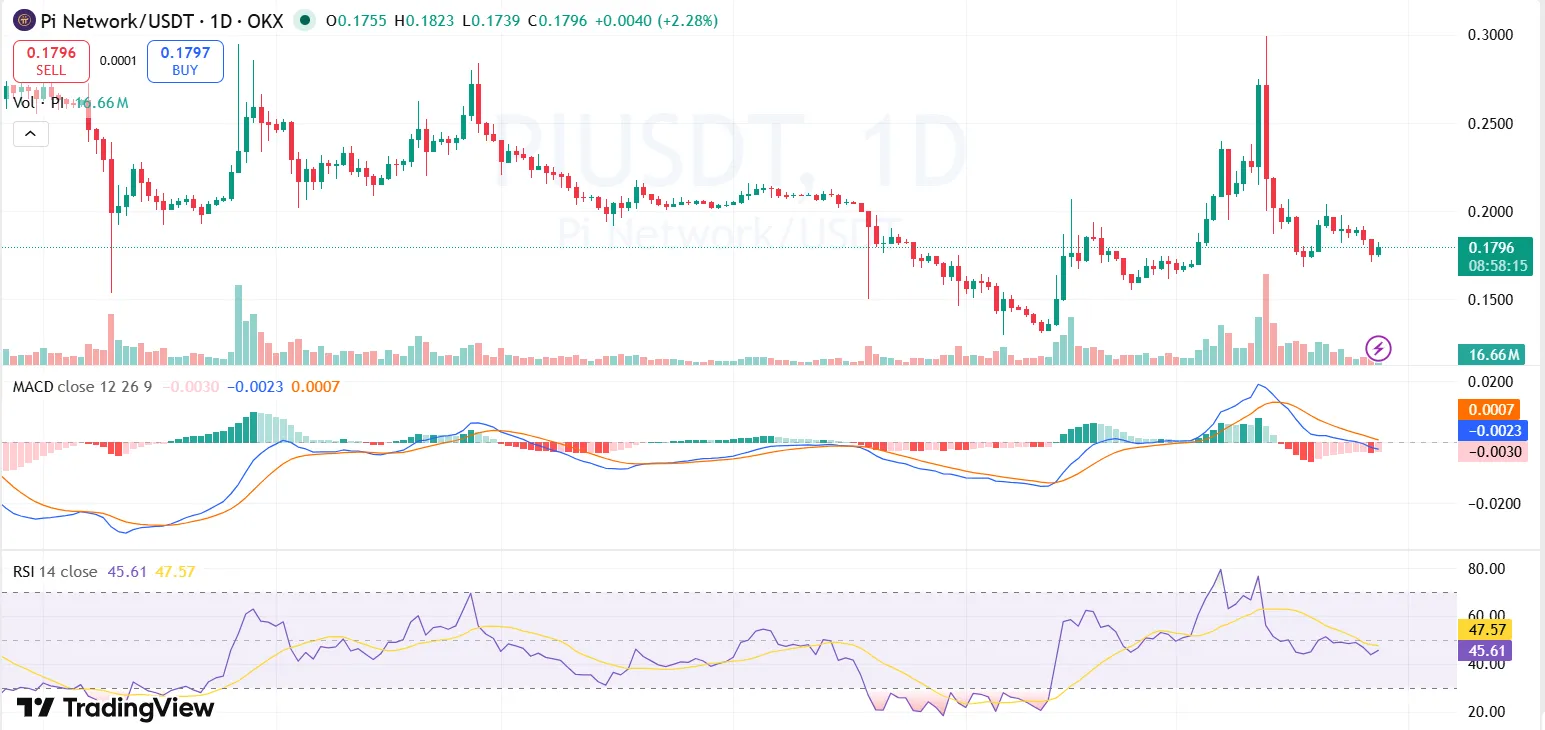
Pi still trades around level of $ 0.174, which is a very drastic drop of about 78% of the all time highs.Although there are continuous technical improvements, the markets still are not looking at it optimistically since traders are taking a look at the market indicators to get the signs of stronger directional movement.
The Relative Strength Index has reached a value of 45.29, and it is below the 50 mark and the moving average of 47.54.This standing depicts poor momentum factors without going over sold territory, and this point showed little buying power at this stage.
In the meantime, the MACD line is below the signal line and the negative histogram proves that the market activity is dominated by the sellers.Despite this downside pressure that seems to be easing, the general mood still indicates that the prudent trading behavior in the short term is preferred.
Ecosystem growth drives infrastructure upgrade strategy.
Pi Network is steadily growing its user base all over the world, tens of millions of participants contribute to the rising transaction activity.This increase puts pressure on the infrastructure and it needs better systems that are able to sustain increased volumes without compromising on its performance.
The present upgrade cycle will respond to these requirements with enhancing efficiency of the processing, synchronization and general reliability of the network.Concurrently, there are a few users still experiencing delays in account verification and migration procedures in the ecosystem.
These challenges remain under the broader transition process as Pi is being developed into a more mature and full functioning blockchain environment.These upgrades will be successful and will help influence the network adoption and utility in the long term.