
Key Insights:
- The $3.7 billion record shows how quickly a new Layer-2 can attract trading liquidity.
- Tokenized equities could give the network a broader user base beyond crypto-native traders.
- Sustaining volume across several months will matter more than another isolated daily record.
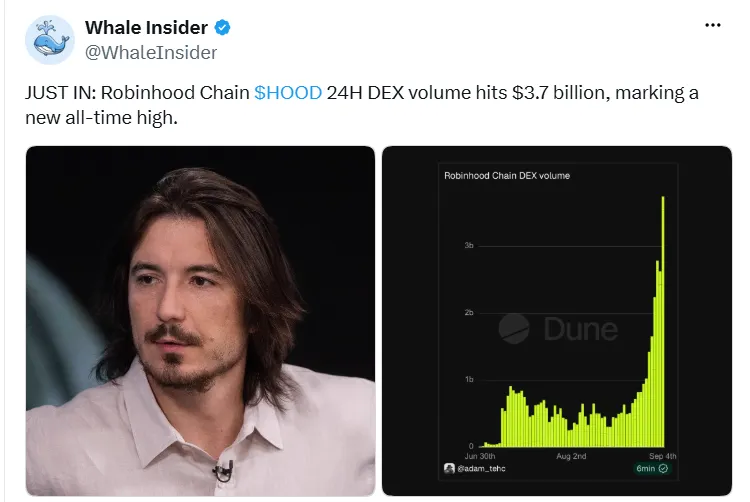
On September 5, Robinhood Chain had a new record of 3.7B USD of 24-hour volume on the decentralized exchange. The surge places the young Ethereum Layer-2 network ahead of major rivals for daily DEX activity and brings its short-term trading momentum into focus.
A rapid rise after the July launch
Robinhood Chain launched its mainnet on July 1, 2026, after opening its public testnet in February. The network runs on Arbitrum’s Orbit stack and uses Ethereum for security while targeting lower transaction costs.
Activity accelerated within days of the launch. Daily DEX volume reached about $560 million to $570 million on July 8 and 9. By July 11, trading had climbed to roughly $878 million.
The pace strengthened again in late August. Daily volume moved between $920 million and $944 million, while August 30 brought about $875 million alongside 5.52 million transactions.
By early September, reported daily activity approached $1.3 billion to $1.9 billion. The latest jump to $3.7 billion therefore marks a major acceleration within a short period.
Uniswap and memecoins fuel early demand
Much of the network’s trading activity has concentrated around Uniswap v3 and Uniswap v4. Together, the two protocols have handled roughly 90% of DEX volume on peak days.
Memecoins helped establish the early trading base. CASHCAT was a significant symbol on the network during the first few weeks, trading between $100 million and $156 million in value.
Launchpads like Pons also were able to ramp up the supply of new tokens. They made it easier for projects to deploy their assets and to obtain early liquidity. Meanwhile, Robinhood Chain has built a second growth channel through tokenized equities. Tokens representing companies such as NVIDIA and Apple have traded on the network.
Tokenized stock trading reached about $85 million in one day on August 25. That activity adds a traditional finance component to an ecosystem that initially drew attention through speculative crypto trading.
The numbers show a sharp but uneven climb
The network surpassed $47 billion in cumulative DEX volume by mid-August. Total value locked also reached roughly $700 million to $800 million by late August, while stablecoin supply increased.
The latest daily record stands out against longer-term rankings. The network had achieved the 5th position in the list of the largest blockchains by DEX volume, revealing more than $23.09 billion in DEX trading volume over the course of 30 days.
Solana led that period with roughly $64.54 billion, showing the gap between a recent daily spike and sustained monthly activity.
The data therefore presents two different pictures. Robinhood Chain has captured exceptional short-term trading intensity, but larger ecosystems still lead across longer measurement periods.
Elevated gas fees could be a hurdle for Robinhood Chain’s success
The rapid expansion of Robinhood Chain has also increased the expenses incurred by the users. Average gas fees have increased by around 82% in 11 days since the network began to become more active, the recent data revealed.
The increase is significant because the lower transaction fees continue to be a key benefit of L2 solutions. With continued high fees, frequent traders may incur additional fees for converting tokens and transferring assets from one node to another.
The rise in fees, however, also indicates high demand for the blocks. Increased activity has the potential to attract more liquidity providers, developers, and trading platforms to operate on Robinhood Chain.
The question is whether the network can keep up with an increasing demand while not compromising its cost advantage. It will be crucial to see if that’s the new normal or if it’s a one-off.
A broader test for Robinhood’s blockchain strategy
Robinhood enters a crowded Layer-2 market with a major built-in distribution advantage. Its traditional brokerage platform has about 24 million funded accounts, creating a large potential audience for on-chain products.
The company’s tokenized equity strategy also separates the network from many competing chains. Most Layer-2 networks compete for DeFi users trading established crypto assets.
Robinhood instead can connect familiar financial products with decentralized infrastructure. That approach could introduce blockchain trading to users who have little interest in traditional DeFi activities.
But in cases of rapid volume growth, network infrastructure and costs may be strained. As activity surged, average gas fees jumped 82 times in 11 days, recent reports showed.
Sustaining the increase in fees may impact user demand. They could also challenge the network’s early value proposition of cheaper transactions.
Conclusion
Robinhood Chain has moved from a July launch to a $3.7 billion daily DEX milestone within weeks. The speed of that expansion makes the network an increasingly relevant player in decentralized trading.
Yet the 30-day figures show that established networks still command deeper and more consistent liquidity. The next test will involve maintaining activity without relying heavily on short-lived token speculation.
An ongoing growth would more solidly Robinhood’s case for integrating traditional markets with blockchain infrastructure. Over the next few months, it will be a contest to determine if this is a sign of sustained adoption, or a blip.