

Key Insights:
- Australia Senate committee backs Digital Assets Framework Bill to regulate crypto platforms and custody services.
- The proposed bill would require digital asset platforms and custody providers to hold an Australian Financial Services Licence.
- Industry groups caution that the definition of factual control may encompass a few technology providers.
Australia’s proposed digital assets framework bill moved closer to becoming law after a Senate committee recommended that Parliament adopt legislation designed to bring cryptocurrency platforms and tokenized custody services under the country’s financial services regulatory system. The recommendation follows a review by the Senate Economics Legislation Committee, which examined the government’s proposal to establish a licensing regime for businesses handling digital assets on behalf of customers.
Digital Assets Framework Bill Introduces Licensing for Platforms and Custodians
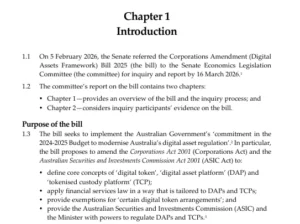
The report, released March 16, reviewed the Corporations Amendment (Digital Assets Framework) Bill 2025, legislation introduced in November 2025 by Assistant Treasurer and Financial Services Minister Daniel Mulino.
The proposal would amend the Corporations Act and the Australian Securities and Investments Commission (ASIC) Act to create a dedicated regulatory structure for digital-asset service providers.
Source: Parliament of Australia
According to the committee, the bill represents a step toward addressing regulatory gaps in how businesses handle customer digital assets. Under the proposed digital assets framework bill, operators of digital-asset platforms and tokenized custody services would generally be required to obtain an Australian Financial Services Licence.
The requirement would apply to entities categorized as “digital asset platforms” (DAPs) or “tokenised custody platforms” (TCPs). The legislation defines digital asset platforms as services that facilitate the trading or transfer of digital tokens, while tokenized custody platforms are entities that hold digital tokens for customers. Both types of businesses would fall under Australia’s existing financial services regulatory system if the bill becomes law.
By incorporating these intermediaries into the Australian Financial Services Licence regime, the proposal would place most centralized cryptocurrency exchanges and tokenized custody operators under the same regulatory framework as other financial service providers.
However, platforms would need to follow asset-safeguarding rules governing the holding and management of digital assets. In addition, businesses onboarding retail clients must meet disclosure obligations.
Lawmakers said these provisions are intended to address situations in which companies currently hold large amounts of customer digital assets without regulatory safeguards comparable to those used in traditional financial markets.
Legislative Plan Focuses on Intermediaries Rather Than Blockchain Technology
Officials involved in drafting the legislation stated that the approach reflects a policy choice to regulate intermediaries that handle customer assets rather than attempting to regulate distributed ledger technology directly.
The Senate committee noted that the framework is intended to close regulatory gaps that have allowed digital-asset businesses to operate outside existing financial services requirements, even when holding client funds.
The report also cited the collapse of several high-profile digital-asset firms, including the cryptocurrency exchange FTX, as an example of events that highlighted the risks associated with platforms that control customer assets.
Industry Groups Raise Concerns About “Factual Control” Definitions
During the consultation process reviewed by the committee, several industry participants raised concerns about how certain definitions in the digital assets framework bill could affect technology providers. Submissions to the committee have reported that the draft legislation relies on tests of the type of digital tokens and factual control to identify which entities are subject to the licensing perimeter.
Moreover, Legal analysis, as cited in the report, notes that such definitions could extend regulatory obligations to technology providers that do not exercise unilateral control over customers’ assets.
Law firm Piper Alderman stated that the current wording could inadvertently apply to software developers or service providers operating in non-custodial environments. The firm said the definitions might capture arrangements where multiple parties share control of digital-asset keys.
The concern centers on modern custody architectures such as multi-party computation (MPC), which distribute cryptographic key management across several participants rather than allowing a single entity to control an asset.
U.S. blockchain company Ripple Labs also commented on the draft legislation during the review process. Ripple agreed with the notion of using control as the primary measure to determine which entities should be included in the regulation’s scope.
However, the company argued that the bill should account for technical structures used in modern digital-asset security systems. Ripple warned that, under a strict interpretation of the “factual control” standard, technology providers that hold only a fragment of a cryptographic key could be classified as custodians even when they cannot independently move assets. The firm recommended clarifying that factual control exists only when an entity can transfer an asset without the client’s cooperation.