Highlights:
- Riot Platforms has sold 3778 BTC in the first quarter and retained 15680 BTC worth almost 1.1 billion dollars at the end of the quarter.
- Bitcoin mining dropped to 1,473 BTC, while the deployed hash rate increased by 26%, indicating capacity expansion.
- Other miners sold large amounts of BTC in Q1 after Riot announced revenue growth and strong reserves.
Riot Platforms Bitcoin sale activity stood out in the company’s first-quarter 2026 production and operations update, which showed that the Nasdaq-listed miner sold a sizeable portion of its bitcoin treasury while continuing to expand its operating capacity.
Riot Platforms Bitcoin Sale Details in Q1 Update
According to the report published on Thursday, Riot sold 3,778 BTC during Q1 at an average price of $76,626 per bitcoin. At the close of the quarter, the company held 15,680 BTC, valued at about $1.1 billion, including 5,802 restricted bitcoin pledged as collateral. The transaction placed Riot among several major mining firms that have recently converted part of their bitcoin reserves into cash, even as they continue to report large treasury balances and infrastructure growth.
The reported treasury figures placed Riot’s bitcoin holdings at approximately $1.1 billion by quarter-end. The disclosure showed that Riot continued to hold a large reserve despite the sale. The update did not separate unrestricted holdings from the restricted collateral beyond the figures disclosed in the report.
The company mined 1,473 BTC in Q1 2026, down 4% from 1,530 BTC in Q1 2025. The fall in production occurred despite Riot reporting increases in deployed and average operating hashrate.
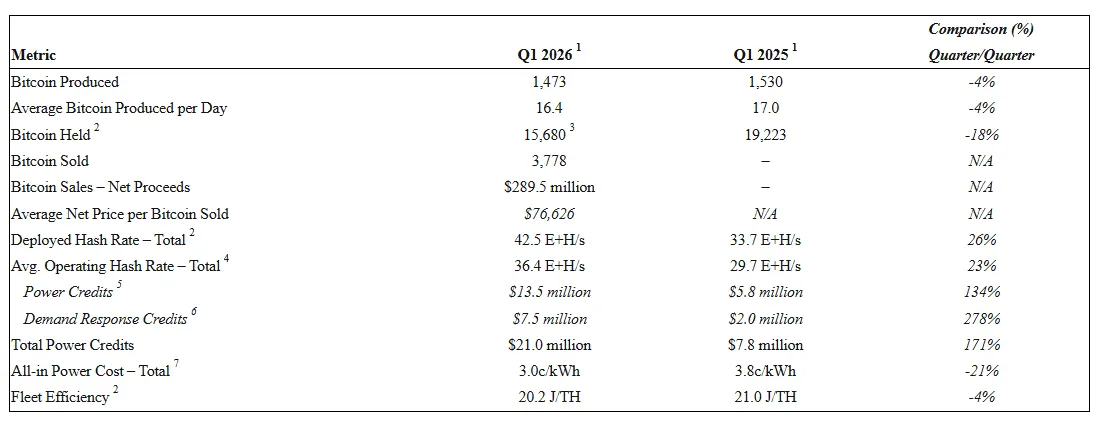 Source: Riot Platforms Q1 2026 report
By the end of the quarter, Riot’s deployed hashrate had reached 42.5 EH/s. That figure represented a 26% increase from the prior-year period. Riot also said its average operating hashrate rose 23% year over year to 36.4 EH/s.
The figures showed that infrastructure capacity expanded during the quarter, even as total bitcoin production declined on an annual basis. Riot’s quarterly update presented both developments together, indicating that the production decline occurred during a period of larger installed and operating mining capacity.
Nevertheless, the Riot Platforms Bitcoin sale therefore came during a quarter in which the company reported mixed operating figures, with lower mined output but higher hashrate. The combination of those metrics made the treasury transaction one of the most closely noted disclosures in the report.
Other Miners Also Reduced Bitcoin Holdings
Riot’s disclosure followed similar treasury moves by other large publicly traded bitcoin miners in recent months. In March, MARA sold 15,133 BTC for about $1.1 billion. The company said the transaction was intended to strengthen its balance sheet during a broader shift toward AI compute infrastructure.
Core Scientific also reported a bitcoin sale earlier in the year. In January, the company sold 1,900 BTC and said it planned to sell all its bitcoin holdings in the first quarter. That sale, like MARA’s, was presented in the context of an AI-related infrastructure shift.
Placed alongside those transactions, the Riot Platforms Bitcoin sale added to a growing list of large treasury sales by mining companies in early 2026. The timing showed that several miners monetized portions of their holdings during the same broad reporting period, although the companies disclosed different reasons and operating contexts for those sales.
Revenue Growth Preceded the Latest Quarter
The Q1 update followed Riot’s record revenue performance in 2025. The company reported annual revenue of $647.4 million, up 71.8% from $376.7 million in the prior year. That earlier revenue growth provided financial context for Riot’s first-quarter operating report, which combined treasury activity with year-over-year changes in output and hashrate.
Riot’s latest figures showed that the company entered 2026 after a year of strong top-line growth and then reported a quarter marked by a significant treasury sale, lower bitcoin production, and higher deployed capacity. The company’s quarter-end bitcoin balance remained large despite the sale, with restricted collateral continuing to account for a notable portion of total holdings.
The Riot Platforms Bitcoin sale also drew attention because Bitcoin functions as both a mined output and a treasury asset for the company. In the quarter under review, Riot reported movement across both sides of that equation by disclosing how much bitcoin it mined, how much it sold, and how much it still held at the end of the period.