

Key Insights:
- As institutional investors shift money to cryptocurrency investment products worldwide, Bitcoin continues to beat gold.
- Recently, global gold funds have been having trouble keeping up investor demand, while Bitcoin ETFs have seen back-to-back monthly inflows.
- JPMorgan thinks macroeconomic uncertainty is further driving digital assets to become a modern way of investing in inflation protection globally.
Bitcoin has become a popular investment choice for those looking to hedge against inflation, currency devaluation, and global geopolitical instability. Recently, JPMorgan analysts noted that there has been a shift in capital from gold to digital assets across the globe.
The banking giant said that Bitcoin has risen by almost 19% since the tensions over Iran have escalated in financial markets. During the same period, gold prices dropped by approximately 5%, reflecting the change in investor sentiment towards gold as an alternative store of value.

ETF inflows strengthen Bitcoin market momentum further
The latest exchange traded fund (ETF) activity showed that the demand for cryptocurrency investment products is growing at an increasing rate among institutions in financial markets around the world. It is a “debasement trade” that is gradually moving from gold into Bitcoin products, according to JPMorgan analysts.
In March 2026, Bitcoin ETFs recorded $1.32 billion in inflows, marking the first positive month this year. In the same investment period, gold ETFs saw over $3 billion of global outflows.
Bitcoin ETFs received another $2.44 billion in fresh institutional capital inflows, which further solidified the trend in April. BlackRock’s IBIT product accounted for almost 70% of all Bitcoin ETF inflows recorded during April globally.
Bitcoin ETFs recently received another $1.38 billion from institutional investors, and May was able to keep the momentum going. The continued inflows are a sign of increased institutional investor confidence in digital assets, JPMorgan analysts said.
Bitcoin Breakout Forecasts in the Making as Gold Rotates.
Bitcoin has been trading around $82,739 recently, but has been met with some moderate profit taking pressure on the wider cryptocurrency trading markets around the world. The cryptocurrency is now trading below the $79,500 mark as investors are cashing out after a bull run.
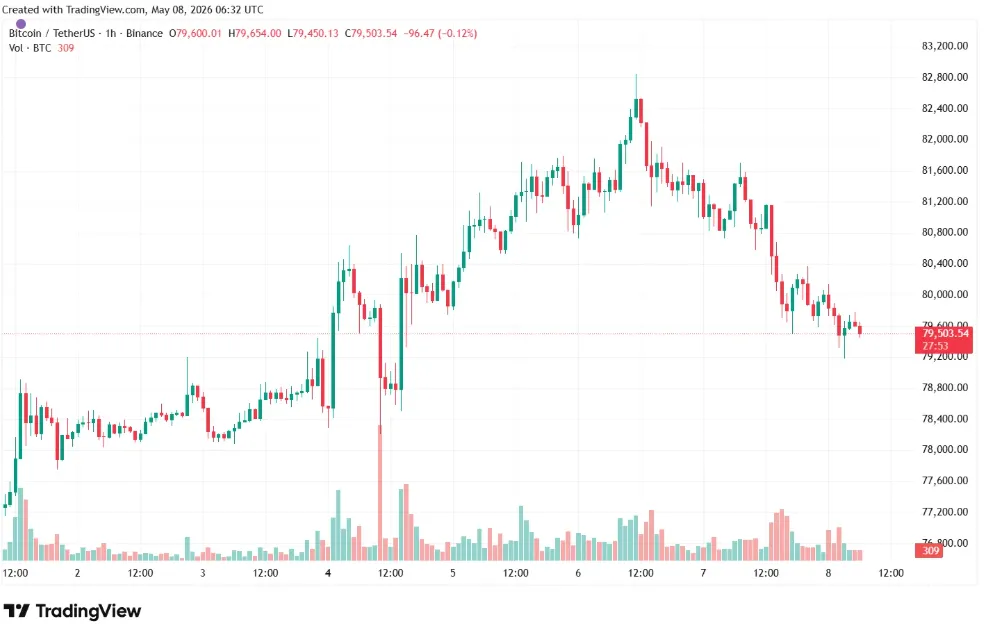
Market analysts still believe the correction is fairly healthy as buyers are still aggressively defending important support zones globally. The $83,000 resistance level is now being closely watched by traders for any sign of another significant breakout to the upside.
If the inflows into the ETFs continue, some analysts predict a new all-time high of around $126,000. The growing institutional involvement, along with the growing macroeconomic uncertainty, is further bolstering the bullish sentiment in the cryptocurrency markets around the world. The institutional involvement is further increasing, and the macroeconomic uncertainty is continuing to strengthen the bullish sentiment in the cryptocurrency markets around the world.
Institutional investors are now looking to broaden their exposure by trading cryptocurrencies on offshore exchanges around the world and by using futures contracts on the CME. Analysts additionally highlighted Strategy’s aggressive Bitcoin accumulation strategy as another growing driver supporting market demand.
If current trends persist, Strategy will be able to acquire close to $30 billion worth of digital assets by year-end, according to JPMorgan estimates. These developments further bolster the notion that institutional capital could continue to support the wider cryptocurrency market cycle.
Inflation concerns continue driving investor behavior globally
Gold has been a traditional safe haven for investors in times of inflation, monetary expansion, and increased geopolitical risk in the financial markets. But younger investors are now seeing decentralized digital assets as modern ways to safeguard their purchasing power across the world.
Bitcoin fans are still touting the cryptocurrency as “digital gold” as it has a fixed supply of 21 million coins that can never be exceeded. Bitcoin is different from fiat currencies, which can be expanded at any time by the central bank’s monetary policy actions around the world.
Recently, regulated exchange-traded funds (ETFs) have greatly enhanced access for retail and institutional investors around the world. Now, investors can gain exposure to cryptocurrencies without having to handle private digital wallets on their own.
Gold continues to be a significant asset in central bank portfolios and institutional investment policies around the world, despite the increasing trend of rising momentum. A number of governments are still buying gold in a frenzy, and this is continuing its longstanding place in the international financial systems around the world.
However, analysts believe that Bitcoin adoption patterns will continue to closely follow inflation expectations and monetary policy decisions worldwide. The future investment flow of cryptocurrencies around the world may be significantly shaped by the Federal Reserve’s interest rate policies and ongoing geopolitical turmoil.
Institutional adoption grows in the traditional financial markets.
Cryptocurrency investing is becoming a common practice for major hedge funds, pension managers, and corporate treasury departments around the world. Traditional finance and digital assets are increasingly converging, with regulated investment products growing rapidly.
Today, macro investors are studying cryptocurrency markets in conjunction with bonds, stocks, commodities, and international monetary policy changes. The latest assessment by JPMorgan, then, is part of a larger institutional evolution in the financial markets with respect to alternative approaches to inflation protection.
While volatility is still significantly higher than gold, investors are willing to endure greater price swings for better long-term gains around the world. As institutional adoption of cryptocurrencies spreads throughout the mainstream financial systems globally, this sentiment may continue to drive the markets.
Conclusion
According to JPMorgan’s latest analysis, institutional investors are increasingly making cryptocurrencies their preferred debasement hedge. The rise of digital assets in today’s investment portfolios, robust inflows into ETFs, rising institutional interest, and macroeconomic uncertainty are all additional factors contributing to their growth.
Bitcoin is becoming more popular with younger and tech-savvy investors around the world, while gold is playing a key role in the world’s reserve systems. The competition between the traditional safe-haven assets and the cryptocurrency markets may have a significant effect on investment strategies around the world in the future.
FAQs
What is JPMorgan referring to as “debasement trade”?
The term refers to investments that preserve purchasing power in times of inflation, weak currency, or high inflation rates around the world.
Why is there a move away from gold to Bitcoin among investors?
The recent global investment performance and the growing accessibility and institutional adoption of digital assets make them a preferred choice for investors.
What was the amount of Bitcoin ETFs that attracted recently?
Bitcoin ETFs gathered $1.32 billion in March, $2.44 billion in April and $1.38 billion in May.
Why is the IBIT significant for markets for BlackRock?
BlackRock’s IBIT accounted for almost 70% of all Bitcoin ETF inflows in April in investment markets worldwide.
Is it possible that Bitcoin could hit $126,000 in the near future?
The analysts believe that the ongoing inflows into the ETFs and institutional demand may help drive another significant bull run in cryptocurrencies.